Showing posts with label England. Show all posts

Saturday, November 2, 2013

Bookshelf: Pitt Cue Co.: The Cookbook

“Can I ask you,” the clerk pressed, “as one American to another, why on Earth would you buy a British barbecue book?” For the past thirty minutes, I’d been pulling down books from the shelves of the Notting Hill bookstore where she worked and had set aside the lurid orange/red cookbook from the local Pitt Cue Co. on my ‘maybe’ stack. “Why waste your money? I mean, how are the Brits going to do barbecue better than anything than we can get back home?”

She had a point. When one thinks of the great barbecue centers of the world, Kansas City comes to mind. Austin. Memphis. Charlotte. American places, all. Pitt Cue, on the other hand, is a thirty-seat joint smack dab in central London; seat of an erstwhile Empire, sure, but cultural backwoods when it comes to barbecue.

Yet here’s the thing; you can find some good ‘cue in the backwoods.

Pickled Hot Dogs
The authors of the book — restaurateurs Tom Adams, Jamie Berger, Simon Anderson and Richard Turner — capture the spirit of barbecue better than some places I’ve sampled it in California, Pennsylvania, New Jersey, and, yes, even places like Texas, Georgia, and Kentucky where they know good ‘cue. The reason the book interested me — and why I bought it a few days later at another store — is that they start with a strong framework and adapt it to local tastes and ingredients. These guys know full well that good barbecue involves smoke and long, low cooking.

Recipes include pulled pig’s head crubeens (normally made only pigs’ trotters and not smoked or nearly so spiced), Buffalo pigs’ tails with Stilton sauce, porger sausage (made with bacon, pork belly, dry-aged beef rib-eye, and pork shoulder), duck giblet sausages, mutton ribs, crumbed pigs’ cheeks, habanero pigs’ ears, mashed potatoes tricked out various ways (with whipped bone marrow, burnt ends, or lardo and rosemary), and plenty of pickles, slaws, and sides.

The recipes in the Pitt Cue Co. cookbook may not be what old-timers expect of smoked meats in the bastions of American barbecue, but many techniques and flavors will be familiar to Americans, even if the details are not quite what we’d expect. Avid eaters will find a lot to like — and you boozers will notice that the boys aren’t shy about lashing whiskey and other spirits around with someone approaching abandon. The drinks chapter alone is 37 pages. Recipes for ‘sweet stuff’ call for bourbon, Pimm’s No. 1 (used both in a sorbet and in a meringue-and-fruit Pimm’s Mess), and Grand Marnier. In a nod to the wine jellies once so popular in the UK — but sticking with the pig and whiskey themes — there’s an old-fashioned jelly, made old-fashioned not with wine but with the ingredients one would find in an Old Fashioned cocktail.

Fennel Cured Scratchings
The only caveat — and this is not a negative, just a bit of a heads up — is that the Pitt Cue Co. book, while drafted for home cooks, is very much a product of a kitchen geared for commercial cooking. Many recipes link to each other and rely on precursor sauces, condiments, or other preparations. What looks like a fairly straightforward recipe may, in fact, call for prunes soaked in whiskey for a month or brine from pomegranate pickles or for chicken, hot sauces, deviled pigs’ trotters, barbecue rubs and sauces, etc.. All it means is that you’ll want to read each recipe all the way through before starting it…but you do that anyway, right?

The next time you tackle a pork shoulder for sausage making, don't you dare toss out that skin. Use it in the sausage, drop chunks of it into baked beans, or season it and roll it into a tight cylinder, cook it, slice it, and deep-fry it for a quick bar snack or appetizer. From Pitt Cue Co.: The Cookbook, here’s crunchy, salted pork skin with the faint Italian-sausage nip of fennel. The only change I'd make it to include a bit of crushed red pepper (such as Aleppo) in the dry cure.
Fennel Cured Scratchings
250 g pork skin, from a whole skinned pork shoulder
15 g Dry Cure (see below)
Oil for deep-frying 
Sprinkle both sides of the skin with the dry cure, then roll up the skin into a sausage (like an Arctic roll) so that the fat side remains on the inside. Place the sausage on a long length of clingfilm and roll it up very tightly. Tie off each end so that the roll is watertight and leave in the fridge for at least 24 hours. 
Bring a medium pan of water to a gentle simmer and add the roll of skin. Weight it down with a heatproof plate and simmer over a low heat for 1 hour, until the roll is squidgy and soft to touch. Remove from the pan and leave to cool, then refrigerate until you are ready to cook. 
Unwrap the skin from the clingfilm and slice the roll of skin into 5mm rings. Heat the oil to 180°C in a deep-fat fryer or large saucepan and fry the rings for 4-5 minutes, or until golden and crispy. The scratchings should not need seasoning.
For the dry rub, the authors suggest a 50:50 mix of Maldon sea salt and smoked Maldon sea salt. While we like using flaky Maldon salt, there’s no particular need to search out that and only that salt if it means paying exorbitant import prices. In the US, plain kosher salt is fine — and if you can get your hands on good smoked salt, do as they say and work it in as half the quantity. This version omits the 150 grams of brown/molasses sugar called for in their regular dry rub.
Pitt Cue Co. Dry Cure 
1 kilo/2.2 lbs salt
10g cracked black pepper
1 star anise, finely ground

10 g fennel seeds, toasted and crushed
Mix all ingredients in a bowl until they are thoroughly combined.
Tom Adams, Jamie Berger, Simon Anderson and Richard H. Turner (2013)
Pitt Cue Co.: The Cookbook
288 pages (hardback)
Mitchell Beazley
ISBN: 1845337565
£20.00

Available from Amazon.co.uk, Waterstones, or Books for Cooks.

Tuesday, September 24, 2013

A Bit of Seed Cake

Knock around old American and English cookbooks and household manuscripts for any length of time and you’ll come across recipe after recipe for seed cake. Not poppy seed cake, mind you; that still has adherents. Rather, I mean a decidedly more old-fashioned seed cake, dating to at least the 17th century, in which the nutty, musty, vaguely anise-like smack of caraway infuses the whole thing.

Yeah, yeah. You’ve had caraway in rye bread, maybe sauerkraut, goulash, or some cheeses. It’s integral to the taste of a Reuben sandwich, but those are all savory. It’s out of place in a sweet, right? Look, if you hate all those things, then skip seed cake; it might be caraway itself you don’t like. But if you do like them and just had never given any thought to sweetness and caraway, give it a try in cake.

Not just any cake, though. Not fancy, multi-tiered, extravagantly decorated cakes. Simple. In fact, the old recipes are essentially pound cakes with a small amount of caraway tossed in. I can’t quite emphasize that enough: a small amount. Poppy seed cakes sometimes call for so much of the blue-black seeds that they look as if someone dropped slices into a cinder pile. A caraway seed cake, on the other hand, should have a light scattering of seeds (fruits, really, but we call them seeds) peeking out of each slice. A teaspoon — at most one and a half — is enough to flavor a three-pound cake.

When I made a loaf yesterday, I overcooked it a bit when I was pulled away by a phone call from a UK distiller — the edges are a bit crusty, but the interior remains moist. Keep a closer eye on your cake than I did mine. And maybe turn off the phone.

Hundreds of recipes are available from the past several centuries, but contemporary chef Fergus Henderson of the London restaurant St. John has got a bit of reputation for his version which he pairs with a glass of Madeira. Me? I take mine with hot black tea.
Seed Cake 
9 oz/260g soft unsalted butter
9 oz/260g caster sugar
1 teaspoon caraway seeds
5 eggs, beaten
11 oz flour, sieved
1 Tbl baking powder
¼ tsp salt
5 oz/150ml full-fat milk (or use 4 parts whole milk, one part heavy cream) 
Grease a 16 x 10 x 8cm loaf tin with butter and line the base and sides with baking parchment. 
Cream the butter, sugar and caraways together either with an electric mixer or in a bowl with a wooden spoon until they are white and fluffy. Gradually mix in the beaten eggs, adding them little by little to prevent curdling. Then sift in the flour and mix until incorporated. Lastly add the milk. 
Transfer the mixture to the prepared tin and bake in an oven preheated to 350°F/180°C/ for 45-50 minutes or until it is golden brown and a skewer inserted in the centre comes out

~ From Fergus Henderson and Justin Piers Gallatly (2007) 
  Beyond Nose to Tail: A Kind of British Cooking Part II

Goes well with:
  • Nigel Slater, another British writer, has a number of books out now. I've got UK editions of all of them. He's worth tracking down. Here was my introduction to his writing (and a recipe for chicken liver pâté). Why UK editions? When possible, I prefer them, especially since I use a combination of eyeballing ingredients and weighing them on a kitchen scale. American editions of books by metric-using authors, on the other hand, have such clunky, bizarre measurements: 2/3 cups plus 1 and one-half tablespoon of flour. What? Did...did you mean 100 grams? Intolerance for making things harder and more complicated might be a carryover from my science background.

Monday, July 8, 2013

George Orwell on Picking Hops in the English Countryside

One can talk and smoke as one works, 
and on hot days there is no pleasanter place 
than the shady lanes of hops,
 with their bitter scent—an unutterably refreshing scent, 
like a wind blowing 
from oceans of cool beer.

Eric Blair
The New Statesman and Nation, 17 October 1931

I've been refreshing my memory of Eric Blair's work lately in preparation for a talk in Denver next month. Blair's novels (writing under his better-known pseudonym George Orwell) include 1984 and Animal Farm, but I've been diving into his more ephemeral essays on language and meaning. While digging though the library, I stumbled across an early essay of his on picking hops in the English countryside. In it, Blair tests the idea that a seasonal worker, wanting to get away from London for a bit, might high-tail it to Kent and make a decent bit of income stripping hops from vines for the English brewing industry.

The squalid camp conditions, dishonest measurers, and exploitive owners, however, left Blair realizing that hop picking, as practiced in early 20th century England, was a wretched experience. "What keeps the business going," he wrote,
...is probably the fact that the Cockneys rather enjoy the trip to the country, in spite of the bad pay and in spite of the discomfort. When the season is over the pickers are heartily glad—glad to be back in London, where you do not have to sleep on straw, and you can put a penny in the gas instead of hunting for firewood, and Woolworth’s is round the corner—but still, hop-picking is in the category of things that are great fun when they are over.
His full essay is here.

A 1929 silent newsreel from the archives of BFI shows families, including children, harvesting hops from right around the time Blair wrote Hop-Picking.


Goes well with:

Tuesday, June 19, 2012

A Dispiriting Glimpse at Molecular Mixology's Latest Offering

My book Moonshine has lots of sidebars, little snippets of text related to the nearby sections, but just enough off-topic that they felt clunky in the main copy. They reflect my scattershot, parenthetical way of thinking and the somewhat difficult time I have keeping my tongue in check. One such sidebar I cut from the final draft concerned booty bumps.

Booty what? Oh, come now. Don't tell me you've never heard of booty bumps.

Photograph: Franck Fife/AFP/Getty Images from The Guardian
Working from the delusion that those around them are unable to detect its aroma, certain day drinkers drink only vodka. Regardless of federal guidelines that specify vodka is to be odorless and tasteless, it is neither. In fact, vodka has a distinct odor and only seems odorless and tasteless when compared with whiskeys, rums, brandies, and other spirits that have more obvious characteristic smells. In other words, we're all onto you, drunkie.

Consumers who want to employ an even sneakier workaround, several informants explained, may take their alcohol from the other end. They may, in effect, take vodka enemas. Ethanol is absorbed rapidly into the bloodstream through the membrane of the lower intestine, delivering the alcoholic punch of a shot of booze, but without the resultant telltale vodka breath. The booty bump. Of course, it's easy to take poisonous amounts of alcohol into one's system accidentally through this inelegant backdoor method. Lest there's any uncertainty; it is not advised.

The things one learns in the course of pursuing a life in alcohol.

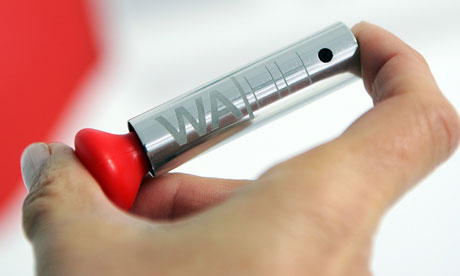
I was reminded of this alternate quick-delivery system because this Sunday's Guardian featured a story about the WA/HH spray that's just gone on sale in Paris. Kim Willsher writes:
With one squirt, its inventors promise, you'll feel all the euphoria of being inebriated for a few seconds without the nasty side-effects of behaving like an idiot and falling over. 
Willsher goes on:
With each squirt from the WA/HH spray delivering just 0.0075ml of alcohol and about 20 squirts in each €20 (£16) lipstick-sized spray, it's pricey night out – the equivalent of €1,300 (£1,000) for a unit of alcohol.
What's next? Whiskey tabs that dissolve on one's tongue? Patches that deliver small but continuous doses of Cognac for hours on end? Call me old fashioned, but I like my whiskey, wine, cider, port, rum, punch and other boozy repasts down my throat in liquid form. Ok, and maybe occasionally as a jelly. I enjoy the taste of alcoholic drinks. God help us all if we grow old in a world where the best option for a stiff drink is £1,000 spritzes of aerosol grain spirits.

If molecular mixology continues in this direction, that ass full of vodka might not seem like such a bad idea.

Thursday, May 31, 2012

I Woke This Morning Thinking of Tits

I woke this morning thinking of tits.

"So what?" you may ask. "I myself think of tits no less than 329 times a day." Yeah, ok, fair enough. You and a bunch of my friends. But bear with me. This is noteworthy for several reasons. I do not recall ever, in the last forty-some years, greeting the day with thoughts of tits. Oh, I can appreciate a nice rack when I see one. I'm gay, not blind. But I spend just slightly more time mulling them over (even in passing thoughts) than I do thinking about which kosher wine I'll serve with breakfast, what's in this month's issue of Cat Fancy, or whether this is the weekend I'll finally crochet a cover for my oven.

To clarify: I do none of that.

Bardot and her, um, raccoon eyes
But here's the thing: I was thinking specifically of Brigitte Bardot's tits — and this despite the fact that no concrete image of Brigitte Bardot came to mind as I stretched under the sheets. Some European sex kitten, I vaguely recalled, whose popularity peaked before I'd learned to walk. Blonde, perhaps.

They were being talked about in my mind in the gravelly, booze-worn voice of British actor Michael Gambon. Though Gambon is known to younger generations as Professor Dumbledor in the Harry Potter movies, his roles as dangerous, dastardly men are what stick in my mind. Albert Spica, for instance, in The Cook, the Thief, His Wife, and Her Lover or Eddie Temple in Layer Cake. The voice, though I could not make out particular words, had a distinctly lascivious tone. Not wholly unexpected, given that these were, after all, tits being talked about, but the voice was overbearing, boorish. I pictured him pawing at me while explaining something...something that clutched at the edges of my memory, then slipped away. This had to do with dinner. I was sure of it. Did Bardot, perhaps, pen a cookbook? And it wasn't jugs, or hooters, or headlights; it was...

My eyes snapped open. I had it! In my best Michael Gambon voice, I barked out "...roast chicken like Bridget Bardot’s tits." A muffled hrrmpf came from the other side of the bed. Not everyone was awake yet.

The phrase that had been haunting me was from A.A. Gill's essay Tour De Gall in last April's Vanity Fair. The piece is so good, so anchored in my memory, that it seemed to have had me wondering whether I'd switched teams in my sleep. In it, Gill wrote about the Paris restaurant L’Ami Louis, frequented by titans of state and screen and which he excoriates, in devilish detail, as the Worst Restaurant in the World. I like the passage below dealing with the recommendation best in the Michael Gambon voice. Try that bit in Michael Caine's if you like, but not soft, velvet Old Michael Caine: Young Michael Caine, all loud and nasal and vaguely threatening.
In all my years as a restaurant critic I have learned that there is a certain type of florid, blowsy, patrician Brit who will sidle up and bellow, with a fruity bluster, that if I ever happen to find myself in Paris (as if Paris were a cul-de-sac on a shortcut to somewhere else) there is this little place he knows, proper French, none of your nouvelle nonsense, bloody fantastic foie gras, and roast chicken like Bridget Bardot’s tits, and that I should go. But, they add, don’t bloody write about it.
If you missed it the first time around, read Gill's essay. L’Ami Louis may or may not be the worst restaurant in the world, but Tour De Gall is the most enjoyable restaurant review I've read in a long time.

And if you still can't quite place Gambon, here he is as Albert Spica in Peter Greenaway's The Cook, the Thief, His Wife, and Her Lover. Not entirely Safe for Work, but, then, you're sitting there reading about tits, so either you're not at work or you suffer from the delusion that nobody knows what you're doing on company time. That's Helen Mirren with the hair and a very young Tim Roth at the table.


Tuesday, April 24, 2012

When I Say Oo, You Say Long

I've slurped up a cuppa from an elephant's trunk 
With a couple of monks who utterly stunk 
I've had bourbons with sultans and creams with queens 
And I've bathed in Earl Grey — I'm really that keen.

And missionaries dismiss me for my single epiphany
The diff between him and me is a simple sip of British tea! 
So when times are hard and life is rough, 
You can stick the kettle on and find me a cup.

~ Professor Elemental

My idiocy reveals itself in stages. Casual acquaintances may, if my guard is down, catch a glimpse of this rare creature, but it's not generally on display. They do not know, for instance, that when my attention flags (or I'm under deadline), I take on the personalities of others. I'll sing the theme song for the 1980's television show The Facts of Life, for instance...in the style of Tom Waits. Or I'll pull a deadpan exsanguination of Jingle Bells, draining it of life and joy as only Jeremy Irons can do. Just this weekend, I could not shake the image of Joe Pesci recast in the role of the android Bishop in Aliens ("You ast me, them A2s always was a little twitchy.") nor of Don Rickles as Lt. Ellen Ripley ("Get away from her, you hockey puck!").

But that all pales to the vocal styling of Professor Elemental. Here, the pith-helmeted Professor gets a little steampunk and throws down Victorian rhymes in Cup of Brown Joy.


Goes well with:
  • Professor Elemental's website. 
  • At the end of the video, you'll note that the good Professor is off for a bit of Battenberg. Some what? Is it bitters akin like Underberg? No; it's cake, a very British checkerboard cake. Robert L. White explains.
  • My own obsessions over the brown stuff (iced? hot? buttered? in punch?) are well established.
  • Also noting his fondness for tea, and akin to Professor Elemental, check out Mr. B, The Gentleman Rhymer strumming his chap hop ukelele in a 2008 performance. Be warned, however, that the rivalry between the two is legendary.

Monday, February 20, 2012

Mixology Monday: Mai Tai Jellies

Sam Bompas and Harry Parr form the firm of, well, Bompas & Parr. Over in the UK, the two are a bit of media darlings. Even if you’ve never heard of the British duo, you perhaps have dabbled in their medium yourself. Sam and Harry, you see, work in gelatin. They have joined the ranks of those who traffic in whores, wars, fishes, and cheese. In their own words, they are jellymongers.

In a house free of children — and in possession of a full set of teeth — the preparation of quivering desserts and congealed salads made of brand-name gelatin does not occupy an appreciable amount of my time. But on rare occasions, I do use unflavored gelatin to stabilize some desserts and to make old-fashioned tea, wine, fruit, or cream jellies.

As pedestrian as the stuff seems today, there was a time when jellies were terribly fancy, palpable evidence that eaters were in the presence of wealth. To start, they were a pain to create; calf’s feet were most often called for in old recipes — hours and hours of boiling, simmering, draining, straining, and purifying (read: servants). Because jellies need to be chilled to set, one had to have either ice or refrigeration. Sure, fridges are ubiquitous now, but in 1790, 1869, or 1901, that was simply not true; great ingenuity and expense were required to get a jelly to gel in warm settings. Elaborate copper molds came into play, and shapes ranged from fanciful to downright architectural.

I’ve been pawing through the American edition of Bompas & Parr’s first book, Jellymongers, with an eye toward making a few jellies that are a step above the usual wobbly suspects. There are fresh citrus jellies, ribband (i.e., striped) and marbled jellies, gold-flecked, booze-spiked, and glow-in-the-dark jellies*.

My opportunity came when drinks writer Doug Winship offered to host this month’s Mixology Monday, the more-or-less monthly roundup of drinks on a changing theme. This month, it’s Tiki, a subset of drinks lashed with rum and laced with fresh fruit juices — and that regular readers may know is dear to my heart.

Tiki’s popularity has ebbed and flowed over the years since the 1930’s, but one of its iconic drinks, the Mai Tai, remains an immensely popular drink. Bompas and Parr know this and they’ve turned their limpid jelly eyes on that classic mid-century cocktail for inspiration. I’ve seen over the years many recipes for Mai Tai-flavored ice creams and sorbets, icebox bars, face masks (yeah, I wasn’t tempted), and more. Most of these recipes are for sweets and many of them omit an essential ingredient: orgeat.

Not these two. Their recipe includes the almond syrup called for in echt Mai Tais. For Winship’s Tiki Mixology Monday, I offer not a drink, but quivering, quavering, wobbly shapes: Mai Tai Jellies.

Mai Tai Jellies

Bompas & Parr use 5 sheets of leaf gelatin in their recipe, but I’ve converted their recipe to one deploying Knox powdered gelatin because that's what I had on hand when Winship emailed me. The London-based duo regard the powdered stuff in a dim light and prefer the leaf version. I've also rounded off their “scant ¼ cups” to 2 ounces. Note that a thin layer of almond oil or neutral vegetable oil applied with a pastry brush to the interior of the mold makes removing the Mai Tai jelly, once set, much easier. I used drinking glasses as molds to create about 5.5-ounce jellies. One could, in a collegiate state of mind, simply make these into several one- or two-ounce jelly shots.

8 oz medium Jamaican rum [I disregarded "medium" and used a mix of 5 oz Appleton Estate 12-year with 3 oz Smith & Cross]
5 Tbl orange curacao [Cointreau]
5 Tbl orgeat (see below)
2 oz 1:1 simple syrup
2 oz lime juice
2 packets (14g total) powdered gelatin [Knox; for a softer set, use 10-11g]
Mint leaves

Combine the rum, curacao, orgeat syrup, sugar syrup, and lime juice in a saucepan.

Sprinkle the gelatin evenly over the surface of the liquid. Leave the gelatin to soften for 10 minutes. Gently, gently heat the liquid (do not bring it to a boil), stirring constantly, until the gelatin is melted.

Once the gelatin has totally melted, pour the whole lot through a strainer and into a pitcher.

Pour this mixture into a prepared mold or glasses (see above) and set it in the refrigerator at least four hours, but 12 will give it a stronger set.

When you are ready to serve, unmold and garnish with the sprig of mint.
Next Thanksgiving, why not ditch the ribbed cranberry jelly and serve slices of these? Edit later that night: I don't usually just fire off a post here, especially one with a recipe, but time was tight and I broke with tradition in the interest of meeting the Mixology Monday deadline. Consequently, I didn't play with this recipe as much as I might normally do. Although we liked the softer set version of the recipe above, keep in mind that this is a lot of alcohol for what seems like a simple Jello-O type dessert. These would be absolutely fine as jelly shots, the purpose of which is to convey a bunch of booze at one go. Despite the inclusion of orgeat, though, one of the crucial ingredients missing here is ice. When drinking a Mai Tai, the dilution of slowly melting ice makes all the difference between a strong, boozy drink and once that soothes and relaxes. So, on a whim, one of the boys popped his Mai Tai jelly in the microwave for 25 seconds, just melting it without getting it too warm, then mixed in a handful of crushed ice. The result: a regular Mai Tai with an unexpected round mouthfeel. Next thing you know, two more glasses went in the machine. Stayed wholly liquid until the very last few sips.

Goes well with:
  • Fortunately, orgeat is much easier to find now than a few years ago, thanks to syrup purveyor monger BG Reynolds. If you don’t see any locally, the company ships.
  • *Glow-in-the-dark jellies? You bet. Ever been in a nightclub and notice that your gin & tonic glowed like a purplish blue beacon? The effect is caused when ultraviolet black lights hit quinine, an ingredient in the tonic water. Quinine fluoresces under UV. Bompas & Parr leverage this quirk of chemistry in the book to create glowing jellies with gin, tonic, rose water, and gelatin. Images of their SFMOMA glowing funeral jellies are here.
  • Converting leaf to powdered gelatin recipes is tricky. Different grades and producers mean that there's no standard conversion for "x number of leaf gelatin = y teaspoons of powdered gelatin." But the good news is that converting to weights makes things easier and there's a detailed discussion over at eGullet that outlines how one goes about doing that. 
  • Leaf gelatin's not at all hard to find; it's just that I had none on hand, am getting ready to head to Bourbon Country for work, and didn't have the time to fuss with having some shipped. If you want to try some, King Arthur sells good quality stuff here.

Harry Parr and Sam Bompas (2011)
Jellymongers: Glow-in-the-Dark Jelly, Titanic Jelly, Flaming Jelly
160 pages (hardback)
Sterling Epicure
ISBN: 1402784805
$19.95

Wednesday, December 21, 2011

Snapdragon: Playing with Fire

If you live in a hoary northern clime and it comforts you to think that those who move to sunny San Diego somehow miss the cold, then, by all means, wrap yourself warmly in that mantle of delusion. We don’t.

Though I had a deft hand at cold weather cooking and drinking, hot punch, mulled wine, and various toddies just don’t carry the restorative powers that they seem to in the darker months of those places plagued with “four distinct seasons.”

 
Snap-dragon
from Robert Chambers' (1879) Book of Days
But add a little fire to the booze rather than just warming it? Well, even self-satisfied San Diegans don’t turn our noses up at that. From the simply flamed orange peel over a cocktail to more elaborate preparations among the tiki crowd, the blazing romance of flames and alcohol is nothing new. In fact, one venerable bit of flaming foodways plays well in both temperate and more frosty climes — snapdragon.

Known to Charles Dickens, Samuel Johnson, and even further back to seventeenth century, the eating/drinking game snapdragon (or snap-dragon or occasionally flapdragon) has largely died out.

Let's walk through it and you'll understand why: First, kill the lights. Next, two to three raisins per person are placed in a broad, shallow dish. Warmed brandy is then poured over them — just enough to come up to their collars — and set alight. As blue and orange flames dance over the surface of the brandy and scamper across the raisins, guests take turns snatching single flaming raisins from the mix and popping them into their mouths, extinguishing the fire-robed fruit.

Around the time of the American Civil War, Anthony Trollope writes of the game in his novel Orley Farm:
'And now for snap-dragon,' said Marian.

'Exactly as you predicted, Mr. Graham,' said Madeline: 'blindman's buff at a quarter past three, and snap-dragon at five.'

'I revoke every word that I uttered, for I was never more amused in my life.'

'And you will be prepared to endure the wine and sweet cake when they come.'

'Prepared to endure anything, and go through everything. We shall be allowed candles now, I suppose.'

'Oh, no, by no means. Snap-dragon by candlelight! Who ever heard of such a thing? It would wash all the dragon out of it, and leave nothing but the snap. It is a necessity of the game that it should be played in the dark—or rather by its own lurid light.'
So, yes, darkness is essential, but speed is the real name of the game. For one, fire is hot and the faster you take your turn, the less chance of sustaining a burn. Second, the brandy won’t flame forever. The alcohol doesn’t burn off entirely (an old wives tale, a cooks’ inside joke), but it does burn until the proof lowers so much that it can’t sustain a flame.

You can understand why today’s safety-conscious parents would shut down a game of snapdragon before it ever began. Burned fingers, singed hair, booze for kids (yes, it was popularly, if not exclusively, a children’s game), burned table linens, and scorched floors get one reported to the authorities for child abuse. God forbid some antic soul should knock over accidentally a bowl of flaming alcohol onto the carpet, a pet, or another person and do some real damage.

Fortunately, I have no children. I do have raisins, however, a broad granite counter., and friends expected Christmas day. Brandy? You know I’ve plenty of brandy.

For obvious reasons, I suggest you not play snapdragon this winter. It died out for a number of reasons, not the least of which is safety. If my knuckles are bereft of hair the day after Christmas, though, you know what we’ve been up to over at the Whiskey Forge.

Thursday, October 6, 2011

A Smooth and Creamy Pâté

My introduction to Nigel Slater’s writing was at Kitchen Arts & Letters, Nach Waxman’s cookbook store in New York. Its manager, Matt Sartwell, understood my tastes and my interest in titles from Europe, Latin America, and Asia. He also understood that I was willing to pay more for such imported books because they were often more interesting than so many of the latest American offerings. Or, at least, the titles in that particular store were.

Once, nearly ten years ago, I was browsing the shelves and making a small pile of books to take home when Sartwell asked me if I’d heard of Slater. The name was only vaguely familiar. British was all I could come up with, perhaps a columnist. “His earlier books weren’t anything special,” I recall him explaining as he took a book from the shelf “But his latest one” — and here he pulled an old clerks' trick by placing it in my hand — “is quite good. He writes like you talk.”

I wasn’t at all convinced that anything resembling more of me was something the world needed.

But I humored Sartwell and flipped through the book. The more I plucked through its pages, the more I realized that this guy did write a lot like I speak. Not entirely. Maybe a bit more floral and breezy than I might be. His ingredients, tastes, and methods of cooking, though, as well as a casual style that puts less emphasis on exactitude than on appropriateness, was uncannily similar to my own. He wrote of “enough” butter, glugs of brandy, and splashes of wine. Commonsense in a way that made me appreciate just how uncommon sense truly is.

I added the book to the pile. Some books in my library I don’t open for years on end. Not a month goes by, though, that I don’t crack open Slater’s Appetite for inspiration. Still on my Braunschweiger high, I was craving a bit of liver sausage. For wont of a proper smoker here at the house, though, braunschweiger was out. Chicken liver it was, then.

The milk was whole, the brandy from Jepson (which I wrote about here), and the schmear photo is mine. The rest of this is all Slater (sounding freakishly like me):

A Smooth and Creamy Pâté

There is a constantly recurring lunch in my house that consists of little more than deli shopping laid out on the kitchen table, eaten from its wrappers and cartons. It is a Saturday morning thing, really. Hunks of bread, either freshly baked sourdough or a crisp ficelle, some tiny, purple-black olives, miniature gherkins, a knobbly salami, and a couple of fat wedges of cheese are pretty much what we seem to have. Yet it is a favorite meal, one I enjoy as much as any other, I like a pear with mine, too, or a huge bunch of sweet, muscaty grapes. The star of such a meal is often a white china dish of homemade pâté to go with the little gherkins, or cornichons as they seem to be called nowadays. It is so difficult—almost impossible—to find a commercial pâté that is both velvety and pink enough that I think it worth making your own. The method that follows may sound pedantic, but it is small points such as the sieving after the initial blending that make the difference between a good pâté and one that is truly sublime. Some swamp-green canned peppercorns, hot, soft, and addictive, to scatter on as you eat will bring untold rewards.

Enough for 6
chicken livers—about 14 ounces
milk—enough to soak the livers in
butter—½ cup, plus ¼ cup at the very end
whipping cream—6 tablespoons
brandy [Jepson Rare Alembic Brandy]

Trim any dark or green bits from the livers, cover them in milk, and leave them for thirty minutes. This will rid them of any bitterness. Soften two-thirds of the ½ cup butter, not so far as to melt it, but just so it takes a finger easily. Melt the remaining third in a shallow pan. When it starts to foam, drop in the livers, drained of their milk [and blotted dry on paper towels]. Take care—they will spit at you. Let them develop a pale, golden crust on one side, then turn them over and do the same to the other. It is essential that the butter is hot enough for this to take only a few minutes, otherwise, the center will not stay pink and the pâté will lose its magic.

Now tip the livers, their butter, the softened butter, and a generous seasoning of salt and black pepper into a blender or food processor with the cream, and blitz to a smooth puree. Pour a couple of good glugs of brandy into the empty pan, put it over the heat, and bring to a boil so the alcohol burns off (some people ignite it at this point, but I have never found it makes that much difference). Pour the brandy into the creamed chicken livers and continue to blitz. No matter how much you whiz the pate there will still be some graininess, but it should remain pink.

Now, using a rubber spatula, push the mixture through a stainless steel sieve into a bowl. I know this is deeply boring, and the sieve is yet another thing to wash up, but it really does make a crucial difference to the pâté, turning the grainy and the mundane into the blissfully velvety. The point is to have as smooth a texture as possible, and you can only get that by sieving. Scrape the whole lot into a terrine or bowl, smooth the top, and put it in the fridge to set.

Half an hour later, and no longer because the mixture will discolor, melt the ¼ cup of butter and scrape off the froth that rises to the surface. Pour the butter over the pate and return it to the fridge to set. I tend to leave mine for most of the day or overnight, but it should be ready in three or four hours. It will keep for a day or two.
Details for the American edition:

Nigel Slater (2002)
Appetite: So What Do You Want to Eat Today?
448 pages (hardback)
Clarkson Potter
ISBN: 0609610783
$35.00

Goes well with:
  • A trip to Kitchen Arts & Letters (1435 Lexington Avenue, New York City, 212.876.5550, www.kitchenartsandletters.com)
  • Jepson made the brandy I used to great effect in our quince-infused brandy.  At $19.99, it was a steal. Peel your eyes and keep 'em peeled for that price at Trader Joe's in case they ever score a great deal on it again. 
  • Jennifer McLagan's new book on offal cookery, Odd Bits. I recommend this one less because there's any particular resonance between the writing styles of McLagan and Slater than because of the odd bit recipes I yoiked from each.

Saturday, April 23, 2011

Rabbit à l’Epicurienne, an Easter Treat

We've mentioned Agnes B. Marshall before. She's the Victorian Alton Brown, the one who was writing about making and using ice cream cones almost two decades before their supposed invention at the 1904 St. Louis World’s Fair and suggested using liquid oxygen in 1901 to make ice cream at the table for the amusement of dinner guests.

As Easter creeps up on us, my thoughts wandered back to Mrs. Marshall while I considered what sort of rabbit I'd like to prepare for Sunday dinner. I'd thought about a Spanish preparation with olives and chorizo; simple pan-fried rabbit with a thyme-infused cream sauce; and even a rabbit mole. In the end, I decided going out for dim sum held more appeal than prepping bunnies for the table. With the task of actually cooking a coney out of the way, I could afford to let my musings get more complicated.

Think of them as bacon stitches
In her recipe Rabbit à l’Epicurienne, Mrs Marshall calls for larding a tender rabbit, an old technique that entailed cutting fatty bacon (or, more often, fat) into small planks called lardons, threading them through a wicked-looking large-bore needle, then inserting them in the surface of lean meats. As the meat roasted, the fat would melt, simultaneously basting and flavoring the roast. With a larding needle, it's tedious, but not hard. Without one, it's a pain in the ass.

From her massive 1891 cookery tome Mrs. A.B. Marshall’s Larger Cookery Book of Extra Recipes, here's Agnes B. Marshall’s recipe for Rabbit à l’Epicurienne
Rabbit à l’Epicurienne


Take a nice tender rabbit, skinned and cleansed, leaving the ears and tail on, remove the liver, take the thin skin from the fillets and cut off the bottom part of the leg to the first joint, then stuff the rabbit with a farce as below and truss it; lard all over the back and legs with finely-cut lardoons of fat bacon, trim these evenly with a pair of scissors, and brush the rabbit over with warm dripping; cover it with a well-greased piece of kitchen paper and put it in a baking-tin and bake, or if liked roast it for forty to fifty minutes, keep it well basted with the fat, and when done take it up on a flat dish; remove the trussing strings and arrange hatchet skewers in their stead, then place the rabbit on a crouton of fried bread on the dish it is to be served, and pour round the sauce as below, and at each end garnish with Saratoga potatoes [homemade potato chips or crisps]; brush the rabbit over with a little thin warm glaze, and serve at once for a remove for dinner or luncheon.

Farce for Rabbit à l’Epicurienne — Put the liver of the rabbit into a stewpan with enough cold water to cover, bring to a boil, then strain and rub through a fine wire sieve; mix it with two ounces of finely-chopped beef suet, a dessertspoonful of finely-chopped parsley, one chopped eschalot, a saltspoonful of coralline pepper, two whole raw eggs, three ounces of Chestnut crumbs…and one tablespoon of fresh mushrooms chopped fine; when well mixed together, use.

Sauce for Rabbit à l’Epicurienne — Put into a stewpan one ounce of butter, two peeled and sliced onions, a saltspoonful of Marshall’s Coralline Pepper, ditto of salt; fry it for fifteen or twenty minutes, then mix with one ounce of Marshall’s Crème de Riz, a teaspoonful of Liebig Company’s Extract of Meat, the strained juice of a lemon, two sliced tomatoes, half a pint of water, a bunch of herbs and a few drops of carmine; stir on the fire till the mixture boils, summer for half an hour, remove the herbs and rub the contents of the stewpan through a tammy, then use after rewarming in the bain-marie.

Happy Easter!

A.B.Marshall (1891) Mrs. A. B. Marshall’s Larger Cookery Book of Extra Recipes. Marshall’s School of Cookery, London.

Thursday, April 7, 2011

Bookshelf: How to Drink

In all honesty, I gave Victoria Moore’s book short shrift when a copy landed on my desk. Plain jacket, presumptuous title. How to Drink? I’m Matthew Rowley, damn it. I’m a connoisseur of teas, have designed stills, own more bitters than shoes, have hauled endangered bottles across borders, hunted forgotten ingredients, and faced down violently paranoid moonshiners without incident. If I know how to do anything, I bloody well know how to drink, thank you.

I can only imagine I was in a monumentally Irish mood when the book arrived.

How to Drink is a delight. It works on two levels. First, there’s the design — an old fashioned, charming sensibility is at work that blends typeset with illustration and suggests at turns both Arts and Crafts Movement and Hatch Show Print fonts. With so much of our modern media reliant on videos and photos, it’s refreshing to find playfulness in something so simple as letters turned slightly askew to become something else entirely.

Second, and more to the point, Moore’s is an opinionated but commonsense and welcoming tone. She writes most frequently on wine in her columns — a genre I largely avoid — but the book also covers tea, coffee, juices, cocktails, cool weather drinks, hot weather drinks, glamorous sips, and homey quaffs. I’m especially taken with her concept of a “good” drink as the right drink poured at just the right moment. She writes: “It’s often said that life’s too short to drink bad wine, but I’d go further. Life’s also too short to drink good wine, or anything else for that matter, if it’s not what you feel like at the time. There’s no point in popping the cork on a bottle of vintage champagne if you really hanker after a squat tumbler of rough red wine.”

Although she has her own voice, I’d put Moore's writing on the same shelf with Nigel Slater’s, Hugh Fearnley-Whittingstall’s, and even — there at the end — H.E. Bates'. It is writing such as hers that lays the rationale of nostalgia: we take time to do things properly because doing so coaxes the very best out of us and what we do, eat, and drink. Moore is very much about the rituals of drinking, say, having a favorite tea cup that makes tea from any other less enjoyable or even a downright insult. She devotes four pages to the gin & tonic, then spends another nine pages on gin — what it is, which brands she prefers, and why. Very sensible. She is as exacting in her approach to an old fashioned as I am and I suspect we could each make the other a pot of tea and be happy with the results.

Yet as much as I know about the hows and whys of drinking, Moore offers surprises. I detest coffee, yet she brings as much attention to detail to bear on the subject that, despite myself, I read every word. I’m still not buying any, but if I had to do so for someone else, I’ve got a better grip than I did of how to go about doing it. Far from being a toss-off, How to Drink is exactly the kind of book with which I like to curl on the couch and mull over why we drink as much as what we drink. 

Since blood oranges are in season, I offer you what Moore calls her favorite drink (and her family calls “the Campari and blood-orange thing”). Simple, light, a solid balance of bitter and sweet. I’m putting it on the menu as our weather warms and my mind turns to lazy weekend brunches.
1 bottle sparkling white wine
2 cups blood orange juice
5 to 6 ounces Campari

Pour the ingredients into a jug. Serve in small champagne flutes or wineglasses.

Victoria Moore (2009)
How to Drink
344 pages (hardback)
Andrews McMeel Publishing
ISBN: 0740785745
$18.99

Goes well with:
  • Moore may be familiar to British readers from her wine column in the Guardian.
  • Hatch Show Print of Nashville, Tennessee, has for years put out fantastic posters. I don’t yet have one of their big woodblock prints on my wall, but one day…

Monday, September 20, 2010

Mrs. Marshall's Liquid Air Ice Cream

Known as Mrs. Marshall to her tens of thousands of students, readers, and customers, Agnes B. Marshall is nearly forgotten these days. What a loss. In her heyday, the Victorian food maven was as much a household name as Anthony Bourdain, Julia Child, or — God help us — Guy Fieri is today.
An even more apt comparison might be Martha Stewart. Like Stewart, Mrs. Marshall opened an umbrella of business ventures — and seems to have excelled in them all. She ran a cookery school in London; sold fancy cookware; hawked a variety of compounds, essences, and syrups under her own label; and generally championed wholesome cookery in an era when toxically adulterated food was commonplace. She published two early books on ices (that is, ice creams, water ices, sorbets, bombes, etc.) and is known to have published recipes for making and using ice cream cones almost two decades before their supposed invention at the 1904 St. Louis World’s Fair. [1]

Generations before today’s molecular gastonomists began deconstructing S’mores, lashing cocktails with smoked foam, and otherwise digging into the science of how food does what it does, she also seems to have been the first person to advocate mixing liquid air with ice cream ingredients to make nearly instant ice cream.
Persons scientifically inclined may perhaps like to amuse and instruct their friends as well as feed them when they invite them to the house. By the aid of liquid oxygen, for example each guest at a dinner party may make his or her own ice cream at the table by simply stirring with a spoon the ingredients of ice cream to which a few drops of liquid air has been added by the servant.
~ Mrs. Agnes B. Marshall
The Table (24 August, 1901)

Turns out that the recipe doesn’t quite work (more than “a few drops” is necessary to make ice cream at the table), but the idea was solid and — in absence of servants — has been reproduced in high school chemistry labs around the United States for decades. It’s exactly the sort of scientifically inspired experimentation that supposedly avant garde molecular gastronomists and molecular mixologists [2] are using to thrill and delight their customers in 2010.

In an essay included in a 1998 reprint of Marshall’s Book of Ices [2], Peter Barham conjectures that Marshall thought of table-made ice cream after seeing or hearing about the public lectures of chemist Sir James Dewar. Dewar was the first to liquefy nitrogen. As the 19th century drew to a close, he’d gotten better at producing it in quantities — though “liquid air” was still a rare curiosity by the time Marshall wrote about it. Dewar nonetheless made a series of popular demonstrations about the new substance. While the rest of his audiences may have been mesmerized by the white “fog” generated when liquid nitrogen is poured into water, Barham surmises that Marshall took inspiration in the frozen water left in the bowl. The Queen of Ice Cream had found a new subject.

Liquid air isn’t new. Nor is ice cream. Turns out that molecular gastronomy isn’t either. But they’re all worth digging into a little more.

As anyone who knows me can tell you, I'm starting with the ice cream.

Notes

[1] Although wafers of various kinds have been made for centuries, ice cream vendors have been stuffing them with the cold stuff for more than 200 years, so they weren’t exactly new to Mrs. Marshall — but she did help popularize them. See Robin [credited as "Robert J."] Weir’s Essay An 1807 Ice Cream Cone: Discovery and Evidence.

[2] Robin Weir (ed) (1998) Mrs. Marshall: The Greatest Victorian Ice Cream Maker. With a Facsimile of The Book of Ices 1885. Syon House, Otley, W. Yorkshire.

[3] Their term. Not mine. See Darcy O’Neil’s An Introduction to Molecular Mixology for a straightforward discussion of molecular mixology at Art of Drink.

Friday, July 30, 2010

Capuchin Capers? Them's Just Pickled Nasturtium Pods

The first I’d heard of capuchin capers was in John Evelyn’s 1699 Acetaria. Subtitled A Discourse of Sallets, the book details the types and uses of plants destined for grand salads of 300 years ago. In recent years, we’ve become accustomed to more eclectic salads than those of, say, the mid-20th century. When once iceberg lettuce ruled America, we now don’t give a second glance at arugula, mâche, radicchio, and perhaps torn herbs tossed in the bowl.

Nasturtium seed pods
17th and 18th century salads — or, rather, sallets, salats, and such spellings — could be a riot of colors, vegetables, fruits, flowers…and seeds. Capuchin capers were nothing more than the seed pods of nasturtium plants preserved in the manner of more exotic — and pricey — Mediterranean capers.

Although many older sources mention the striking similarity between pickled nasturtium pods and actual capers (also a pickled bud), I gave them short shrift; it seemed just one more example of a foodstuff born of scarcity while users convinced themselves it was just as good as the real thing.

Turns out, capuchin and Mediterranean capers are surprisingly similar. The color is not quite the right green (too light), the covering (ridged and grooved) is off, but the smell and — more importantly — the taste is close enough that after running an experimental batch earlier this summer, I went into the fields to gather enough buds for a few pints.

Fence row nasturtium flowers and seed pods in San Diego
Evelyn notes nasturtiums ought “to be monthly Sown: But above all the Indian, moderately hot, and aromatick, quicken the torpent Spirits, and purge the Brain, and are of Singular effect against the Scorbute [scurvy]. Both the tender Leaves, Calices, Cappuchin Capers, and Flowers, are laudably mixed with the colder Plants.”

“Monthly sown” because nasturtiums are in their entirety such useful plants and a supply throughout the growing season makes good sense. For using the plants’ “hot and aromatick” properties into winter, Evelyn recommends candying the buds as strewing herbs (that is, strewn on the floors of homes to keep down the stink in pre-modern England). Haven’t tried that. But those capers are another story.

Evelyn’s cappuchin capers (also capuchin, capuchine, capuccin, etc) are named after capucine, the French word for nasturtium. One presumes the French name for the flower comes from Capuchin friars who may have grown them as medicinal plants in their monasteries. One is not, however, a scholar of French etymology, and will leave that that shit alone for now [edit 2 Aug 2010: see Tammy's note below for confirmation of my inexpert use of French].

Adapted from The River Cottage Preserves Handbook’s recipe for Nasturium “capers”, here’s

Capuchin Capers

5 tsp salt
7 oz nasturtium seed pods
2 bay leaves (see "Notes on aromatics" below)
2.5 cup white/rice wine vinegar

Add the salt to 2.5 cups distilled or bottled water. Stir to dissolve. Rinse and drain the seed pods, then add them to the brine. Allow to stand 24 hours at room temperature.

Drain and dry the pods well. Pack into sterilized small jars, add the bay leaves (and/or other aromatics, if using). Leave about half an inch of headroom, then top with vinegar. Seal with vinegar-proof lids and leave in a cool, dark place for at least two weeks.
Notes on aromatics: Poke around old receipt books and you’ll find seemingly unending recipes for nasturtiums and their buds. They do have a peppery bite and go well in salads, with steaks, etc. Historically, a broad range of aromatics have complemented that bite when preserving the seed pods: dill, tarragon, chervil, nutmeg, black pepper, mace, cloves, bay leaves, etc. I used bay leaves only, but play with the flavors that suit you.

Strew the “capers” in salads, use them in tartar sauce, make compound butters, season tapenade with them. They’re versatile, they’re cheap, and they’re a bit of the 17th century you can bring to your own table as easy as pie. Or, rather, pye.

Goes well with:
  • Evelyn, John (1699) Acetaria. A Discourse of Sallets. Prospect Books out of the UK has issued a handsome printing edited by Christopher Driver and with a forward by Tom Jaine — Powell’s in Portland carries it. (Prospect also released C. Anne Wilson’s laudable history of distillation, Water of Life).
  • My take on The River Cottage Preserves Handbook.

Sunday, June 27, 2010

Bookshelf: The River Cottage Preserves Handbook

Ten Speed Press has released an American edition of Pam Corbin’s The River Cottage Preserves Handbook. For five days, it barely left my side.

I toted it in my briefcase and in my backpack. I brought it out at coffee shops and flipped through it before bed. A handbook in the truest sense, the small book fits in my (admittedly oversized) hands, but contains a wealth of information about pickling, candying, putting up, and otherwise preserving ephemeral produce. Although not a bartenders’ guide by any means, its sensibilities about capturing seasonality in glass speak volumes to modern cocktail enthusiasts.

Originally a British title, the current incarnation has a few odd moments with measurements — as do most European cookbooks adapted to the American market. Understand that "1.1 pounds" of an ingredient was originally "half a kilo" and the recipe flows more easily. Measuring that pesky 0.1 pound exactly then becomes slightly less imperative.

The Handbook contains the usual recipes one finds scattered throughout other books on preserves. It has, for instance, recipes for fruit butters, for chutneys, herbal vinegars, marmalades, jellies, jams, and pickles of various sorts. For those who just can’t keep booze out of the kitchen, there are syrups, sloe gin, elderflower cordial, sage elixir, and a rummy shrubb or two.

Clearly, Corbin knows her subject well and has brought together dozens that would otherwise take some research to unearth. Many show an experimental stamp on otherwise venerable recipes with plenty of riffs on basic ideas. With a solid discussion of what makes good preserves and how to stave off spoilage, it’s a book I’d recommend to beginners as well as advanced preservers. As Fearnley-Whittingstall puts it in the introduction, “…she will show you the ropes and then give you the reins.”

The book’s recipes evoke homey and comforting memories of foods that perhaps we’ve never even eaten, but wish we had, all infused with Corbin’s pragmatic take on making the most of one can — there’s even a Compost Heap Jelly recipe, using up apple scraps and citrus skins. Oh, hush; it’s little more than a strained marmalade. Like many River Cottage recipes, however, it does make one pause to think about untapped potential for eating well.

For the first time in years of living in Southern California’s nearly eternal Spring, I found myself wistfully musing over seasons, almost – but not quite – missing the changing of leaves, the onset of cooler nights, and Winters huddled inside, bundled up against the cold, with a pot of tea and jars of my own lemon curd and jams to remind me of the Summer that had past and which will yet come again.

Of course, my senses returned to me and I’m reminded that we do not “enjoy” distinct seasons as other parts of the world. I don’t have to draw close the shutters and light a fire to enjoy a pot of tea and my own lemon curd, nor is it necessary where we live to put up foods as talismans against a harsh, barren Winter. But I do it anyway. Making my own preserves, my own chutneys, marmalades, and jams somehow does allow me to feel as if I am laying in protection against hard times. Even if everything else goes South, I seem to think to myself, we will never go hungry. As God it is my witness and all that.

In a less reflective moment, I admit that I just like the taste of my own preserves. Inspired by the book, I have indeed made, among other things, new batches of lemon curd. Last week, four pounds of blueberries transformed into two sheets of fruit leathers. Following Corbin’s general instructions, it was simplicity itself.

The European beech (Fagus sylvatica) is a separate species from the North American F. grandifolia. Haven’t tried a drink made from either, but Corbin offers a take on an old French cordial I’ve written about before.
Beech Leaf Noyau

One loosely packed grocery bag full of soft young beech leads, sufficient to pack tightly into a 2 ½ to 3-cup jar
2 cups gin
1 ½ cups granulated sugar
Brandy


Pack beech leaves into an earthenware or glass jar until it’s about nine-tenths full. Pour the gin over the leaves, making sure they are well covered (they will oxidize and turn brown if exposed). Let steep for 7-10 days so the leaves can release their striking green pigment. Strain the infused June through cheesecloth or a jelly strainer bag.


Put the sugar and 1 cup of water into a saucepan and heat gently to dissolve the sugar. Allow to cool completely or adding to the infused gin. Add a couple of capfuls of brandy too.


Put a couple of fresh beech leaves into a sterilized screw-top or stoppered bottle, then add the noyau and seal.


Wait for a cold winter night, then partake of this potent liqueur. Use within years (it may darken in color over time).

Pam Corbin (2010 American edition)
Introduction by Hugh Fearnley-Whittingstall
The River Cottage Preserves Handbook
216 pages, hardback
Ten Speed Press
ISBN: 9781580081726
$22.00

Goes well with: 
.

Thursday, May 20, 2010

A Writer’s Guide to Moonshine, Part 1

The single, universal, and defining characteristic of moonshine is that it is made outside the law…That’s your litmus test. If you can you buy it in liquor stores, it’s not moonshine.

Matthew Rowley

Time magazine has a load of information on the resurgence of moonshine this week. Some of the writing is good, some bewilderingly bad. I’ll have more to say on this in the coming days, but for now, I want to tackle just one aspect of a flawed article.

It’s testament to the underground nature of illicit liquor that factually incorrect reporting passed muster at Time. One can only assume that Time’s editors — like journalists in general — are so unfamiliar with the lore of moonshine that they just didn’t smell bullshit when it was dumped on their desks.

Actually, you don’t have to be steeped in moonshine lore to get the story right; you just have to talk to knowledgeable people or pick up a book. Or go online for basic research. Here’s what I mean.

Dan Fletcher (whom I don’t know) wrote a solid piece called Moonshine: Not Just a Hillbilly Drink. Nothing groundbreaking, but it’s engaging and accurate. In it, he interviews Max Watman, author of Chasing the White Dog. Max is a friend and, I can testify, knows his stuff. The piece is mostly Max talking, but Fletcher asks good questions and leads us to a sense of moonshine as substance both dangerous and full of potential.

Then there’s Josh Ozersky’s White Dog Rising: Moonshine's Moment. Reading it, I was angry — actually angry — at Ozersky’s sloppy, willful misinformation. It was writing such as this that inspired me to write Moonshine! in the first place. I worked for years to overturn decades of bad information about illicit liquor, to provide a guide and reference source that, while it didn’t contain everything, did refute an accretion of hearsay, fakelore, and flat-out benighted misunderstanding.

I’m not just picking fly shit out of pepper. As writers, it’s incumbent upon us to get stories right or we lose credibility, individually and as a class. The truth about moonshine is out there…and it’s not hard to find. Yet Josh “Mr. Cutlets” Ozersky fumbles badly in the pages of a respected national magazine and others will take his confused writing as reality. Take, for instance, this:
Moonshine, both then and now, is whiskey as it comes out of the still: no oak barrels, no caramel color, no aging. It's just straight liquor from fermented corn or wheat mash.
The writing is not just scratching the surface, it’s wrong. Let’s start with moonshine “then.” Francis Grose’s 1785 Dictionary of the Vulgar Tongue — the go-to definition for first baby steps research into moonshine history — describes moonshine as “white brandy smuggled on the coasts of Kent and Sussex, and the gin in the north of Yorkshire” at night to avoid detection. Brandy, gin. No mention of whiskey. Also, in 1785, such smuggled spirits would have arrived in wooden barrels, thus unavoidably imparting taste and possibly color to the spirits. Not “barrel aged” as we use the term today, but it was certainly in barrels.

Ok, so maybe 18th century England isn’t what Ozersky had in mind. Fair enough. There was a time between the late 18th and early 20th centuries when Scots-Irish settlers did, in fact, make genuine whiskey from actual grain here in North America. But not merely corn and wheat, as Mr. Cutlets proclaims; rye whiskey is older than the United States itself. It was largely the spirit at the heart of the 1790’s Whiskey Rebellion, the skirmish that helped set the tenor for hundreds of years of moonshiner/government relations — and which he actually mentions in the article. His definition also ignores other American spirits such as peach brandy and applejack, sorgum skimmin’s, rum, and other untaxed local spirits.

Or perhaps the 20th century is where we should cast our eyes for this “straight liquor from fermented corn or wheat mash.” In the mythological mountain South, that pure old mountain dew was corn whiskey. But even in 1974, actual journalist Joe Dabney realized that style of moonshine was on the wane, replaced by modern sugar washes that distillers took up in widespread corner-cutting in the 1920’s. In Mountain Spirits, he wrote “The truth is that compared to equivalent figures from five, ten, and twenty years ago, the ‘corn likker’ craft is dying fast.” No, what was around for most of the last 90 years was not corn whiskey at all, but spirits made from table sugar, made fast to be sold fast. The old corn whiskey of our parents’ and grandparents’ eras was rarely corn and rarely whiskey. But it sure was moonshine.

In the American idiom, moonshine refers to illicitly distilled spirits – illicit because the distilleries are unregistered and the liquor untaxed. After twenty years of researching moonshine and those who make it, I’ve come to this conclusion: The single, universal, and defining characteristic of moonshine is that it is made outside the law.

There. That’s it. Spirits are moonshine when their manufacturers illegally avoid paying taxes. That’s your litmus test. If you can you buy it in liquor stores, it’s not moonshine. What it’s made from, what color it is, and how old it is are irrelevant. I’ve had moonshine made from apples, dates, rye, corn (and corn flakes for that matter), sugar, agave nectar, and countless other starches and sugars. I’ve had stunning hausgemacht absinthes and mediocre garage grappa. I’ve had it right off the still and aged for upwards of 20 years. I’ve had it aged in new and charred barrels and aged in stainless so that it mellows and becomes more polished without oak notes.

Don’t let anyone ever tell you “Moonshine, both then and now, is whiskey as it comes out of the still: no oak barrels, no caramel color, no aging. It's just straight liquor from fermented corn or wheat mash.”

That’s fine for 6th grade book reports, but when you’re writing your articles, blogs, and books, take the time to find out what the real story is instead of repeating the same old tired romanticized myths of American history.

Obscure information that only those steeped in two decades of moonshine study would know? Could be. Could very well be. Or you could go to the library and read my book.

You want to write about moonshine? Talk to me. Talk to Max Watman. Talk to people for whom it’s important to get the story right. Try Paul Clarke at The Cocktail Chronicles, Jim Myers at the Nashville Tennessean, or distiller Jonathan Forester who helps run the discussion forums for the American Distilling Institute (but be sure to quote him correctly). Even go online and talk to Harry and Wal on yahoo’s distilling groups (link on the righthand panel here). Though we may not agree on every point, these are observers who understand what one means by “moonshine” and I’d stand by most of what they have to say about it.

In fact, if you’re writing articles, speeches, scripts, books, even research papers, email me or post comments here with questions about moonshine — what it is, what it isn't, where it came from, where it’s going. I’m traveling this weekend, but if I know the answers, I’ll tell you when I get back to the office. If I don’t, I'll try to find out the facts. One thing I won't do, I promise, is regurgitate tall tales for the gullible.

.

Monday, February 1, 2010

Bookshelf: Manual of a Traditional Bacon Curer

What makes a good bacon curer is not rocket science,
but common sense.
The whole idea is not only to make bacon
but good bacon.

~ Maynard Davies

Such is the thrall in which bacon holds modern Americans that a young woman approached me and my stack of curing manuals at the coffee shop and, barely taking her eyes off them, asked “Can I come home with you?”

The passions which bacon ignites are understandable. Bacon should be wonderful. It should ignite passions. So often, it's the idea of bacon that fires us rather than actual bacon. Which is not how it used to be. In his 1833 Cottage Economy, William Cobbett lauded the stuff: “it has twice as much strength in it of any other thing of the same weight.” It’s only recently that truly excellent cured and smoked sowbelly has been broadly available as Americans rediscover the flavors and textures that we’ve been missing for all too long.

Most of what has passed for bacon during my lifetime has been pallid, tepid stuff. Oh, it was ok. And occasionally examples from small smokehouses were great. But the majority was so pumped with water and polyphosphates that it shrank to half its size on frying and threw off a strange white residue that brought to mind the gummy white residuum that accumulates in the corners of some peoples’ mouths when they’ve forgotten to drink their water.

Nasty.

Enter master curer Maynard Davies. I don’t go much for role models, but if I did, Davies—Britain’s reigning bacon pornographer—would be king of them all. Retired now from the trade, he’s a bit of a cult hero in the UK, a darling of Slow Food types for his continuing promotion of traditional British charcuterie. Given Americans’ lust for bacon and a growing locavore sentiment, it’s surprising he’s not better known here. His new book, Manual of a Traditional Bacon Curer, might be just the thing to bring him to wider and well-deserved American attention.

His previous books—Adventures of a Bacon Curer and Secrets of a Bacon Curer—were charming memoirs from a seasoned expert in curing meats, must-haves for aspiring bacon-makers with a bit of experience under their belts, but not how-to manuals. Davies is dyslexic and his earlier, less structured, narratives about life on his farm and the vagaries of cottage industry charcuterie meant one had to read between the lines a bit to glean valuable gems about curing meats.

Not this time. Manual of a Traditional Bacon Curer shows a firm editorial hand and explains his processes in clear, tight detail. It is truly a manual. Even an amateur could pick up this book and come away with a solid idea of what’s involved in curing pork and how to get started. The charm is still there. But his recipes are now laid out with precise ingredients and succinct directions. If there’s a brine, it’s not a “strong brine”—it’s 70% or 40% or whatever that particular recipe calls for. The color photographs are the best of any charcuterie or butchery book in my library.

The manual is meant for professional bacon curers and others who work with pork who might regularly break down entire pig carcasses, but the small batch sizes and easily scalable recipes mean that amateur and aspiring bacon curers will be able to tackle most of these recipes at home or in restaurant kitchens. A smoker, however, does help with the most interesting of the recipes.

Ingredients, techniques, and tools are covered as are facilities. Want to know how to lay out a curing house? That’s here. So is how to construct a proper smokehouse and how to maintain brine tanks. He includes notes on which pigs of what size to use and lays out—in full-color, step-by-step photos—how to divide their carcasses into useable parts. Be warned that the photos are deliciously graphic.

Recipes—about 150 of them—cover bacon (wet and dry cures), ham, an array of sausages, and other specialty items such as brawn, tongue, black puddings, and faggots (no snickering: they’re ancient British forcemeat balls roasted under a mantel of caul fat, akin to fancy-ass French crépinettes). Want haggis recipes? There are two. One, seemingly, is not enough.

Bacon varieties include: Ayrshire (with Demerara and black pepper); Derbyshire Favourite spiked with juniper berries; hard Romany bacon with mace, bay, and caraway; Penitentiary Dry Cured (a recipe learned from his younger days teaching American prisoners how to cure meats); London Spiced (allspice, coriander, muscovado sugar); and others, variously infused with the flavors of ginger, honey, raisins, coriander, cider, red wine, white pepper, red pepper, beer, treacle, and other ingredients that could delight American palates unfamiliar with traditional British recipes.

If you make sausage or cure your own meats—any kind, not just pork—don’t delay. Get a copy of Maynard’s book today.

It’s the one we’ve been waiting for.


Maynard Davies (2009)
Manual of a Traditional Bacon Curer
160 pages, hardback
Merlin Unwin Books
ISBN: 978 1 906122089
£25.00

Buy it directly from Amazon.co.uk here or US Amazon here.
.