Showing posts with label baking. Show all posts

Wednesday, February 19, 2014

Bierocks, Beer Rocks, Berrocks

I made the mistake of posting a food photo on Facebook last month without explaining how to make the things. Yesterday several friends took notice and asked for the recipe. For those who cannot do without bierocks, here’s that recipe. Bie-what? Yeah, we had that conversation at home. Between a Midwesterner and a native Californian, it went something like this:

"What are they?"
"Bierocks."
"What?"
"Bierocks."
"They're what?"
"German bao."

"Oh!"

Coastal Californians, of course, have more intimate knowledge of dim sum dumplings such as xiaolongbao than they do of Midwestern comfort food, so appealing to a bao sensibility was simply a fast way to get at the heart of the meaning. I could have just as easily called them Kansas empanadas. Bierocks, brought to the American Midwest by 19th century Mennonite immigrants, are stuffed rolls that fit in the palm of your hand.

Norma Jost Voth writes in Mennonite Foods and Folkways from South Russia (volume 1):
Bierocks, among Molotschna Mennonites, were bread pockets amply filled with a mixture of ground beef and cabbage. A little like a hamburger sandwich, they made a hearty meal, were conveniently served hot or cold and made ideal traveling companions for trips or picnics...The word Bierock is related to the Turkish word berok or boerek. Today, in the Crimean city of Simferopol (where Russian Mennonites went to school or went shopping) they are called cherbureki and sold on the street.
Also spelled beer rocks or berrocks, the word is also a cognate of piroshki, pierogi, pirogi, and the dozens of other spellings for those thick, filled dumplings popular in Polish families, and are similar to Russian, Ukrainian, and other central and eastern European dumplings. These, however, are a bit bigger and baked rather than simmered and pan-fried. In the American Midwestern states of Kansas, Nebraska, and Missouri, even larger versions are sometimes known as runzas (because, wags that we were in college, we figured a meal of the low-grade examples from our dorm’s cafeteria would deliver a nearly immediate, and perhaps fatal, case of the runs).

No worries. These shouldn’t cause such gastronomic distress — unless you gorge a dozen or so. Then you deserve it. In fact, I am under orders to make more “German bao.” The recipe below is one I adapted, slightly, from Bruce Aidells and Dennis Kelly’s good book, Real Beer and Good Eats. The filling is classic: cabbage, onions, and sausage. It is, however, a versatile recipe and practically begs to be tweaked. Some variants I like: (1) Make a pseudo-Reuben by swapping out 2 cups of rye flour for 2 of all purpose flour, add some caraway to the dough, and use sauerkraut, pastrami, and Swiss cheese (deli Swiss is fine or class it up with a nice Comte or cave-aged Emmenthal), (2) Use any or all of mushrooms, fried onions, spinach, or Swiss chard as fillings. (3) Try roast pork, garlic, broccoli raab, and sharp provolone. You get the idea. Keep the stuffing moist and fully enclosed when you make the buns and you should have no problems.

Bierocks

Filling
1½ pounds/680 g fresh sage or smoked sausage, removed from the casings
1 cup/300g onion, diced small
4 cups/300g shredded cabbage
1 Tbl fresh minced garlic (or 1 tsp powdered)
1 tsp salt
1 tsp dried onion powder
½ tsp pimento/smoked paprika

Dough
⅓ cup/75g sugar
½ tsp salt
1 package (1 ounce) active dry yeast
1½ cups/350ml warm cooking water (at about 100° F.) from the potatoes
⅔ cup/150g butter, softened
2 eggs
1 cup/265g warm mashed potatoes (at about 100° F.)
7—7½ cups/about 900g all-purpose flour

To make the filling: Fry the sausage over medium heat 3-5 minutes to render some of the fat. Pour off the fat, and add the onion, cabbage, salt, and spices. Cover and cook for 10 minutes, or until the cabbage has wilted. Set aside to cool while you prepare the dough.

To make the dough: Dissolve the sugar, salt, and yeast in the warm potato water. Proof in a warm spot (80-100°F/27-38°C.) until the mixture becomes bubbly, about 5-10 minutes. Pour into a large mixing bowl. Blend in the butter, eggs, mashed potatoes, and 7 cups of the flour.

Knead on a floured surface until the dough becomes elastic and easy to work, about 5-10 minutes. Add the remaining flour if needed. Place the dough in a large oiled bowl and cover loosely with plastic wrap. Let rise in a warm spot for 45 minutes to 1 hour until the dough doubles in size.

After it has risen, punch down the dough and form into 24 equal balls. Pat the balls into ½-inch-thick rounds, about 2 inches in diameter. Place about ¼ cup of the filling in the middle of each round. Form the dough around the filling to make round rolls. Pinch the seams together and place, seam-side down, on a baking sheet. Put in a warm spot and let the rolls rise for 20-40 minutes. It the surface of the dough has dried out, brush lightly with water.

Heat the oven to 375°F/175°C. Bake the rolls for 20-25 minutes or until the beer rocks have a nice golden color and a mouth-watering aroma. The rolls freeze well.

Makes 24 rolls, 3-4” diameter.

Adapted from Bruce Aidells and Dennis Kelly (1992) Real Beer and Good Eats: The Rebirth of America's Beer and Food Traditions.

Goes well with:

  • Aidells and Kelly's book can be had for ridiculously little money on Amazon. 
  • Speaking of homey Midwestern foods, it's still cold and wet in huge swaths of the US; try some German bacon dumplings or homemade egg noodles to take the chill off.  
  • Norma Jost Voth's Mennonite Foods and Folkways from South Russia is not quite as cheap or common as Real Beer and Good Eats, but it should be easy enough to track down copies in the US and Canada. Volume one can be found here and volume two here.
  • Finally, if you just can't bring yourself to make dough from scratch, you could — in extremis — pop open a tube of ready-to-bake biscuits, stuff them, and bake them off as above. It's ok: I've cooked drunk before, too. Tart them up at least a little, though; an egg glaze, maybe, sprinkled with flaky salt, caraway seeds, or a blend of cumin and smoked paprika. 

Tuesday, September 24, 2013

A Bit of Seed Cake

Knock around old American and English cookbooks and household manuscripts for any length of time and you’ll come across recipe after recipe for seed cake. Not poppy seed cake, mind you; that still has adherents. Rather, I mean a decidedly more old-fashioned seed cake, dating to at least the 17th century, in which the nutty, musty, vaguely anise-like smack of caraway infuses the whole thing.

Yeah, yeah. You’ve had caraway in rye bread, maybe sauerkraut, goulash, or some cheeses. It’s integral to the taste of a Reuben sandwich, but those are all savory. It’s out of place in a sweet, right? Look, if you hate all those things, then skip seed cake; it might be caraway itself you don’t like. But if you do like them and just had never given any thought to sweetness and caraway, give it a try in cake.

Not just any cake, though. Not fancy, multi-tiered, extravagantly decorated cakes. Simple. In fact, the old recipes are essentially pound cakes with a small amount of caraway tossed in. I can’t quite emphasize that enough: a small amount. Poppy seed cakes sometimes call for so much of the blue-black seeds that they look as if someone dropped slices into a cinder pile. A caraway seed cake, on the other hand, should have a light scattering of seeds (fruits, really, but we call them seeds) peeking out of each slice. A teaspoon — at most one and a half — is enough to flavor a three-pound cake.

When I made a loaf yesterday, I overcooked it a bit when I was pulled away by a phone call from a UK distiller — the edges are a bit crusty, but the interior remains moist. Keep a closer eye on your cake than I did mine. And maybe turn off the phone.

Hundreds of recipes are available from the past several centuries, but contemporary chef Fergus Henderson of the London restaurant St. John has got a bit of reputation for his version which he pairs with a glass of Madeira. Me? I take mine with hot black tea.
Seed Cake 
9 oz/260g soft unsalted butter
9 oz/260g caster sugar
1 teaspoon caraway seeds
5 eggs, beaten
11 oz flour, sieved
1 Tbl baking powder
¼ tsp salt
5 oz/150ml full-fat milk (or use 4 parts whole milk, one part heavy cream) 
Grease a 16 x 10 x 8cm loaf tin with butter and line the base and sides with baking parchment. 
Cream the butter, sugar and caraways together either with an electric mixer or in a bowl with a wooden spoon until they are white and fluffy. Gradually mix in the beaten eggs, adding them little by little to prevent curdling. Then sift in the flour and mix until incorporated. Lastly add the milk. 
Transfer the mixture to the prepared tin and bake in an oven preheated to 350°F/180°C/ for 45-50 minutes or until it is golden brown and a skewer inserted in the centre comes out

~ From Fergus Henderson and Justin Piers Gallatly (2007) 
  Beyond Nose to Tail: A Kind of British Cooking Part II

Goes well with:
  • Nigel Slater, another British writer, has a number of books out now. I've got UK editions of all of them. He's worth tracking down. Here was my introduction to his writing (and a recipe for chicken liver pâté). Why UK editions? When possible, I prefer them, especially since I use a combination of eyeballing ingredients and weighing them on a kitchen scale. American editions of books by metric-using authors, on the other hand, have such clunky, bizarre measurements: 2/3 cups plus 1 and one-half tablespoon of flour. What? Did...did you mean 100 grams? Intolerance for making things harder and more complicated might be a carryover from my science background.

Thursday, September 19, 2013

Sausage Biscuits for a Party

What is that ring? Scroll to the end.
The weather has turned. The ungodly, soul-sucking heat that followed me on travels in the last two months has broken. Finally, the idea of turning on the oven isn’t the suicidal notion it was just a few weeks ago. Sunday, we made cookies. Last night: a side of salmon quickly roasted with Irish butter, a scattering of salt and pepper, and a few dollops of pesto. And then there’re sausage biscuits.

My California friends talk a good game about their gym routines and diets; low-fat, low-carb, gluten-free, and all that. Whatever. If I put out a basket of sausage biscuits at some shindig at the house, they’re gone.

Nothing fancy, little cocktail nibbles like these are common throughout the South and the variations are Legion. Sausage patties tucked into split biscuits are a bit more substantial as breakfast sandwiches nationwide, but these are smaller — just a bit smaller than a table tennis ball — and have nuggets of of crumbled, cooked country sausage throughout. Unlike the little deep-fried bitterballen I like to make at the last minute and serve with mustard, these biscuits can be made days ahead of time and are good just as-is.

John Martin Taylor gives a version in Hoppin' John's Lowcountry Cooking with a rich cheese-and-flour dough a lot like what Southern cooks might use for cheese straws, another party staple. It’s his recipe I use. The sausage you want is pork, the kind with sage, black pepper, and almost too much crushed red chiles. I don't bother with the pecan halves, but you do what you like.

These go well with beer, whiskey, Champagne, more biscuits, and French 75 cocktails. And maybe more beer. And just one more biscuit.

After all, it’s back and shoulders day. Gotta load up on protein.
Sausage Biscuits  
1 pound country sausage
6 ounces (1½ sticks) unsalted butter
1½ cups grated extra-sharp cheddar cheese
¼ cup freshly grated Parmesan cheese
1 tsp salt
1½ cups plus about 2 tablespoons unbleached all-purpose flour
Perfect pecan halves (optional) 
Fry the sausage over medium-high heat until it is cooked through, drain, and allow to cool. Cream the butter and cheeses together. Sift the salt and flour together over the cheese mixture and blend together with a wooden spoon or spatula. Crumble the sausage and mix it in with your hands. Chill the dough for about 30 minutes. 
Heat the oven to 350°F/175°C. Pinch off small pieces of the dough and roll them into 1-inch balls. Place the balls about an inch apart on baking sheets [use baking parchment or a silicone baking sheet if you like, but they're not strictly necessary]. If desired, top some or all of the balls with perfect pecan halves, pushing the pecan into the dough and flattening the balls. Bake for 15 to 20 minutes or until they begin to brown. Serve warm or at room temperature. 
Store in airtight containers for no more than 1 week.

~ From Hoppin' John's Lowcountry Cooking: 
Recipes and Ruminations from Charleston and the Carolina Coastal Plain (2012).

While baking, the biscuits will throw off crispy, melty cheesy bits in a sort of crunchy brown halo surrounding each. Throw them out if you want, but canny eaters will toss them into a gratin crust, a sweet potato mash, or a bacon-and-spinach salad. 

Goes well with:
  • What else is Hoppin' John up to? Check out his blog or order some of his stone-ground grits.
  • A simple pork sausage. If you use this recipe rather than buying pre-made sausage, omit the fennel and Worcestershire sauce, add rubbed sage, and up the quantities of black pepper and red chiles. Grind finely.
  • And if you are into making your own sausages, check out Elise Hannemann's Liverwurst, a 1904  German recipe that uses ground bacon in the mix, resulting in what Americans would recognize as homemade Braunschweiger. 
  • If pork and homemade charcuterie's not your bag, how about bread? My dad makes a pretty righteous loaf of dense onion rye bread. 
  • Lastly, you may still be seeing peaches in the stores. The season's mostly gone for us, but those left will still make good jam, perfect for slathering on non-sausage, plain ol' buttermilk biscuits. 

Monday, June 24, 2013

19th Century Rose Brandy from Virginia

Within days of moving into the new house, I uprooted all the rose bushes. This was partly because I wanted to make room for herbs in that spot (indeed, wormwood, basil, parsley, and more grow there now). I uprooted them also because they weren’t healthy bushes and I would rather coax something to life there rather than nurse them back to health. But mostly I ripped them out because I can’t abide the overpowering smell of fresh roses. Not in a vase, not in a garden, not as a gift — and for God’s sake, never even near the dinner table where their overpowering odor would ruin any meal.

That’s fresh roses. Roses preserved are another matter. The suffocating, cloying smell of fresh roses can be tempered through skillful distillation, infusion, and preserving in sugar that leaves their distinctive floral notes in place, but smooths out the high notes. Candied rose petals strewn across a cake? Fine. Looks pretty, too. Rosewater in cocktails? Sure, Champagne and mild bourbons can — with a restrained hand — sometimes become the base of delicious rosy drinks. Odds are, I’d rather enjoy that bourbon without the rosewater, but if some bartender wants to show off, why not?

And then there’s baking. Desserts, puddings, pies ~ this is where rose flavors can shine and, apart from the occasional cocktail, where I tend to use rose as a flavoring. A hand pie, filled with stewed dried apples, palm sugar, and rosewater then fried and tossed in sugar is a sublime thing indeed. Good rosewater and even rose syrups are available in Middle Eastern markets and well-stocked liquor stores, but I am tempted to try a batch of 19th century rose brandy. This recipe hails from Virginia, but the technique is nearly identical to older French recipes.

From Mary Stuart Smith’s 1885 Virginia Cookery-Book, here is a rose brandy specifically for flavoring cakes and other desserts. And, hey, maybe a few cocktails.
Rose Brandy for Flavoring 
Gather leaves from fragrant roses, without bruising; fill a pitcher with them, and cover them with French brandy; next day pour off the brandy, take out the leaves, and fill the pitcher with fresh ones, and return the brandy. Do this until it is strongly impregnated; then bottle it. Keep the pitcher closely covered during the process.
Now if only I hadn't ripped out all those rose bushes...

Goes well with:

Thursday, May 16, 2013

Hot Bagels (with Ham)

We enjoy a many excellent things here in Southern California. Our bagels, regrettably, are too soft, too airy, too...bland. They should be chewy, savory, just a little tacky to the tooth. When I stumbled across a digitized version of Hot Bagels this morning, I was reminded of everything I miss about well-made bagels from back East; making by hand, simmering in scalding water, and tearing into a hot, fresh one with my teeth. Really. You doesn't just daintily nip off the part you want; that part needs to be pulled apart with a strong bite and a firm grip. 

The bulk of the old 16mm film  from the Brooklyn Public Library shows bagels being made in Brooklyn.  In it, bagel — enthusiast is too tame a word. Obsessive? Yes, bagel obsessive Marty Rosenblatt can hardly contain his excitement to order a dozen. Ham isn't often found in bagel shops, but here Rosenblatt lays it on thick:
Hiya, Freddie baby, give me a dozen...my life's blood! Without bagels, what is a day? Yeah, make it a dozen assorted. Dat's it, give me the garlic, the sesame, the onion; give me them all baby, that's it! They're still handmade eh? Hot bagels! Wait a second, let me PAY yah! Here you are, kid. 


Goes well with:


Monday, December 17, 2012

Cooking with Lard, Potash, and Hartshorn: 1932 Lebkuchen

A little royal icing with rum is no hateful addition
I've just returned from a week in Kansas City where, among other errands, I delivered a small load of German yuletide spice cookies known as lebkuchen. Don't know it? You've heard of gingerbread? Same deal. Well, close enough to get the idea, anyway. Like its Anglo-American and French cousins, gingerbread and pain d'épices, lebkuchen has been around for centuries. A tipoff that it hails from another age is the ancient use of honey rather than sugar for sweetening. Not that lebkuchen is terribly sweet — just enough to satisfy a late morning/mid-afternoon craving with a cuppa tea. The glugs of rum in the icing and dough itself don't hurt.

The cold dough is stiff
Made with ground almonds and candied citron, the fancy version I baked is more properly dubbed Elisenlebkuchen (perhaps St. Elisabeth's lebkuchen, but German bakers have no consensus on the meaning). The recipe comes from a Weimar-era German cookbook: Frau F. Nietlispach's Das Meisterwerk der Küche  (Bong & Co, Berlin, 1932). If honey weren't sufficient, the cake-like cookie calls for three additional ingredients that firmly anchor it in another age: potash, hartshorn, and lard.

As I reviewed Nietlispach's recipe, I flipped through the contents of our pantry in my mind. The lard (Schweinschmalz) was no stranger in my baking repertoire. For the candied citron (Zitronat), I used a diced mix of homemade candied orange peel and the last of my candied Buddha's Hand/Cthulhu Head citron.

A quick check with my old pal Michael McGuan revealed that he had just rendered lard the day before; within 40 minutes I'd gotten my hands on 200 grams of it. More than enough for this recipe. The cooked pork smell rolling off the creamy white lard gave me pause. Would it be too strong for cookies? I forged on anyway without any attempt to refine it. The porkiness, in fact, faded away to the barest nothing after baking, a faint savory porcine whisper that complemented the spices.

Thinner shapes cooling on the rack
But what about the potash and hartshorn? Potash is a particularly old ingredient and may refer to a number of substances that include potassium. Originally made from leaching wood ash and reducing  the potassium-rich residue in pots, potash was a important source of income for colonial Americans who cleared and burned forests as if the trees were without end. The alkaline salt is used in glass-making, fertilizer manufacturing, and occasionally to inhibit certain enzymes in beer brewing, but its use in baking is what interests us here. Along with hartshorn (see below), potassium carbonate (K2CO3) is a chemical leavening agent that helps give loft and lightness to somewhat stiff doughs. Baking soda commonly substitutes for it in modern recipes.

Brokeback Lebkuchen
Hartshorn or hartshorn salt [Hirschhornsalz, (NH4)2CO3] is also known as baking or baker's ammonia. With the advent of baking soda and baking powder, it fell from favor in the US, but traditional baking recipes from northern Europe, Poland, and Scandinavia still employ it. Although it was once actually obtained from shavings of deer antlers, industrial sources assure that woodland animals are no longer culled for cookie ingredients. At least not on a commercial basis. While baking, hartshorn releases ammonia gas that expands the dough. Although the gas dissipates fairly quickly, the lebkuchen may have a whiff of smelling salts about it right out of the oven. Don't be alarmed; it doesn't last.

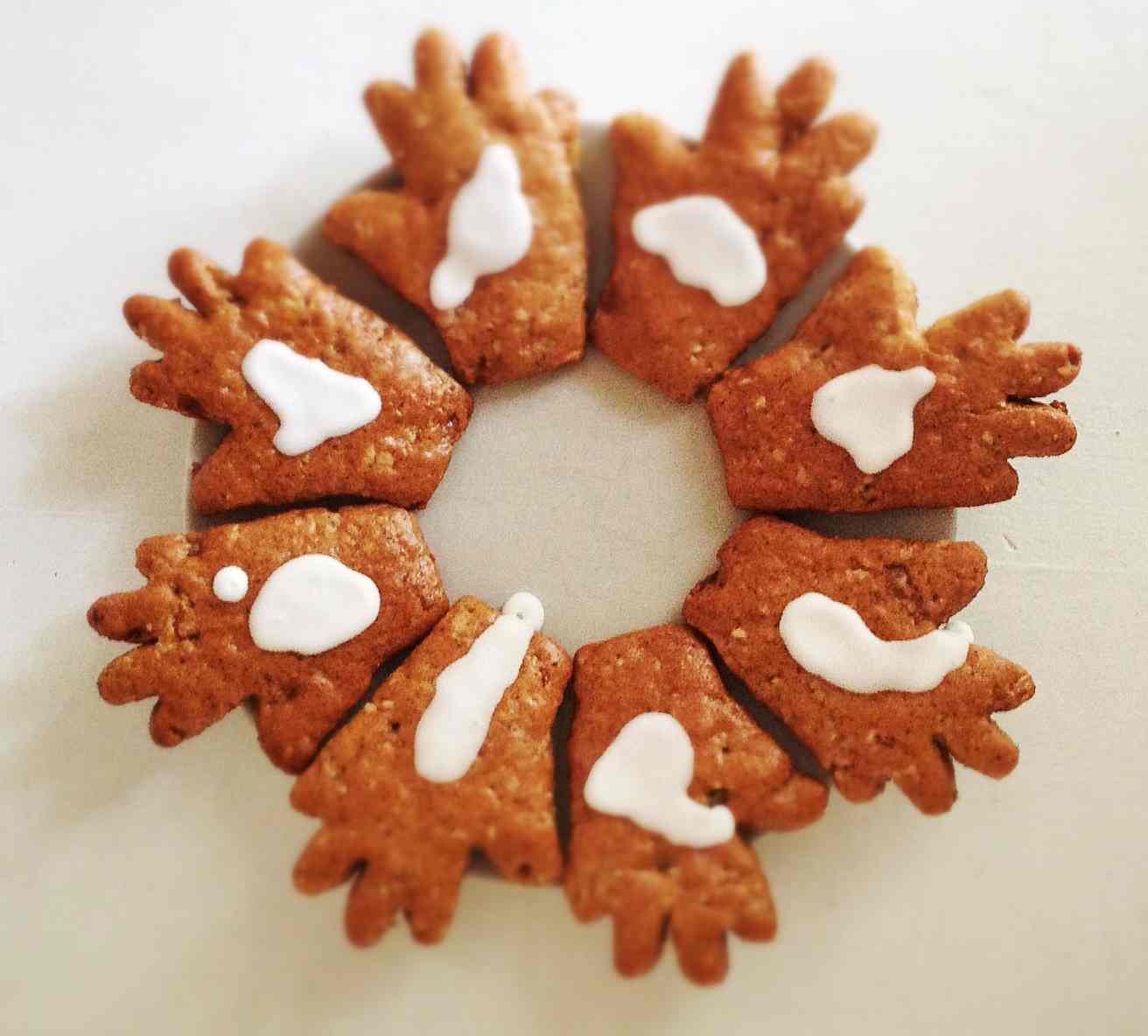
Royal icing is one of the traditional decorations for these cookies and I doled it out in blocks, lines, stars, and other shapes on the thick slabs I made with half the batch and on the thinner stars, gingerbread men, and open-palmed hands. A little bit of rum in the icing isn't a bad thing. Alton Brown has as good a recipe as any. He uses vanilla extract, but a similar amount of lemon juice or —my choice — rum also works to loosen and flavor the icing.

For those who can read the old German script, here's the recipe:

Gunter glieben glauchen globen. Doesn't make any sense to you? Check out below.
And if reading that doesn't come easily to you, here is my transliteration and adaptation for modern kitchens. The text of Frau Nietlispach's recipe follows for those who like to check against the original.

Elisenlebkuchen
(Rowley )

½ pound honey
½ pound sugar
100 g pork lard
1-1.25 pounds flour
½ pound peeled and grated sweet almonds
125 g finely cut mixed candied citron and orange peels
2 eggs
4 g each of ground cinnamon, ground cloves, cardamom
15 g of potash (potassium carbonate, 2.5 tsp), dissolved with 2 Tbl of rum
4 g hartshorn (ammonium carbonate, 0.75 tsp) dissolved with 2 Tbl of rum

Let the honey, sugar and fat boil in a pot. In the bowl of a stand mixer combine the spices, almonds, and one pound of the flour. Carefully add the hot honey mixture and mix slowly to blend. Then add the eggs, potash, and ammonium carbonate and continue mixing until the dough is smooth and shiny. Add additional flour if necessary to achieve a dough that’s just barely tacky to the touch.

Let it rest, covered with plastic wrap, overnight in the refrigerator.

When you are ready to cook, heat the oven to 350°F. Roll out the dough, using flour as necessary to prevent sticking, in large slabs [5-10mm thick] and cut into rectangles about 8 x 5 centimeters or round cakes roll about 5mm and cut into shapes with cookie cutters.

Line a cookie sheet with parchment paper a silicone baking mat. Transfer individual cookies to the sheets. Bake slabs 18-20 minutes or cut-out shapes 12-25 minutes. Transfer to a wire rack to cool. After cooling, coat them with different glazes to such as chocolate, sugar and raspberry glaze and decorate each cakes differently: with [royal icing], finely chopped almonds, colored granulated sugar (nonpareils), chopped, green pistachios, halved almonds, etc. [As an alternate to lining cooking sheets] before baking, you can put the cookies on Oblaten [baking wafers].

Elisenlebkuchen  
(Nietlispach)
1/2 Pdf. Bienenhonig, 1/2 Pdf. Zucker, 100 g Schweinschmalz, 1  Pdf. Mehl, 1/2  Pdf. geschälte und geriebene Süß Mandeln, 125 g feineschnittenes Zitronat, 2 Eier, 4 g gemahlener Zimt, Nelkenpulver, Kardamom, 15 g Pottasche, 4 g Hirschhornsalz, beides in etwas Rum aufgelöst — Honig, Zucker und Fett laßt man aufkochen, fügt  Gewürze, Mandeln und Mehl zu dem heißen Honig, verrührt gut und kochen. Dann kommen Eier, Pottasche und Hirschhornsalz dazu, worauf man den Teig sehr gut verkneten muß. Ist er glatt und blank, rollt man in aus, sticht große, runde Kuchen aus und bäckt sie aus gefettetem Blech schnell bei guter Hitze. Nach dem Erkalten sind sie mit verschiedenen Glasuren: Schokoladen-, Zucker- und Himbeerglasur zu überziehen und jeder Kuchen anders zu garnieren: mit feingehackten Mandeln, buntem Streuzucker (Nonpareilles), gehackten, grünen Pistazien, halbierten Mandeln ufw. Man kann die Kuchen vor dem Backen auch auf Oblaten legen.
Goes well with:
  • Elise Hannemann's Liverwurst, another old German recipe from the library here.
  • Ginger comes up a lot at the Whiskey Forge. From Soulless Ginger Lemonade to Kentucky Mules, check out some of the other recipes.
  • Want to make your own lard at home? It's easy as pie. Easier, even. Here're directions.
  • Look for potash (Pottasche) and hartshorn (Hirschhornsaltz) among the baking ingredients at grocers catering to a German clientele; the brand I use is Alba Gewürtze. No German delis in your neighborhood? Try ammonium carbonate and potassium carbonate from GermanDeli.com.

Monday, June 25, 2012

Ginger Tea After Shouting at the Pipes

Sunday nights, I often meet friends out for beers and tequila. Not last night.

Last night, as my friends gamely tried to have as enjoyable a time as they could manage without me (this is how I imagine it goes when I'm not around), I was curled on my bathroom floor, sweating, shivering, too weak even to reach for the phone. "Come," I wanted to plead. "Bring me water." I had an inexplicable, insatiable craving for butterscotch candies. My febrile hallucinations were occasionally interrupted with bouts of roaring at the porcelain. Afterwards, the cool tile floor felt so, so good.

When Dr. Morpheus came home hours later, the verdict was swift: food poisoning.

Though we didn't have butterscotch candies, I got water and, after a while, ginger tea. We call the stuff ginger tea, but the hot drink is more properly a decoction. That is, it's a highly seasoned liquid that's been flavored by long, low cooking of plant matter in water. See? It's kinda like tea. Calling it a decoction around the house, though, is like calling a possum an opossum; technically correct, but a bit contrived.

Ginger has long been regarded as soothing to upset stomachs. You may recognize it from that ginger pie I sometimes bake. I break out this decoc...this tea now and then to combat queasiness. Even if the effect is a placebo, sipping this hot, bracing tea helps me feel just a little better. But I tell you this: when I'm wrapped in a towel to ward off chills and my clammy, sweaty head is pressed against the cool toilet like it's dispensing God's own heavenly grace, a little better makes a world of difference.
Ginger Tea for an Upset Stomach

The proportions here are to taste, but the end result should smell and taste strongly of ginger. I like a bit of honey to round out taste and to soothe my throat, but leave it out if you got some beef against honey.

1 quart/liter of water (more or less)
8 oz/ 230g fresh ginger
Honey (optional)

Wash but do not peel the ginger. Slice into fat coins or ovals. Put them in a nonreactive pot big enough to hold around 1.5 quarts. Pour the water over it. Bring to a boil, then reduce the heat and simmer for about 20 minutes. Strain some into a glass or mug, sweeten with honey to taste, and return the pot to a low flame.
Top off with fresh water now and then as you strain off more to drink until the ginger loses its potency or you just get sick of the stuff. 
I haven't tried this next bit, but it stands to reason that when you're done with the drink and there's some left in the pot, you could strain off the solids and add twice the volume of sugar as tan ginger water is left. Heat just until the sugar dissolves and you've got yourself a nice ginger syrup for cocktails or drenching cakes or whatever.

Now, if you'll excuse me, I still feel wrecked, like I've been mauled by a cougar or fell off a speeding truck. I'm off for some Ibuprofen and tea.

Wednesday, December 28, 2011

My Dad's Onion Rye Bread

Butter is not optional.
For as long as I can remember, my father has made onion rye bread, three loaves at a time, mostly in cold months. The first loaf we eat while it’s almost too hot to handle, rivulets of melted butter besmearing our hands; the second is half gone before it cools to room temperature; and the third, more often than not, is deployed in ham sandwiches. With 24 hours, not a crumb or crust remains.

Not long ago, I jumped at the chance to bake a few of these dense, moist loaves with him. Since snow recently had fallen, we cooled a pot of hot milk and sugar in the white stuff while the yeast proofed in the warm kitchen. Turning one’s back porch into an extension of the freezer is perhaps the only part of Winter I truly miss.

Cooling hot milk in the snow
When it came time to pull the ingredients together, I was amused that he regards aromatic elements in recipes — even his own — as I do. Only three tablespoons of caraway seeds in the recipe? Meh, sprinkle in some more until it looks right. One cup of chopped onions? We could probably put in a bit more without upsetting anyone.

Slightly misshapen, but so damn good.
Mind you, we both inflate the volume of those kinds of ingredients in the first place when we transcribe  recipes, so we might easily end up using twice the spices and aromatics as whatever the recipe called for before it got to us. The ingredients below are what’re on his written directions. If you want more onions or caraway, then you’ve got a baseline.

Our family isn’t shy about slathering butter on almost every slice. You shouldn’t be, either. Because the tops of these loaves are strewn with coarse salt before baking, though, stick with unsalted butter.

Onion Rye Bread

2 cups milk
¼ cup sugar
4 tsp salt
¼ cup vegetable oil
2 packages active dry yeast
1 cup warm water
6 cups all purpose white flour
3 Tbl caraway seeds
1 cup chopped onions
2.5 cups rye flour
Corn meal
q.s. cream
q.s. coarse salt

Scald milk; stir in the sugar, salt, and oil. Cool to lukewarm. Soften yeast in the warm water and when it’s foamy, add this yeast mixture to the lukewarm milk.

Blend in all of the all purpose flour, mixing well. Add caraway seeds, onions, and 2 cups of the rye flour.

Sprinkle the remaining rye flour on a board or counter and knead the dough until it’s smooth. Put the smooth dough into greased bowl, cover, and allow to rise in a warm place until doubled in size. Punch down and fold dough from edges to center.

Cover with a clean kitchen towel and let the mass rise again until doubled. Divide into three equal loaves. Put each into a greased pan sprinkled with corn meal. Brush the tops of the loaves with cream, then strew liberally with coarse salt. Cover with a clean towel and allow to rise again until doubled in size.

Bake at 350ºF/175ºC for 45 to 60 minutes. Remove from pans when they sound hollow when tapped on the bottom. Cool on wire racks (unless you plan to tear into them right away, then just grab a board, a knife, and a boatload of butter).

Friday, November 4, 2011

Root Beer Cake

Root beer cake. Yeah, I know. Sounds like something Ernest Matthew Mickler would've praised. But I stumbled across a recipe for just such a thing while reading Andrew Carmellini's new book American Flavor and it struck a nostalgic chord. I've also been on soda and baking kicks lately as well as preparing to move (we bought a house this week), so anything that reduces the number of cans, bottles, and boxes from the kitchen larder or the liquor closets get boosted to the top of the to-cook, -drink, -make list.

When I said I'd made a root beer cake, the looks at home could only be described as nonplussed. If  I had described it as a dark spice cake or a moist cousin of German lebkuchen, the initial response might've been more enthusiastic. Turns out that the cake is very much like a spice cake, spiked with star anise, cardamom, nutmeg, lemons, and pepper. The top is covered with with spiced glaze flavored with some of the same spices.

Like a spice cake, it gets better on the second day. And the third. I'd make this for kids and to bring along on picnics, but, man, the doughnut potential here is so, so tempting.

A word of warning; the batter is very liquid. You might think something is amiss (especially since the measurements for the cake are odd). Not to worry; it comes out just fine.

From Andrew Carmellini's American Flavor, here's...

Root Beer Cake

The Cake

1 tablespoon unsalted butter, at room temperature, for the pan
1.5 cups plus 1 Tbl all-purpose flour
One 12-ounce bottle (1.5 cups) root beer
½ cup molasses
½ tsp plus 1/8 tsp baking soda
¾ cup dark brown sugar
¼ cup plus 2 Tbl vegetable oil
3 tablespoons plus 1 teaspoon granulated sugar
One 1-inch piece of fresh ginger, peeled and grated on a microplane or on the finest side of a box grater (1 tsp)
2 tsp vanilla extract
1 large egg
1 ¾ tsp baking powder
1 ¼ tsp ground star anise
1 ½ tsp ground cardamom
½ whole nutmeg, grated (or 2 tsp ground nutmeg)
Finely grated zest of 2 lemons
1 tsp kosher salt
½ tsp fresh-ground black pepper

The Root Beer Glaze
¾ cup heavy cream
1 Tbl sassafras bark (or ½ tsp sassafras extract; see Note)
2 cups powdered sugar
Pinch of ground star anise
Pinch of ground cardamom
¼ tsp kosher salt
¼ whole nutmeg, grated (or about 1 tsp ground nutmeg)
Finely grated zest of ½ lemon


To Make the Cake

Preheat the oven to 350°F.

Grease the bottom and sides of a 10-inch cake pan with some of the butter.

Cut out a piece of parchment paper so it fits closely into the bottom of the cake pan. Line the bottom of the pan with the parchment, and then grease the parchment with more butter.

Shake 1 tablespoon of the flour into the cake pan, and shake it around so it sticks to the butter. Tap out any excess flour that doesn't stick to the parchment or to the sides of the pan.

Pour the root beer and molasses into a deep medium-sized pot, and bring the mixture to a boil over high heat. (You need those high sides because the baking soda will froth up very high, and you don't want it to spill over! So make sure there's some meaningful space between the liquid and the top of the pot.)

Pull the pot off the heat and whisk in all the baking soda, so it froths up. Then put the pot right in the fridge to cool down a little.

While the root beer mix is cooling down, whisk the brown sugar, vegetable oil, granulated sugar, ginger, and vanilla extract together in a mixing bowl. The mixture will be a little chunky at this point.

Crack the egg into the bowl and whisk well. The egg is what makes everything come together smoothly: you should have a thick paste. Set this aside.

In another mixing bowl, combine rest of the flour with the baking powder, star anise, and cardamom. Grate in the nutmeg and lemon zest, and add the salt and pepper. Whisk everything together so it's well combined. Take the root beer mixture out of the fridge. Pour a third of the flour mixture into a large mixing bowl; pour in one-third of the root beer mixture, then one-third of the sugar paste. Whisk everything together slowly (so it doesn't splash everywhere), and then add another one-third of the flour, another one-third of the root beer, and so forth, until everything is combined in the bowl. (The mix doesn't need to be completely and smoothly combined until the last of the wet and dry mixtures are in the bowl.) You should have wet, almost liquid batter.

Pour the batter into the cake pan, put the pan on a cookie sheet (to catch drips and splashes), and put on the middle oven rack.

Bake the cake for 45 minutes without opening the oven at all (this cake will sink if you shake it up while it's baking). Check it: the cake should be high and dark brown, with a little bit of spring-back when you touch it (but not too much-it's a very moist cake), if it's not quite ready, rotate the pan and put it back in the oven for another 5 minutes before checking it again. The whole baking process shouldn't take longer than 55 minutes, even in a slow oven.

While the Cake is Baking, Make the Glaze

Whisk the cream and sassafras together in a small pot, and bring it up to a boil over medium-high heat. As soon as it boils, pull the mixture off the heat, pour it into a glass or ceramic container (something that won't crack from the heat), and put it in the fridge. Let the mixture cool for about 30 minutes while the sassafras steeps into the cream, so you have a nice root beer flavor.

In a mixing bowl, combine the powdered sugar, star anise, cardamom, and salt. Grate in the nutmeg and lemon zest, and whisk everything together.

Strain the cooled cream through a fine-mesh strain into a small mixing bowl (so the sassafras pieces don’t end up in the glaze).

Gently whisk ½ cup of the cream into the powdered sugar mixture, holding back the last 2 tablespoons see if you need it. If the mixture is dry and not coming together as a glaze, add more cream. Whisk the mixture well, until you have a shiny, thick liquid.

To Finish the Cake

When the cake is ready, pull it out of the oven and let it rest for about 5 minutes.

Flip the cake out of the pan onto a serving plate. Spread the glaze thickly on top of the warm cake with a spoon. The glaze will melt and drip down the sides as you slather it on.

You can serve the cake as soon as it's cooled to room temperature-but like all spice cakes, it's even better the day after you make it. Store it covered at room temperature.


Andrew Carmellini (2011)
American Flavor
336 pages (hardback)
Ecco
ISBN: 0061963291
$34.99

Goes well with:
  • Drinking Cheerwine Like It's My Job. Root beer's all well and good, but I swear that there will come a day when a Cheerwine cake will cool on our kitchen counter. 
  • My review of Andrew Schloss' new book Homemade Soda — and how my mom came to think there was a drive-by shooting in her dining room.
  • My take on Brad Thomas Parsons' new book Bitters. It's because I make my own bitters, infusions, and extracts that I happened to have everything on the ingredient list for this cake.

Monday, October 3, 2011

Kruidnoten Liqueur, A Genever Recipe

Hiram Walker makes a gingerbread liqueur, biscotti-flavored cordial is not unheard of, and in his The Joy of Mixology Gaz Regan gives a recipe for a Jägermeister-spiked Oatmeal Cookie cocktail. Americans, though, simply don’t make cookie-flavored cocktails and cordials at home. Not often, anyway.

Fitting then, that the Dutch — who, after all, ran the first commercial still in America in the 17th century and gave us our word cookie — have a recipe combining the two. In a post last month, Lizet Kruyff relates a recipe for kruidnotenlikeur from Maak van de noot een deugd (roughly “Make a virtue out of nothing”), a new Dutch cookbook devoted entirely to cooking with kruidnoten.

Kruidnoten are tiny gingerbread cookies, cousins to the Christmastime specialty peppernuts. A direct translation is "spice nuts" but "nuts" refers to their diminutive size; they are no more likely to contain nuts than are peppernuts (or doughnuts, for that matter). Typical spices in the little cookies include ginger, cinnamon, nutmeg, cardamom, white pepper, cloves, and coriander, but such things vary with the baker.

With the help of Renée de Vries, an internet specialist at the University of Amsterdam, I tracked down online excerpts from the book. Why? Well, because Kruyff’s blog calls for 12 liters of genever, a Dutch spirit enjoying a modest renaissance in the US. Even counting my personal stash of current and vintage bottlings, there are probably not 12 liters of the stuff in our entire neighborhood. Plus only 500 grams of sugar to make a cordial with that much liquor? Something is not right. A look at the original reveals that her "12" liters is actually "1/2" liter. Big difference.

My somewhat loose and streamlined translation follows. For sticklers, see the original recipe below. Kruyff suggests both using white rum as an optional base spirit and, if you're so inclined, adding a splash of cream after the maceration. The original recipe notes that you can use cane sugar for a "warmer" taste and darker color.
Kruidnoten Liqueur

1/2 liter jonge genever or vodka
3 handsful of kruidnoten
200ml water
500 grams of cane sugar

Push the kruidnoten through the bottle's opening. Put the bottle away for about six weeks in a dark closet. Give the bottle a shake now and then to show it who's boss and so that the flavors can blend. Do not worry if it looks nasty.

After six or seven weeks, strain through cheesecloth or a clean tea towel into another bottle. Do this again if you doubt whether particles remain.

Make the syrup. Put the sugar and water in a saucepan with a thick bottom. Bring to the boil, stirring. Stir until all sugar is dissolved. Let cool, mix with the kruidnoten infusion and pour into a pretty bottle.
Proost!

Karin Sitalsing, Marije Sietsma en Helga de Graaf (2011)
Maak van de noot een deugd: koken met kruidnoten
120 pages (hardback)
Loopvis
ISBN: 9081764802
€ 17,95

Monday, September 5, 2011

It’s All Going to Biscuits

Summer slurs into Autmn subtly in Southern California, but there's no denying that cooler weather is creeping upon us.

With the onset of light blanket nights, I’ve begun drinking more hot tea and resumed baking — pies mostly, but buttermilk biscuits as well. These are for me comfort foods and lately I’ve been craving a bit of comfort.

Biscuit, butter, and peach preserves
But hot buttermilk biscuits cry for some kind of...something, even if it’s just butter or honey. So, before Summer slipped way entirely, I scored one last flat of peaches and made a big jar of preserves for slathering on my steamy little indulgences.

There had been vague plans for using these peach preserves in a barbecue sauce, as a base to sweeten and flavor juleps, with roast pork, or maybe even to complement a batch of bitterballen, but at this rate, I think it’s all going to biscuits.
Peach Preserves

About 2.5 pounds ripe peaches
2.5 cups sugar
2-4 oz fresh lemon juice
one half teaspoon unsalted butter

Plunge the peaches in boiling water for about 1 minute to loosen the skins. Remove them with a skimmer to an ice bath and slip off the skins. Cut the skinned peaches in half, remove their pits, and cut each half into small, bite-sized pieces. Place the pieces in a large, heavy, nonreactive pan (I use a big old enameled Le Creuset Dutch oven). If you prefer an even more fine preserve, use a pastry knife to cut pieces into bits a little larger than grains of rice. Add the sugar and lemon juice. Let stand about ten minutes.

Turn the heat to high, add the butter (to help tamper down foaming) and cook about 10-14 minutes, until it holds its shape on a chilled saucer.

Ladle into jars and either process or keep in the fridge.

Makes about a quart of preserves.

Goes well with:

Monday, December 27, 2010

Salted Ginger Cookies

Every year around Christmas, we make batches of pliable, chewy ginger cookies. In addition to fresh and powdered ginger, the cookies are spiked with white pepper and coarse sea salt, then covered in sugar before baking. When they come out of the oven, they’ve spread from jaw-breaker sized balls to 2-3” flat discs. They keep well enough, but freeze whatever’s not eaten within four days.

We’re on day No. 3 and I don’t think there will be any call for a freezer.

Salted Ginger Cookies

½ cup/110g brown sugar
½ cup/100g white sugar
½ lb/226 g unsalted butter
1 egg
1/3 cup/80ml molasses
2 ¼ cup/280g all purpose white flour
1 Tbl fresh ginger, grated
2 tsp powdered ginger
1 tsp powdered cinnamon
½ tsp powdered allspice
¼ tsp white pepper
½ tsp coarse sea salt, mounded*
2 tsp baking soda
Additional sugar for rolling dough balls*

Cream the butter and sugars together in a stand mixer. Mix in the egg, then the molasses. Then add the remaining ingredients (except rolling sugar) and blend thoroughly until it forms a stiff dough.

Preheat the oven to 325°F/165°C/Gas mark 3.

Chill at least half an hour, then roll pieces of dough in your hands to form into 1” balls. Roll these in granulated sugar, then arrange on a greased sheet pan (or, as we do, one lined with a silicone mat). Bake about 12 minutes. Cool on a rack.

* Note on the salt and sugar: Free-flowing table salt isn’t what you want here. Part of this cookie's appeal is its random distribution of small, irregular chunks of grey sea salt. If it’s too large, crush it a bit, but you don’t want the salt completely pulverized. We usually use white table sugar for rolling the dough balls, but demerara would be nice and possibly even large-grained German hagelzucker (though I use that one for other cookies, I haven't tried it with these). 

Don't feel like making ginger cookies? Make ginger pie. 

Thursday, December 9, 2010

Adobo, Pfeffernüsse, and a Game Called "Filippino"

I woke this morning thinking about adobo and Pfeffernüsse. No, it's not some lame odd-couple cop movie. They're two different foods. My brain runs that way, holding simultaneous parallel thoughts that have nothing to do with each other. It's not always for the best.

Adobo is a particularly Filipino way of preparing chicken, but also beef, pork, fish, and other animal proteins that often incorporates vinegar, garlic, black pepper, bay leaves, onions, and sometimes coconut milk. It's amazingly good and my life is better both for knowing how to make a few varieties and for having stellar Filipino friends who introduced me to it. 

Pfeffernüsse, on the other hand, hail from Germany. They are tiny cookies (literally "pepper nuts") that are more or less heavily spiced. They're good with coffee, tea, hot chocolate, hot spiced wines, and other winter warmers. Spices may include black pepper, anise, mint, ginger, cloves, etc. One also finds them under similar names in Russia, Ukraine, Poland, and Scandinavia. I first had them in graduate school in Kansas where a large Mennonite population still consider them part of traditional — almost obligatory — Christmas baking.

See? Simultaneous parallel thoughts that have nothing to do with each other.

Then, as I mulled over the morning's news with hot tea, I pulled a book on Pfeffernüsse off the cookie shelves. Page 25 of Peppernuts Plain and Fancy holds this little gem contributed by Johanne Reynolds of Hong Kong:
In Denmark pebernødder (peppernuts) were very much a part of our Christmas celebration. Not only did we children bake them, but also played a peppernuts game — 'filippino' — guessing how many pebernødder an opponent held in his hand. If you guessed correctly, he forfeited his handful to you. If wrong, you shared from your "store" the same number he held in his hand. That's the nearest we ever came to gambling in our Lutheran home!
A simple game for simpler times. Maybe 'filippino' was just one family's game, maybe it was more widespread. I'm not Danish, so I don't know. I do wonder, though, how it came to have the name. No answers today, just questions.


Norma J. Voth (1978) Peppernuts Plain and Fancy: A Christmas Tradition from Grandmother’s Oven. Herald Press, Scottsdale, Pennsylvania.

Tuesday, November 23, 2010

My Culinary Library: What Good Does It Do?

[I intended to call this post Julia Child, Dorie Greenspan, and the Coke Fiend in my Bed, but then decided it would be disrespectful to Ms. Greenspan, to the memory of Ms. Child, and to whomever is in my bed. The story has those elements, but it’s about how I use — and want others to use — my culinary library. So. Boring title rather than the titillating one.]

 * * * 

In the final days of the last century we had a home in Philadelphia. It was a little three-story house in Bella Vista, a neighborhood that included the city’s bustling Italian Market. Eventually, I came to work in the market, but before then when I was a museum curator, I was a regular at the shops, buying cheeses, fresh bread, olive oils, charcuterie, and all sorts of kitchen equipment that I use to this day. Food and cooking were a big part of my life.

I also had cookbooks. Thousands of them. And not just cookbooks, but bartending guides, ice cream manuals, corporate histories of food and drinks companies, biographies, sausage making texts, and many more. The books were in English, French, German, Spanish, and Dutch and spanned three centuries. I used them every single day for research. In the decade we spent in Philly, I nearly doubled the size of my culinary library. For much of that time, though, I didn’t allow anyone else to use the books — as I mentioned, it was my library. That changed, though, when I met fellow collector Chef Fritz Blank and when someone made off with my copy of Baking with Julia.

Baking with Julia was a gift. As such, it held additional importance to me beyond its utilitarian use. Written by Dorie Greenspan, it was an offshoot of a Julia Child-hosted PBS series. Its well-crafted recipes for savory and sweet breads, pastries, flatbreads, pies, tarts, cakes, and the like kept me company for a few weeks one summer: I kept it on a nightstand for reading at night and toted it to the kitchen in the morning. It was, in short, a keeper.

Until it disappeared, that is. We’d driven to Montreal for a week or so and came back to find the book wasn’t where I’d been putting it. Looked around. Nope. Not anywhere. Gone. When I asked if he’d seen it, our houseguest mentioned that he’d had a friend over one night while we were away. This friend, he explained, had slept in our bed and was a bit of an amateur baker.

Yes, it's bad to store books this way
Ugh.

I went to change the sheets and found a black plastic straw under a pillow. It had been cut down to about 2 inches, one end dusted in a white residue.

Fantastic. A stranger in my bed, snorting cocaine, and poaching my library. The humorist in me mused “You can only have two of the three, Rowley” but the truth is, I wasn’t amused by any of it. Bastard probably snorted the coke right off the book’s cover. Poor Julia.

My cocaine-dusted Baking with Julia had been a gift from Blank, the chef I mentioned. Before he retired, he was owner of a high-end French restaurant in Center City named Deux Cheminées. At 10,000 volumes, his culinary collection was certainly larger than mine. In fact, his massive library made the 2,000 books in my own home seem…not the least bit crazy. It seemed to reflect the perfectly reasonable efforts of a connoisseur, not a lunatic hoarder. There was an important difference, though: while I kept my books to myself for research and pleasure, anyone who knew about it could ask to study in the dark quiet library on the second floor of his restaurant.

His openness got me thinking about my own miserly — and typical — approach to book collecting. The thief made me want to lock away my own library and keep it from anyone other than my family and me. I hated that fucker. People, clearly, were not to be trusted. Even friends with the best intentions had occasionally forgotten to return books I’d let them borrow.

What's behind those books? Oh. More damned books.
On the other hand, the library would be useful to others in the field. Why should I be the only one allowed to use it? Despite my smoldering resentment at the thief (I never replaced the book, just so I can squint my eyes and seethe a little every time I see a copy), I realized that I could open my library to others without losing books. Well, not likely lose them, anyway.

The thief brought into sharp focus how I want my library to be used. First and foremost, it’s my collection. I use it at all hours of day and night for myself. As far as I know, it’s the most extensive culinary library — private or public — in San Diego.

Secondly, though, I want others to use it. For the last ten years, I’ve let chefs, cooks, writers, historians, graduate students, journalists, culinary students, bartenders, charcutiers, and others come to my home and research whatever it is that interests them. No one may borrow books (remember — even friends, best of intentions, and all that), but those in the business of food and drinks may pull up a chair, take notes, and find answers to questions they sometimes didn’t even realize they had.

I once helped a chef rejigger her churros recipe by letting her compare recipes in a dozen books. As thanks, she assured me that I could come to her restaurant as often as I liked for free churros and chocolate. Another time, a meat curer came to research sausage recipes and ended up with ham cures he didn’t know he had wanted. More than one distiller has come to use the English and German distilling handbooks on my shelves.

I like this so much better than my earlier book-hoarding ways. By using the library here, researchers aren’t taking anything from me. It’s not like they’re using all my sugar or drinking down my whiskey (though both sometimes happen). My pleasure in my collection is not diminished by their use of it. In fact, it’s not uncommon for visitors to bring samples and gifts. I don’t demand or even expect it and I certainly don’t charge to use the library, but how nice is it to receive bottles of spirits made by the distiller standing in my living room? Likewise, a box of benne wafers, a loaf of rye bread, a few dozen Amalfi lemons, homemade sausages and cured meats, a box of homemade beers, or even books inscribed by their authors make me glad that I’m making new friends and helping others.

French confiture books wrap around the case
Libraries ought to be used. If you have one, even if it’s not as large as mine, let others use it. In my experience, they’re not likely to take advantage of you, steal your books, rip out pages, or use bacon as bookmarks (talk to public library librarians sometime about what they find as bookmarks and take appropriate cautions). Set reasonable rules about what users may and may not do with the books and be clear about what those rules are. You will help others, you will earn new friends, and if you’re as interested in your subject matter as much as I am in mine, you will learn as much from your guests as they learn from you.

I may no longer be a curator, but I still think like one.

Sunday, March 14, 2010

Ginger Pie, a Rescued Recipe

Harold and Maude—Hal Ashby's’ black-humored 1971 film—once inspired me to bake a pie. If I’d known how much research eventually would be involved in making the simple dessert, I’d’ve said to hell with it. The perseverance paid off.

In the movie, Ruth Gordon’s seventy-nine year old Maude invites a much younger Harold (played by Bud Cort) into her rail car home. Maude—eccentric, art-loving, vivacious—stands in wild contrast to morose Harold whose faked suicides are sad jokes staged to wring some evidence of warmth from his frosty mother. In the rail car, Maude offers him oat straw tea and ginger pie. While prospects of oat straw tea did nothing for me, I was left dumb in the wake of increasingly irrelevant dialog at the mention of ginger pie.

Ginger pie? I’m no stranger to baking, but I’d never heard of it. At first, I mistook the pie for a physical thing. It had a homespun, old-timey ring that reminded me of something long forgotten. Dandelion wine, maybe, or spring tonic. At first dozens, then hundreds, then—literally—thousands of cookbooks stymied me as I hunted for a recipe. Gingerbread, ginger tea, ginger snaps, stir-fries, ginger syrups, ginger cordials, chutneys, beers, ales, candies, ginger-lacquered duck, and more, but no ginger pie.

Since nothing suggested or resembled what I was looking for, I put together working notes on a recipe of my own. Some of the ingredients were obvious, but I felt as if I were reinventing something that should be easy to find: Pie? No problem—got pans, got dough. Next! A great big mess of ginger. And eggs. And…um… sugar, of course. Plus…maybe…damn. There’s got to be a recipe in one of these books.

But I forged on. Southern chess pie had a sturdy, crack-topped custard that seemed a versatile base—But what kind of ginger? Fresh? Candied? Dried and ground? Preserved in syrup? In sherry? Just ginger juice? I try each of those. Fresh ginger turned out to have the strongest, most assertive flavor, giving racy overtones to an otherwise sweet and homey pie.

Fresh ginger holds promises of liveliness and sass, of exotic and ancient histories. There is a potency in a fat hand of fresh ginger that just might inspire a breath of fire when it's reduced to tiny, tiny cubes and strewn throughout a rum-laced custard.

The search for the recipe and subsequent experiments with what I thought ginger pie should be brought me a deeper understanding of what I was stalking. When I failed to uncover any recipes, I went back to Maude, the root of my inspiration.

Her eccentric, nuts-to-tradition take on life is a big part of the film’s appeal. During a memorial Mass, she psst, psst, pssts Harold’s attention with sibilantly inappropriate offers of licorice. Her wistful reminiscences hint at a past built on old world loves and tragedies. Once a firebrand activist, Maude continues in small ways undermining worldly complacency by finding joy in simple, everyday things; somersaults, a field of daisies, raucous songs, and seagulls, as well as frequent and spontaneous episodes of grand theft auto.

I came to realize that ginger pie was not some old-fashioned recipe fallen out of favor. It was more than that. By offering a slice, Maude extends not only hospitality, but a slyly camouflaged offer of herself and Harold’s first hints of escape from his doleful life. With the point of that pie, she wedges open Harold’s somber soul and floods it with bracing warmth and sweetness, the distillate of her own fading life’s fire and spice. Harold’s change is so profound that he picks up a banjo, abandons his mourning suits, turns cartwheels, and declares his intention to marry a woman old enough to be his grandmother.

This pie doesn’t affect those sorts of change; it’s not likely—not likely, mind you—to prompt proposals. Sitting here with a late-night wedge pilfered from the kitchen, though, I can’t help but smile. In the end, I don’t know what Maude’s recipe was, but I’ve cemented friendships over slices of this rich, ginger-and-rum custard pie. Surely that is the sort of thing she meant to dish up.

Ginger Pie

1 unbaked pie crust
¼-1/3 cup minced young ginger
2.5 oz aged rum*
1.5 cups sugar
8 Tbl unsalted butter, room temperature
¼ tsp salt
3 eggs
2.5 Tbl all purpose flour
¼ cup heavy cream
1 tsp vanilla extract
1 tsp lemon zest

At least one hour before beginning, combine the ginger and rum in a small bowl or jar and set aside.

Cream the butter and sugar. Add eggs one at the time and mix after each addition. Add remaining ingredients, including the rum and ginger, and combine thoroughly.

Pour the mixture into the unbaked pie crust and bake at 350F about 50 minutes, until the center has mostly set, but is still just a little wobbly – it will firm on standing. It should have a slightly darkened, crusty top. If necessary, cover the pan with a tented piece of aluminum foil or an overturned stainless steel bowl to prevent overbrowning while the pie bakes.

Warm, the pie cries for heavy dollops of whipped cream barely able to hold itself together. Cold, it’s best to sneak mall slivers while the rest of the house sleeps.

* Appleton Estate V/X or Clement VSOP are both grand rums for the pie. You want something with some age to it. In a pinch, you could use a white rum, but avoid spiced and dark ones: After all, this is a ginger pie, not a rum pie.

Tuesday, November 3, 2009

Lost Abbey Gingerbread Cake

Serpent’s Stout is out now. Drink some now, eat some later.

Last year, I spent the better part of a Friday night with brewer Tomme Arthur of Lost Abbey just north of San Diego. Before that, cheesemonger Zeke Ferguson, photographer John Schulz, and I began with lunch under the hop vines at Stone Brewing’s beer garden. We ended up at Lost Abbey among racks of oak barrels, eating cheese, breaking out funky chocolates, and sampling a load of Tomme’s specials, including some vintage bottles he pulled out so we could taste the variations over years. All in all, it was a great night.

It also made me more appreciative of Lost Abbey beers, so I’ve been scoring more of them since then. This week, I grabbed a stout. At 11% abv, Serpent’s Stout is a seasonally available beer (early winter) in a 750ml corked bottle. It’s a very dark, malty beer, light on the carbonation, with an almost creamy texture. Given its notes of chocolate, molasses, and even coffee, I immediately realized how well it would work in baking.

After lightly chilling the bottle, I poured out 8 ounces, then savored the rest as Tomme intended. The portion I set aside went into a dense, dark, moist gingerbread cake that carried over the lingering taste of Serpent’s Stout with undertones of molasses and racy ginger. Photo to the left courtesy of StudioSchulz.com.

Adapted from Claudia Fleming’s Guinness Stout Ginger Cake in The Last Course: The Desserts of Gramercy Tavern, this version contains slightly more ginger and double the cardamom of the original.

Lost Abbey Gingerbread Cake

1 cup Lost Abbey Serpent Stout
1 cup molasses
½ Tbl baking soda
3 large eggs
½ cup granulated sugar
½ cup firmly packed dark brown sugar
¾ cup canola oil
2 cups all-purpose flour
2 ½ Tbl ground ginger
1 ½ tsp baking powder
¾ tsp ground cinnamon
¼ tsp ground cloves
¼ tsp freshly grated nutmeg
¼ tsp ground cardamom
1 ½ Tbl peeled fresh gingerroot, grated or finely minced

Preheat the oven to 350°F. Butter a 9- X 5-inch loaf pan, line the bottom and sides with parchment, and grease the parchment. Alternatively, butter and flour a 6-cup Bundt pan or ring mold.

(1) In a large and deep saucepan over high heat, combine the stout and molasses and bring just to a boil. Turn off the heat immediately, stir to mix thoroughly, and add the baking soda. The resulting foam will subside after a few beats.

(2) Meanwhile, whisk together the eggs and both sugars in a bowl, then whisk in the oil.

(3) In a separate bowl, sift the flour, then whisk in ground ginger, baking powder, cinnamon, cloves, nutmeg, and cardamom.

Combine the stout mixture (1) with the egg mixture (2), then whisk this liquid into the flour mixture (3), half at a time. Add the fresh ginger and stir to combine.

Pour the batter into the pan and bake for about 1 hour, or until the top springs back when gently pressed and a cake tester inserted in the middle comes out clean. Do not open the oven until the gingerbread is almost done, or the center may fall slightly. Transfer to a wire rack to cool.
Because of the canola oil, this cake keeps at room temperature for several days. Serve with whipped cream, ice cream, or just plain with a cup of coffee or tea.

Goes well with:

Friday, Saturday, or Sunday nights at The Lost Abbey’s tasting room.

Port Brewing / The Lost Abbey
155 Mata Way, Suite 104
San Marcos, CA 92069
(800) 918-6816