Showing posts with label liqueurs. Show all posts

Wednesday, April 18, 2012

John Wright's Homebrew from the Hedgerow Series

My "May blossom rum" is simply hawthorn blossoms, 
covered with white rum and left in a jar for a week. 
The petals are removed and the result bottled. 
The flavour and bouquet is almost exactly that of 
May blossom itself with a surprising 
overtone of almonds.

~ John Wright

John Wright’s niche is foraged food and he has penned a number of handbooks for the British market on his expertise in the field, including The River Cottage Hedgerow Handbook, Edible Seashore, and Mushrooms. But last year, he launched a column for The Guardian that keeps me coming back again and again. In it, he covers country wines, local liqueurs, backyard apéritifs, and other hedgerow homebrews close to my heart.

Recently, he’s explored smoked vodka. Ok, maybe that’s not to everyone’s taste. But his DIY solution involving a can, some tubing, and sawdust is readily replicable and can be applied to a variety of spirits. His earlier piece on the sea buckthorn fizz made me remember that, while we don’t seem to have sea buckthorn around these parts, a store nearby carries liter cartons of the requisite juice which I nabbed within the hour.
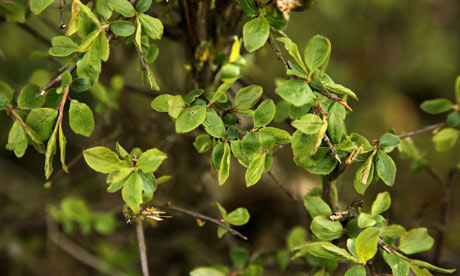
Blackthorn leaves. Photograph: John Wright
Americans will quibble over — and flat-out disagree with — some of Wright’s pronouncements. When he writes, for instance, that white rum has “no real flavour of its own,” let’s cut the man some slack. He is a forager, after all, and not a bartender or boozer whose job it may be to identify any number of white rums in blind tastings. But his takes on orange beer, parsnip wine, rhubarb wine, chestnut liqueur, cider, blackberry whiskey, dandelion and burdock beer, and so much more have inspired me to pay closer attention to the seasons here in San Diego and what’s flowering and fruiting when in the parks nearby. Lemons, grapefruit, and rosemary are everywhere here; it's the keen eye that spots rose hips, lemonwood flowers, and feral nasturiums, just there for the taking.

From his most recent article, here’s Wright’s verbatim scaled-down version of épine, a French aperitif that’s a very close cousin to sloe gin since it uses the leaves of the blackthorn bush rather than the sloe fruits familiar to us. We are told that in France friends of his friend who supplied the recipe are ignorant of sloe gin and leave the fruits to rot on the shrubs. Sacré bleu!
Épine apéritif
2½ litres of red wine or homemade red fruit wine such as blackberry or elderberry
Half a bottle of brandy or eau-de-vie
500g sugar
About half a litre of blackthorn leaves (don't use more leaves than I recommend because blackthorn, like all the plum species, produce traces of cyanide as a byproduct of the almond flavour it imparts)
Put all the ingredients into a food quality plastic container, stir and fit the lid tightly. Leave for two weeks, stirring occasionally. Transfer to clean bottles using a funnel and some doubled-up muslin cloth to filter out the bits. As with nearly all drinks it improves with age. Santé!

Goes well with:
  • The entirety of John Wright’s Homebrew from the Hedgerow series is here.
  • Sloe what? Sloe gin? Yup. Check out what Irish poet Seamus Heaney says about it here. 
  • The River Cottage Preserves Handbook is a great little tome. I write about it here and include a recipe for beech leaf noyau. 
  • About those feral nasturiums. They'll be coming into seed soon enough. Here's a recipe for pickling the pods. 

Friday, April 6, 2012

A Fistful of Pears

I recently heard a straight guy — a married man, with kids — declare about distiller Lance Winters "I would be that man's wife in a heartbeat." I'm not sure how Winters would feel about that. Or Mrs. Winters, for that matter. But I understand the sentiment. See, we have a deep and abiding respect for St. George Spirits here at the Whiskey Forge. More than once I've considered chucking my entire career, throwing myself at Winters' feet, and saying "Teach me." That hasn't happened yet.

Yet.

But this morning, that old thought resurfaced as I watched the new video A Fistful of Pears featuring Winters and Jeff Levy of Bread & Gin. Recipe for the brandy-and-Bonal drink is below. Meanwhile, here's the California distiller slinging liquor and smoking a cigar like he's doing it a favor:


A Fistful of Pears

1 oz Aqua Perfecta pear liqueur
1 oz Aqua Perfecta pear brandy
1 oz Bonal aperitif wine
Grapefruit peel for garnish

Stir brandy, liqueur, and Bonal in a mixing glass with ice, strain into a chilled glass. Rim with fresh grapefruit peel, drop in the peel.

Monday, December 19, 2011

Drinking Advocaat

I think it is better always 
to have a drink before people arrive 
and that way, 
you’re just a bit more mellow...

~ Nigella Lawson

Now that we’ve established some semblance of a nomenclature and etymology for the egg liqueur advocaat, three questions arise:
  1. Who makes the stuff?
  2. Once you’ve got it, what do you do with it?
  3. If you can’t find it, is there an easy way to make it at home?
Last things first: yes, there’s an easy way to make advocaat at home. My own recipe with fresh eggs and VSOP brandy makes 1.4 liters of about 37-proof egg liqueur (see below).

If you’re put off by the prospect of making your own, though, three main brands are common enough to find on the shelf at your local boozery or through online vendors ; Bols (from Holland), Verpoorten (Germany), and Warninks (made by DeKuyper Royal Distillers in Holland). A bottle of any of these is readily available for $17-28.

Just as eggnog and even bourbon find their ways into a variety of desserts from cookies to cake, so, too, does advocaat. Most simply, it’s drizzled over ice cream. It’s also incorporated into cream fillings for cakes and pastries, sauce (just add it to vanilla sauce), folded into tiramisu, paired with baked fruit, and hundreds of other desserts.

In its drinking form (rather than the thicker, slightly cooked, incarnation), advocaat is indistinguishable from German eierlikör. One could easily slap alternate labels on the same product for different markets. Our European colleagues have been guzzling the infamous Snowball made with these egg liqueurs for some time. Popular — or at least well-known — in the UK, it’s simply one part advocaat to two parts lemonade (British lemonade, i.e., Sprite, 7-Up, or bitter lemon soda). Here, Nigella Lawson bangs one out:


Recipes for homemade advocaat typically call for anywhere from half to a full liter of alcohol per dozen eggs. I take a middle path with slightly fewer eggs and split the difference on the booze. The result? More boozy than some, not as much as others.

Here’s how we make drinking advocaat around these parts. For a thicker, spoonable, version, use whole eggs, ditch the milk, and heat the mixture in a double boiler.

The sweetened condensed milk is not traditional — or even strictly necessary — but it does creep up in some Dutch recipes. I like the additional smoothness and slightly cooked taste it lends to the finished drink, but feel free to omit it. Should you do so, add up to an additional ¾ cup of sugar. Likewise, if you just can’t get enough liquor inside you, this recipe will easily admit another 250ml/1 cup of 40% abv alcohol.

Rowley’s Authentic San Diego Advocaat

10 egg yolks
250g/1.25 c sugar
3-4 gratings of fresh nutmeg
A pinch of salt
1 tsp vanilla extract
14 oz can of sweetened condensed milk
750ml brandy, neutral grain spirits, or vodka

Strain the egg yolks through a medium sieve into a large mixing bowl to remove the chalazae (those repugnant, curled little white cords that attach the yolk to the shell). Add the sugar, salt, and nutmeg. Whisk gently to combine.

Stir in the vanilla extract, sweetened condensed milk and alcohol. Whisk vigorously, then pour into sterilized bottles. Seal. It's drinkable now, but better after two weeks in the refrigerator.

Makes about 1400ml of 18% abv advocaat.

Notes
  • Clear spirits such as vodka or NGS will not affect the color of the drink noticeably. Many people prefer them for this reason. I use aged brandy which lends a slightly darker cast to the drink.
  • Hold me in contempt if you will, but I use Paul Masson Grande Amber VSOP for this. Best brandy in the world? No, of course not. One of the best you'll ever get for under $10 per bottle, though. Recently, I scored a 750ml bottle at a local pharmacy for $8. Love those Christmas liquor sales...
  • Clean egg yolks and whites off kitchen and cocktail gear with an initial rinse of cool water. Hot water can cook the stuff and make it much harder to remove.

Sunday, October 24, 2010

Chartreuse Hot Chocolate

In Southern California, some stereotypes hold true. Some of us do keep surfboards at the office. Our local produce is, generally, fantastic. We do eat avocados and oranges right off the trees. Our temperate weather means the grill operates year-round. But it’s a mistake to think that we have no seasons here, as some assert. We have them. They are more subtle than in other places, perhaps, but we have them.

Our recent spate of bracing, wet weather was a reminder of that. In particular, it made me reminisce about foods I used to eat when I lived places with more distinctly unpleasant seasons. Last week’s egg noodles and pork ragout were one outgrowth of that nostalgia. Another has been hot chocolate spiked with Chartreuse.

The Pères Chartreux — the Carthusian monks who make Chartreuse — currently make several varieties of spirits, including genepi, walnut and fruit liqueurs. Although an 80 proof yellow version of their famous herbal liqueur is available, the monks’ green Chartreuse is most commonly mixed into drinks. At 110 proof, this ancient liqueur packs a punch and lends lovely vegetal notes to drinks. Since moving to California, I have never been without a bottle of the green. Never. The yellow? Harder to find on store shelves here.

I was prodded to add Chartreuse to hot chocolate on reading Madeline Scherb’s A Taste of Heaven. The book is part travel guide and part cookbook of meals one may find in abbeys — and convents — around the world. Given the brewing and distilling/rectifying traditions of many monasteries, it’s not surprising that abbey beers and a few liqueurs show up in recipes; beer soup with Achel, chicken livers over apples with an Orval reduction, caramelized bananas with Westmalle tripel and dark rum.

Chartreuse is such an assertive spirit that I can identify it by smell even from several feet away. I happen to love the smell and the taste. If you’re not certain you will, don’t use the whole amount called for below. Instead, start with less. If you like it, add more. Scherb calls this Christmas Cocoa. I’ve tweaked her proportions just a bit, but I say there’s no need to restrict it to Christmas.

Chartreuse Hot Chocolate

8-12 oz good quality hot chocolate
1 oz green Chartreuse (or less, see above)

Warm a mug with hot water. Toss the water and pour the hot chocolate into the warmed mug. Add green Chartreuse and stir. Breathe deeply as you drink. Let the aroma get into your lungs. Not the drink, of course. Chartreuse is fantastic, but there's no call to drown in the stuff.

Madeline Scherb (2009)
A Taste of Heaven: A Guide to Food and Drink Made by Monks and Nuns
240 pages, paperback
Tarcher/Penguin
ISBN: 1585427187
$15.95