Showing posts with label molecular mixology. Show all posts

Friday, August 31, 2012

Bookshelf: Modernist Cuisine

I’ve cast, on occasion, disparaging remarks about modern food and drink. Meant every word, too. As a drinks judge, I’ve been served badly executed drinks by aspiring molecular cocktologists hellbent on deploying foams and smoke in places they did not belong (once, horribly, with Diet Dr Pepper and black tapioca pearls). Cooks are not immune to the desire to foist upon us novel creations. A few months back, the San Diego Tribune asked me to suggest places with great modern desserts. “I’ve had it with modern desserts,” I responded.
Few things depress me more than the freakish curiosities of pastry chefs who’ve abandoned familiar forms in a misguided rush for the sublime. Deconstructed this and re-imagined that...Just make a cake and make it delicious. I don’t need to crack open an egg shell (“Oh, look! It’s really the frosting, frozen with liquid nitrogen! And ambergris angel food cake with a colloidal Meyer-lemon center!”) to get genuine, unalloyed pleasure. Keep your modern desserts. I’ve got ice cream and brownies. 
Yet as hamfisted as some of the executions are, modernist cuisine — what some have dubbed molecular gastronomy — is creeping into wider acceptance, understanding, and successful use. Even by home cooks. And so I’ve been boning up on modernist cooking. Like it or not, the approach will grow more widespread in upcoming years as ingredients and techniques once thought exotic or uber-geeky become commonplace. It behooves us to understand what we're facing when we're presented with such things.

Click to embiggen
Different cooks have different takes on what modernist cooking is, but if there were one common thread, it is an earnest questioning of received kitchen knowledge and a desire to discover through experimental inquiry how best (defined variously) to prepare certain dishes.

Quite famously, for instance, in On Food and Cooking, science writer Harold McGee debunked the widely held notion that searing a steak “sealed in” its juices, making it juicier and more succulent than without the customary brown crust. As adamantly as even some professional chefs insist on this practice, it has no basis in truth. In fact, searing steak demonstrably causes it to lose moisture. That sizzle you hear when a steak is slapped on the grill? Those are juices vaporizing. If the surface were sealed, you wouldn’t hear that sound. Any steak eater can attest, however, that a degree of sear on a steak is good — not for any juice-sealing, but because of a browning process that helps makes food from cookies to dry-aged rib-eyes taste delicious. The process is called the Maillard reaction. Merely knowing that will earn you a degree of respect among cooks who dig this sort of thing.

The go-to book of the moment — and undoubtedly for decades to come — is Nathan Myhrvold’s six-volume Modernist Cuisine. Sure, you could (and should) read Harold McGee’s books if you want to get a grip on why modern cookery at times seems to have become unmoored from its classical foundations. You should also read those edited or written by and about Hervé This, Ferran Adrià, Nicholas Kurti, Heston Blumenthal, and others at the fore of what Jeffrey Steingarten has dubbed “hypermodern” cooking. Modernist Cuisine, though, is where the vacuum-packed, sous-vide meat of the matter lies.

Order up: The Mushroom Swiss Burger
At a breath-taking $625, this isn’t a purchase for the casual cook. The recipes can seem daunting with their calls for esoteric equipment and occasionally obscure ingredients. I’ve been working my way through it on and off for the last month. Quite simply, I cannot afford many of the kitchen tools, toys, and ingredients described in its pages. But that doesn’t stop me from wanting a hamburger as prepared following Myhrvold’s method: wrapped (a la Laura Palmer) in plastic, warmed in circulating water for about thirty minutes to 56°C/133°F, frozen in liquid nitrogen for 30 seconds, then deep-fried in 232°C/450°F oil for one minute to brown the crust. In volume five, Myhrvold gives the recipe for a mushroom Swiss cheese burger. Despite the 30-hour preparation, I want, as Liz Lemon says, to go to there.

Like the very best manuals, Modernist Cuisine is one to revisit time and time again. The photography is a joy and the writing is easy to understand even if the concepts are not at first intuitive. I didn’t absorb it all on the first reading, nor will I on the second. But having plowed through it feels a bit like I’ve survived a postgraduate seminar on anatomy and organic chemistry — and I’m hungry for more.

Just keep those foaming, smoking, glow-in-the-dark, hot-gel cocktails at arm’s length.

Nathan Myhrvold et al (2011)
Modernist Cuisine: The Art and Science of Cooking 
2438 pages (hardback)
The Cooking Lab
ISBN: 0982761007
$625.00

Goes well with:
  • A more approachable (and affordable) manual comes from British bacon-curer Maynard Davies. Manual of a Traditional Bacon Curer  may be smaller and cheaper than Modernist Cuisine, but it too is very good indeed.
  • Speaking of cocktologists, don't forget this guy when you're deciding what to drink.

Tuesday, June 19, 2012

A Dispiriting Glimpse at Molecular Mixology's Latest Offering

My book Moonshine has lots of sidebars, little snippets of text related to the nearby sections, but just enough off-topic that they felt clunky in the main copy. They reflect my scattershot, parenthetical way of thinking and the somewhat difficult time I have keeping my tongue in check. One such sidebar I cut from the final draft concerned booty bumps.

Booty what? Oh, come now. Don't tell me you've never heard of booty bumps.

Photograph: Franck Fife/AFP/Getty Images from The Guardian
Working from the delusion that those around them are unable to detect its aroma, certain day drinkers drink only vodka. Regardless of federal guidelines that specify vodka is to be odorless and tasteless, it is neither. In fact, vodka has a distinct odor and only seems odorless and tasteless when compared with whiskeys, rums, brandies, and other spirits that have more obvious characteristic smells. In other words, we're all onto you, drunkie.

Consumers who want to employ an even sneakier workaround, several informants explained, may take their alcohol from the other end. They may, in effect, take vodka enemas. Ethanol is absorbed rapidly into the bloodstream through the membrane of the lower intestine, delivering the alcoholic punch of a shot of booze, but without the resultant telltale vodka breath. The booty bump. Of course, it's easy to take poisonous amounts of alcohol into one's system accidentally through this inelegant backdoor method. Lest there's any uncertainty; it is not advised.

The things one learns in the course of pursuing a life in alcohol.

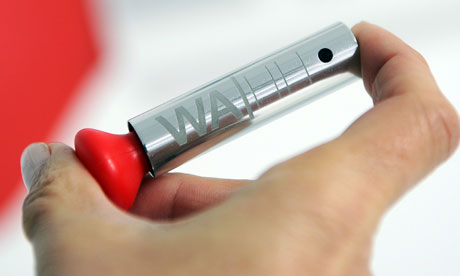
I was reminded of this alternate quick-delivery system because this Sunday's Guardian featured a story about the WA/HH spray that's just gone on sale in Paris. Kim Willsher writes:
With one squirt, its inventors promise, you'll feel all the euphoria of being inebriated for a few seconds without the nasty side-effects of behaving like an idiot and falling over. 
Willsher goes on:
With each squirt from the WA/HH spray delivering just 0.0075ml of alcohol and about 20 squirts in each €20 (£16) lipstick-sized spray, it's pricey night out – the equivalent of €1,300 (£1,000) for a unit of alcohol.
What's next? Whiskey tabs that dissolve on one's tongue? Patches that deliver small but continuous doses of Cognac for hours on end? Call me old fashioned, but I like my whiskey, wine, cider, port, rum, punch and other boozy repasts down my throat in liquid form. Ok, and maybe occasionally as a jelly. I enjoy the taste of alcoholic drinks. God help us all if we grow old in a world where the best option for a stiff drink is £1,000 spritzes of aerosol grain spirits.

If molecular mixology continues in this direction, that ass full of vodka might not seem like such a bad idea.

Monday, September 20, 2010

Mrs. Marshall's Liquid Air Ice Cream

Known as Mrs. Marshall to her tens of thousands of students, readers, and customers, Agnes B. Marshall is nearly forgotten these days. What a loss. In her heyday, the Victorian food maven was as much a household name as Anthony Bourdain, Julia Child, or — God help us — Guy Fieri is today.
An even more apt comparison might be Martha Stewart. Like Stewart, Mrs. Marshall opened an umbrella of business ventures — and seems to have excelled in them all. She ran a cookery school in London; sold fancy cookware; hawked a variety of compounds, essences, and syrups under her own label; and generally championed wholesome cookery in an era when toxically adulterated food was commonplace. She published two early books on ices (that is, ice creams, water ices, sorbets, bombes, etc.) and is known to have published recipes for making and using ice cream cones almost two decades before their supposed invention at the 1904 St. Louis World’s Fair. [1]

Generations before today’s molecular gastonomists began deconstructing S’mores, lashing cocktails with smoked foam, and otherwise digging into the science of how food does what it does, she also seems to have been the first person to advocate mixing liquid air with ice cream ingredients to make nearly instant ice cream.
Persons scientifically inclined may perhaps like to amuse and instruct their friends as well as feed them when they invite them to the house. By the aid of liquid oxygen, for example each guest at a dinner party may make his or her own ice cream at the table by simply stirring with a spoon the ingredients of ice cream to which a few drops of liquid air has been added by the servant.
~ Mrs. Agnes B. Marshall
The Table (24 August, 1901)

Turns out that the recipe doesn’t quite work (more than “a few drops” is necessary to make ice cream at the table), but the idea was solid and — in absence of servants — has been reproduced in high school chemistry labs around the United States for decades. It’s exactly the sort of scientifically inspired experimentation that supposedly avant garde molecular gastronomists and molecular mixologists [2] are using to thrill and delight their customers in 2010.

In an essay included in a 1998 reprint of Marshall’s Book of Ices [2], Peter Barham conjectures that Marshall thought of table-made ice cream after seeing or hearing about the public lectures of chemist Sir James Dewar. Dewar was the first to liquefy nitrogen. As the 19th century drew to a close, he’d gotten better at producing it in quantities — though “liquid air” was still a rare curiosity by the time Marshall wrote about it. Dewar nonetheless made a series of popular demonstrations about the new substance. While the rest of his audiences may have been mesmerized by the white “fog” generated when liquid nitrogen is poured into water, Barham surmises that Marshall took inspiration in the frozen water left in the bowl. The Queen of Ice Cream had found a new subject.

Liquid air isn’t new. Nor is ice cream. Turns out that molecular gastronomy isn’t either. But they’re all worth digging into a little more.

As anyone who knows me can tell you, I'm starting with the ice cream.

Notes

[1] Although wafers of various kinds have been made for centuries, ice cream vendors have been stuffing them with the cold stuff for more than 200 years, so they weren’t exactly new to Mrs. Marshall — but she did help popularize them. See Robin [credited as "Robert J."] Weir’s Essay An 1807 Ice Cream Cone: Discovery and Evidence.

[2] Robin Weir (ed) (1998) Mrs. Marshall: The Greatest Victorian Ice Cream Maker. With a Facsimile of The Book of Ices 1885. Syon House, Otley, W. Yorkshire.

[3] Their term. Not mine. See Darcy O’Neil’s An Introduction to Molecular Mixology for a straightforward discussion of molecular mixology at Art of Drink.