Showing posts with label ginger. Show all posts

Monday, December 17, 2012

Cooking with Lard, Potash, and Hartshorn: 1932 Lebkuchen

A little royal icing with rum is no hateful addition
I've just returned from a week in Kansas City where, among other errands, I delivered a small load of German yuletide spice cookies known as lebkuchen. Don't know it? You've heard of gingerbread? Same deal. Well, close enough to get the idea, anyway. Like its Anglo-American and French cousins, gingerbread and pain d'épices, lebkuchen has been around for centuries. A tipoff that it hails from another age is the ancient use of honey rather than sugar for sweetening. Not that lebkuchen is terribly sweet — just enough to satisfy a late morning/mid-afternoon craving with a cuppa tea. The glugs of rum in the icing and dough itself don't hurt.

The cold dough is stiff
Made with ground almonds and candied citron, the fancy version I baked is more properly dubbed Elisenlebkuchen (perhaps St. Elisabeth's lebkuchen, but German bakers have no consensus on the meaning). The recipe comes from a Weimar-era German cookbook: Frau F. Nietlispach's Das Meisterwerk der Küche  (Bong & Co, Berlin, 1932). If honey weren't sufficient, the cake-like cookie calls for three additional ingredients that firmly anchor it in another age: potash, hartshorn, and lard.

As I reviewed Nietlispach's recipe, I flipped through the contents of our pantry in my mind. The lard (Schweinschmalz) was no stranger in my baking repertoire. For the candied citron (Zitronat), I used a diced mix of homemade candied orange peel and the last of my candied Buddha's Hand/Cthulhu Head citron.

A quick check with my old pal Michael McGuan revealed that he had just rendered lard the day before; within 40 minutes I'd gotten my hands on 200 grams of it. More than enough for this recipe. The cooked pork smell rolling off the creamy white lard gave me pause. Would it be too strong for cookies? I forged on anyway without any attempt to refine it. The porkiness, in fact, faded away to the barest nothing after baking, a faint savory porcine whisper that complemented the spices.

Thinner shapes cooling on the rack
But what about the potash and hartshorn? Potash is a particularly old ingredient and may refer to a number of substances that include potassium. Originally made from leaching wood ash and reducing  the potassium-rich residue in pots, potash was a important source of income for colonial Americans who cleared and burned forests as if the trees were without end. The alkaline salt is used in glass-making, fertilizer manufacturing, and occasionally to inhibit certain enzymes in beer brewing, but its use in baking is what interests us here. Along with hartshorn (see below), potassium carbonate (K2CO3) is a chemical leavening agent that helps give loft and lightness to somewhat stiff doughs. Baking soda commonly substitutes for it in modern recipes.

Brokeback Lebkuchen
Hartshorn or hartshorn salt [Hirschhornsalz(NH4)2CO3] is also known as baking or baker's ammonia. With the advent of baking soda and baking powder, it fell from favor in the US, but traditional baking recipes from northern Europe, Poland, and Scandinavia still employ it. Although it was once actually obtained from shavings of deer antlers, industrial sources assure that woodland animals are no longer culled for cookie ingredients. At least not on a commercial basis. While baking, hartshorn releases ammonia gas that expands the dough. Although the gas dissipates fairly quickly, the lebkuchen may have a whiff of smelling salts about it right out of the oven. Don't be alarmed; it doesn't last.

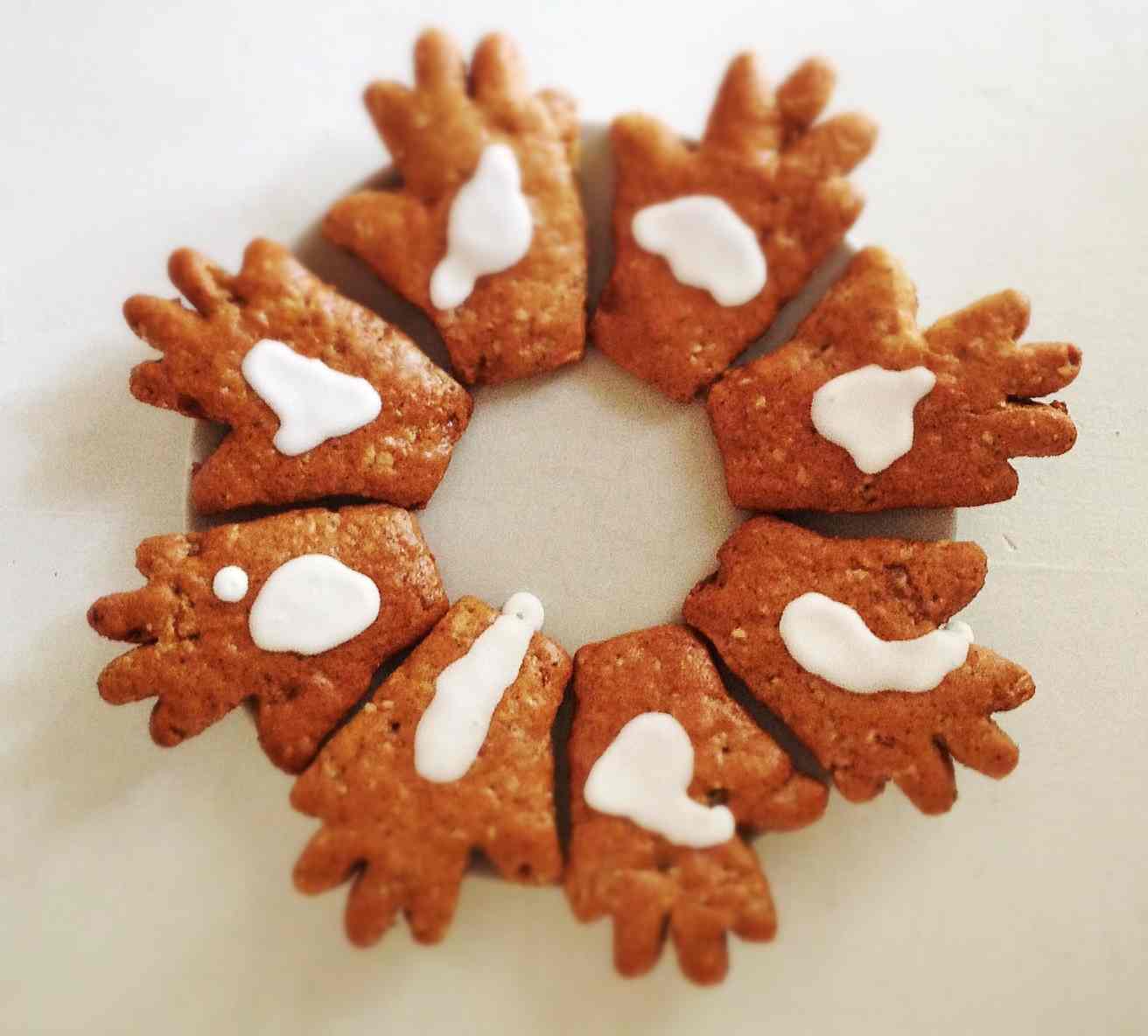
Royal icing is one of the traditional decorations for these cookies and I doled it out in blocks, lines, stars, and other shapes on the thick slabs I made with half the batch and on the thinner stars, gingerbread men, and open-palmed hands. A little bit of rum in the icing isn't a bad thing. Alton Brown has as good a recipe as any. He uses vanilla extract, but a similar amount of lemon juice or —my choice — rum also works to loosen and flavor the icing.

For those who can read the old German script, here's the recipe:

Gunter glieben glauchen globen. Doesn't make any sense to you? Check out below.
And if reading that doesn't come easily to you, here is my transliteration and adaptation for modern kitchens. The text of Frau Nietlispach's recipe follows for those who like to check against the original.

Elisenlebkuchen
(Rowley )

½ pound honey
½ pound sugar
100 g pork lard
1-1.25 pounds flour
½ pound peeled and grated sweet almonds
125 g finely cut mixed candied citron and orange peels
2 eggs
4 g each of ground cinnamon, ground cloves, cardamom
15 g of potash (potassium carbonate, 2.5 tsp), dissolved with 2 Tbl of rum
4 g hartshorn (ammonium carbonate, 0.75 tsp) dissolved with 2 Tbl of rum

Let the honey, sugar and fat boil in a pot. In the bowl of a stand mixer combine the spices, almonds, and one pound of the flour. Carefully add the hot honey mixture and mix slowly to blend. Then add the eggs, potash, and ammonium carbonate and continue mixing until the dough is smooth and shiny. Add additional flour if necessary to achieve a dough that’s just barely tacky to the touch.

Let it rest, covered with plastic wrap, overnight in the refrigerator.

When you are ready to cook, heat the oven to 350°F. Roll out the dough, using flour as necessary to prevent sticking, in large slabs [5-10mm thick] and cut into rectangles about 8 x 5 centimeters or round cakes roll about 5mm and cut into shapes with cookie cutters.

Line a cookie sheet with parchment paper a silicone baking mat. Transfer individual cookies to the sheets. Bake slabs 18-20 minutes or cut-out shapes 12-25 minutes. Transfer to a wire rack to cool. After cooling, coat them with different glazes to such as chocolate, sugar and raspberry glaze and decorate each cakes differently: with [royal icing], finely chopped almonds, colored granulated sugar (nonpareils), chopped, green pistachios, halved almonds, etc. [As an alternate to lining cooking sheets] before baking, you can put the cookies on Oblaten [baking wafers].

Elisenlebkuchen  
(Nietlispach)
1/2 Pdf. Bienenhonig, 1/2 Pdf. Zucker, 100 g Schweinschmalz, 1  Pdf. Mehl, 1/2  Pdf. geschälte und geriebene Süß Mandeln, 125 g feineschnittenes Zitronat, 2 Eier, 4 g gemahlener Zimt, Nelkenpulver, Kardamom, 15 g Pottasche, 4 g Hirschhornsalz, beides in etwas Rum aufgelöst — Honig, Zucker und Fett laßt man aufkochen, fügt  Gewürze, Mandeln und Mehl zu dem heißen Honig, verrührt gut und kochen. Dann kommen Eier, Pottasche und Hirschhornsalz dazu, worauf man den Teig sehr gut verkneten muß. Ist er glatt und blank, rollt man in aus, sticht große, runde Kuchen aus und bäckt sie aus gefettetem Blech schnell bei guter Hitze. Nach dem Erkalten sind sie mit verschiedenen Glasuren: Schokoladen-, Zucker- und Himbeerglasur zu überziehen und jeder Kuchen anders zu garnieren: mit feingehackten Mandeln, buntem Streuzucker (Nonpareilles), gehackten, grünen Pistazien, halbierten Mandeln ufw. Man kann die Kuchen vor dem Backen auch auf Oblaten legen.
Goes well with:
  • Elise Hannemann's Liverwurst, another old German recipe from the library here.
  • Ginger comes up a lot at the Whiskey Forge. From Soulless Ginger Lemonade to Kentucky Mules, check out some of the other recipes.
  • Want to make your own lard at home? It's easy as pie. Easier, even. Here're directions.
  • Look for potash (Pottasche) and hartshorn (Hirschhornsaltz) among the baking ingredients at grocers catering to a German clientele; the brand I use is Alba Gewürtze. No German delis in your neighborhood? Try ammonium carbonate and potassium carbonate from GermanDeli.com.

Wednesday, October 17, 2012

A Swift Kick from a Kentucky Mule

I am aware, in some vague sense, that a mule is a type of shoe, although I am fairly certain that I don't own any. More familiar to me is the proper dead mule, a symbol deeply entwined in — and arguably a signifier of — the literature of the American South. But it is the Kentucky Mule, that bourbon-fueled harbinger of excess, that has kicked off many an evening with friends and family around the Whiskey Forge.

Everything tastes better through a grunge filter
Some history: Around the time of the Japanese attack on Pearl Harbor, vodka was an obscure spirit in the United States, small potatoes, nothing like the cash cow it is today. The Moscow Mule is the drink that changed that.  That original mule, a vodka-and-ginger beer highball, was made famous at the Cock 'n' Bull Tavern in Los Angeles. By the time Elvis sang his way through Blue Hawaii twenty years later, the drink had become a classic. In Vintage Spirits and Forgotten Cocktails, Ted Haigh reports that a girlfriend of Jack Morgan, the Cock 'n' Bull's owner, had inherited a copper goods business. She presumably was the source of the squat copper mugs that remain to this day de rigueur for serving the drink.

Vodka, though, is not everyone's first choice when it comes to making and downing mixed drinks. Nor are copper mugs. Enter the variations. Tweaking the basic idea of a spirit, lime, and ginger beer leads to regional and topical versions of the drink; the Mexican Mule (tequila), Caribbean Mule (rums), the Blackberry Mule, and Audrey Saunders' Gin-Gin Mule. Most of them benefit from a dash or two of cocktail bitters. Classically, that has meant Angostura bitters, but when we swap bourbon for the vodka to yield a Kentucky Mule, I've found that Fee Brothers' old fashion aromatic bitters is the better choice. Use what you've got.

American-style ginger ale doesn't have the backbone this drink requires. Instead, use the more fiery ginger beer. A Cock 'n' Bull brand does exist. We've used that as well as Bundaberg from Australia and the fearsome Blenheim's from South Carolina (I quite like that one, but it's a bit strong for some). We've found that Gosling's sells a reasonably-priced, all-natural ginger beer for making a Dark 'n' Stormy, but it's our favorite of the lot for this drink instead: light fizz, well-balanced ginger taste and aroma, not overly sweet. A liter runs less than $3. No, Gosling's didn't send me any. We just like it a bunch. Get some.
Kentucky Mule 
2 oz good (but not your best) bourbon. Buffalo Trace is great here.
Half a small lime
4-5 oz ginger beer (Gosling's if you've got it; if not, use your favorite)
2 dashes aromatic bitters (Fee Brothers, Angostura, or dealer's choice) 
Build the drink on ice in a highball glass. Squeeze the lime into this and drop in the shell. Dash in the bitters and give it a quick stir. If you're a stickler for tradition, use copper mugs rather than glass. Some folks garnish with mint and lime wedges, but then some folks listen to Nickleback and dabble in crossdressing. To each his own.
Goes well with:
  • The drink's versatility should be apparent and the template works with lots of iterations. Using pisco could result in a Peruvian (or Chilean) Mule. Applejack could yield a New Jersey (or an Orchard) Mule. You get the idea. Use gin, swap in tonic for the ginger beer, and lose the bitters...holy cow, it's a Gin & Tonic. 
  • The truth of food and drink origin stories are so often obfuscated by good stories. Eric Felton takes a closer look at the origin of the Moscow Mule and Cock 'n Bull's head bartender, Wes Price. Felton's version putting Price as the originator feels like a better fit. 
  • I like ginger. There's always some around. Here's what I do with it
  • We did overindulge in mules last year. I'm pleased to be making them again, but one of the drinks we started making when we grew tired of so much ginger beer was the Punky Monkey cocktail with Buffalo Trace bourbon and Scarlet Ibis rum. Good, good stuff. 

Thursday, June 28, 2012

Two Lemonades: Fresh or with a Soulless Ginger Twist

Summer has come on cruelly for parts of the United States. Since last week, temperature spikes in the Midwest and East Coast have made me worried for family...and relieved that San Diego remains, as ever, lovely.

I will be traveling to those hot and humid places over the next few weeks, though, and undoubtedly will keep cool with beer, whiskey, iced tea...and lemonade.

I don't bother with pre-made lemonade, the powders and mixes. I'm not all snooty and think they're too sweet or otherwise unhealthy — it's just that fresh lemonade is easy to make from three ingredients we always have on hand; lemon juice, water, and sugar syrup. Why fake it when doing it properly takes so little effort?

This is an extremely versatile basic recipe. The ratio of ingredients is a straightforward 5:5:3, so use cups, milliliters, coffee mugs, etc. Any volume will work as long as you maintain the ratio. Scale up or down as your thirst, crowd, and container size dictate.
Fresh Lemonade

17oz/500ml fresh lemon juice
17oz/500ml cool water
10oz/300ml 2:1 sugar syrup

Mix in a pitcher. Chill if you've got time. Pour into glasses over fresh ice.
Monday, I was faced with a pot of ginger-infused water. It was leftover from Sunday night's ginger tea. Rather than throw it out, I swapped it out for the water I would otherwise use in the above recipe and made ginger syrup with the rest.

I strained the ginger water and set aside 250ml. About about 350ml remained, so I added twice the volume of sugar (700ml) and heated the mix in a pot just enough to dissolve the sugar. With everything in place, it was simple to make a batch of
Soulless Ginger Lemonade

Soulless? Does it lack the pungency and bite we expect from fresh ginger? No, that's there. It's even more refreshing than the plain version. Soulless because, as even we gingers know, we have no souls.

8oz/250ml fresh lemon juice
8oz/250ml  cool ginger-infused water
5oz/150ml 2:1 ginger syrup

Mix in a pitcher. Chill if you've got time. Pour into glasses over fresh ice.
Of course, if you have ginger syrup on hand already, this is a snap to make. Just use that and plain cool water. Doctor this any way you see fit; blend it with blackberries, spike it with mint or basil, but don't forget the ameliorative effect a stiff dose of bourbon could have on a glass of ginger lemonade. Carbonate the stuff, add a dash of bitters with the bourbon and you've got something pretty close to a Kentucky Mule.


Goes well with:

Monday, June 25, 2012

Ginger Tea After Shouting at the Pipes

Sunday nights, I often meet friends out for beers and tequila. Not last night.

Last night, as my friends gamely tried to have as enjoyable a time as they could manage without me (this is how I imagine it goes when I'm not around), I was curled on my bathroom floor, sweating, shivering, too weak even to reach for the phone. "Come," I wanted to plead. "Bring me water." I had an inexplicable, insatiable craving for butterscotch candies. My febrile hallucinations were occasionally interrupted with bouts of roaring at the porcelain. Afterwards, the cool tile floor felt so, so good.

When Dr. Morpheus came home hours later, the verdict was swift: food poisoning.

Though we didn't have butterscotch candies, I got water and, after a while, ginger tea. We call the stuff ginger tea, but the hot drink is more properly a decoction. That is, it's a highly seasoned liquid that's been flavored by long, low cooking of plant matter in water. See? It's kinda like tea. Calling it a decoction around the house, though, is like calling a possum an opossum; technically correct, but a bit contrived.

Ginger has long been regarded as soothing to upset stomachs. You may recognize it from that ginger pie I sometimes bake. I break out this decoc...this tea now and then to combat queasiness. Even if the effect is a placebo, sipping this hot, bracing tea helps me feel just a little better. But I tell you this: when I'm wrapped in a towel to ward off chills and my clammy, sweaty head is pressed against the cool toilet like it's dispensing God's own heavenly grace, a little better makes a world of difference.
Ginger Tea for an Upset Stomach

The proportions here are to taste, but the end result should smell and taste strongly of ginger. I like a bit of honey to round out taste and to soothe my throat, but leave it out if you got some beef against honey.

1 quart/liter of water (more or less)
8 oz/ 230g fresh ginger
Honey (optional)

Wash but do not peel the ginger. Slice into fat coins or ovals. Put them in a nonreactive pot big enough to hold around 1.5 quarts. Pour the water over it. Bring to a boil, then reduce the heat and simmer for about 20 minutes. Strain some into a glass or mug, sweeten with honey to taste, and return the pot to a low flame.
Top off with fresh water now and then as you strain off more to drink until the ginger loses its potency or you just get sick of the stuff. 
I haven't tried this next bit, but it stands to reason that when you're done with the drink and there's some left in the pot, you could strain off the solids and add twice the volume of sugar as tan ginger water is left. Heat just until the sugar dissolves and you've got yourself a nice ginger syrup for cocktails or drenching cakes or whatever.

Now, if you'll excuse me, I still feel wrecked, like I've been mauled by a cougar or fell off a speeding truck. I'm off for some Ibuprofen and tea.

Friday, December 2, 2011

Pumpkin and Ginger Doughnuts

I’ve been making booze since I was too young to buy it. But I’ve been making doughnuts and fritters even longer than that.

When I was very young, my mother taught me how to make a cheaty sort of doughnut (or, if that’s the way you roll, donut) from uncooked biscuit dough, the commercial stuff that came in a tube. Although I was barely able to tie my own shoes at that age, my siblings were all teenagers and slept in until unfathomable hours on weekends while my father golfed. If Mom was in the mood, we got doughnuts — all to ourselves.

While she handled the hot oil, it was my duty to lay out the dough, cut out shapes with an upturned glass, and then toss those sizzling fried gobs into a brown paper bag, coating them with sugar and cinnamon. They were still so hot when we tore into them that fingers of steam curled up from every bite.

With no kids of my own, it’s no longer the kind of cooking I’m likely to do. But homemade doughnuts have been a bit of an obsession ever since those early days. On a recent trip to Chicago, I idly picked up Allegra McEvedy's recent book Bought, Borrowed & Stolen where I found her recipe for pumpkin and ginger doughnuts.

With a fat ribbed pumpkin on the counter and a drive to eat up as much as is reasonable before we move, it was a simple matter of time before I succumbed to that Autumnal allure of hot pumpkin and spice. Do as you like, but swapping out an ounce of dark rum for an ounce of milk in the glaze is not the worst thing you could do this week.

From the Guardian UK, here’s McEvedy frying up a batch. Recipe follows the video.


Pumpkin and Ginger Doughnuts

150ml / ¼ pint whole milk
5 teaspoons (15g / ½oz) fast-acting dried yeast
100g / 3½oz sugar, plus 1 teaspoon extra
1kg / 2lb plain flour, plus extra for kneading and rolling
1 tin (460g / 14¾oz or thereabouts) of mashed pumpkin (or make your own by roasting 650g (1¼ lb) peeled pumpkin or squash, foiled, in a medium oven for 40 minutes, then mashing it)
½ teaspoon ground cinnamon
½ teaspoon salt
1 egg, beaten
4 tablespoons melted butter
2 tablespoons plain oil [peanut, vegetable, canola]
1-1.5 litres (1¾ – 2½ pints) oil, for frying

For the glaze:
a knob (around 1 teaspoon) butter
75ml / 3fl oz milk
175g / 6oz icing sugar
1½ teaspoons ground ginger
75g / 3oz ginger, washed and unpeeled
½ teaspoon vanilla extract

Heat the milk gently until it's just warm to the touch, then whisk in the yeast and the 1 teaspoon of sugar and leave to stand for 20 minutes, until frothy.

In a large bowl mix the flour, pumpkin (or squash), cinnamon, salt and sugar, then pour in the yeast mixture, beaten egg, melted butter and the oil then bring it all together to make a soft dough. Turn out on to a well-floured surface and knead with floured hands for about 5 minutes, adding more flour as necessary so that it doesn't stick to you or the surface.

Roll out the dough to a thickness of about 2cm / ¾ inch and use two circular cutters, one with a diameter of 8cm / 3½ inches and one with a diameter of 4cm / 1¾ inches, to make your rings. Use the trimmings to re-roll, then leave them to rise for 30 minutes.
Knock up the glaze by melting the butter in the milk and whisking in the icing sugar, ground ginger and vanilla extract. Coarsely grate the ginger root and squeeze the juice into it too – you can re-use the fibres for tea / hot toddies.

Pour the oil into a wide, thick-bottomed pan to a depth of about 2.5-3cm / 1–1¼ inches. Heat it up until hot but not nearly smoking, then turn the heat down to medium. Slide one of the doughnuts in first, just to check the temperature is right: it should fizzle and float up to the surface, very gently bubbling away. Cook them in batches for 5-7 minutes total, turning halfway through so they are evenly golden brown all over, then take them out with tongs or a slotted spoon and put them on a wire rack.

When they're cool enough to pick up, dip them into the glaze on both sides and tuck in not long after: there's not many ills in the world that can't be cured with a warm doughnut.

Allegra McEvedy (2011)
Bought, Borrowed & Stolen: Recipes and Knives from a Traveling Chef
224 pages (hardback)
Conran
ISBN: 1840915773
$24.99

Goes well with:
  • Ginger pie. I can't help it. I'm a sucker for ginger in all forms and ginger pie in particular.
  • We often have pumpkins around the house. Sometimes, they even get turned into tiki-style jack o'lanterns.
  • Half-Slab Pumpkin, a recipe I outright stole from British writer Nigel Slater and then let mutate into something entirely new.
  • Doughnuts aren't the only fritters on offer. How about some lovely brain fritters or the New Orleans rice cakes called calas?

Monday, December 27, 2010

Salted Ginger Cookies

Every year around Christmas, we make batches of pliable, chewy ginger cookies. In addition to fresh and powdered ginger, the cookies are spiked with white pepper and coarse sea salt, then covered in sugar before baking. When they come out of the oven, they’ve spread from jaw-breaker sized balls to 2-3” flat discs. They keep well enough, but freeze whatever’s not eaten within four days.

We’re on day No. 3 and I don’t think there will be any call for a freezer.

Salted Ginger Cookies

½ cup/110g brown sugar
½ cup/100g white sugar
½ lb/226 g unsalted butter
1 egg
1/3 cup/80ml molasses
2 ¼ cup/280g all purpose white flour
1 Tbl fresh ginger, grated
2 tsp powdered ginger
1 tsp powdered cinnamon
½ tsp powdered allspice
¼ tsp white pepper
½ tsp coarse sea salt, mounded*
2 tsp baking soda
Additional sugar for rolling dough balls*

Cream the butter and sugars together in a stand mixer. Mix in the egg, then the molasses. Then add the remaining ingredients (except rolling sugar) and blend thoroughly until it forms a stiff dough.

Preheat the oven to 325°F/165°C/Gas mark 3.

Chill at least half an hour, then roll pieces of dough in your hands to form into 1” balls. Roll these in granulated sugar, then arrange on a greased sheet pan (or, as we do, one lined with a silicone mat). Bake about 12 minutes. Cool on a rack.

* Note on the salt and sugar: Free-flowing table salt isn’t what you want here. Part of this cookie's appeal is its random distribution of small, irregular chunks of grey sea salt. If it’s too large, crush it a bit, but you don’t want the salt completely pulverized. We usually use white table sugar for rolling the dough balls, but demerara would be nice and possibly even large-grained German hagelzucker (though I use that one for other cookies, I haven't tried it with these). 

Don't feel like making ginger cookies? Make ginger pie

Sunday, March 14, 2010

Ginger Pie, a Rescued Recipe

Harold and Maude—Hal Ashby's’ black-humored 1971 film—once inspired me to bake a pie. If I’d known how much research eventually would be involved in making the simple dessert, I’d’ve said to hell with it. The perseverance paid off.

In the movie, Ruth Gordon’s seventy-nine year old Maude invites a much younger Harold (played by Bud Cort) into her rail car home. Maude—eccentric, art-loving, vivacious—stands in wild contrast to morose Harold whose faked suicides are sad jokes staged to wring some evidence of warmth from his frosty mother. In the rail car, Maude offers him oat straw tea and ginger pie. While prospects of oat straw tea did nothing for me, I was left dumb in the wake of increasingly irrelevant dialog at the mention of ginger pie.

Ginger pie? I’m no stranger to baking, but I’d never heard of it. At first, I mistook the pie for a physical thing. It had a homespun, old-timey ring that reminded me of something long forgotten. Dandelion wine, maybe, or spring tonic. At first dozens, then hundreds, then—literally—thousands of cookbooks stymied me as I hunted for a recipe. Gingerbread, ginger tea, ginger snaps, stir-fries, ginger syrups, ginger cordials, chutneys, beers, ales, candies, ginger-lacquered duck, and more, but no ginger pie.

Since nothing suggested or resembled what I was looking for, I put together working notes on a recipe of my own. Some of the ingredients were obvious, but I felt as if I were reinventing something that should be easy to find: Pie? No problem—got pans, got dough. Next! A great big mess of ginger. And eggs. And…um… sugar, of course. Plus…maybe…damn. There’s got to be a recipe in one of these books.

But I forged on. Southern chess pie had a sturdy, crack-topped custard that seemed a versatile base—But what kind of ginger? Fresh? Candied? Dried and ground? Preserved in syrup? In sherry? Just ginger juice? I try each of those. Fresh ginger turned out to have the strongest, most assertive flavor, giving racy overtones to an otherwise sweet and homey pie.

Fresh ginger holds promises of liveliness and sass, of exotic and ancient histories. There is a potency in a fat hand of fresh ginger that just might inspire a breath of fire when it's reduced to tiny, tiny cubes and strewn throughout a rum-laced custard.

The search for the recipe and subsequent experiments with what I thought ginger pie should be brought me a deeper understanding of what I was stalking. When I failed to uncover any recipes, I went back to Maude, the root of my inspiration.

Her eccentric, nuts-to-tradition take on life is a big part of the film’s appeal. During a memorial Mass, she psst, psst, pssts Harold’s attention with sibilantly inappropriate offers of licorice. Her wistful reminiscences hint at a past built on old world loves and tragedies. Once a firebrand activist, Maude continues in small ways undermining worldly complacency by finding joy in simple, everyday things; somersaults, a field of daisies, raucous songs, and seagulls, as well as frequent and spontaneous episodes of grand theft auto.

I came to realize that ginger pie was not some old-fashioned recipe fallen out of favor. It was more than that. By offering a slice, Maude extends not only hospitality, but a slyly camouflaged offer of herself and Harold’s first hints of escape from his doleful life. With the point of that pie, she wedges open Harold’s somber soul and floods it with bracing warmth and sweetness, the distillate of her own fading life’s fire and spice. Harold’s change is so profound that he picks up a banjo, abandons his mourning suits, turns cartwheels, and declares his intention to marry a woman old enough to be his grandmother.

This pie doesn’t affect those sorts of change; it’s not likely—not likely, mind you—to prompt proposals. Sitting here with a late-night wedge pilfered from the kitchen, though, I can’t help but smile. In the end, I don’t know what Maude’s recipe was, but I’ve cemented friendships over slices of this rich, ginger-and-rum custard pie. Surely that is the sort of thing she meant to dish up.

Ginger Pie

1 unbaked pie crust
¼-1/3 cup minced young ginger
2.5 oz aged rum*
1.5 cups sugar
8 Tbl unsalted butter, room temperature
¼ tsp salt
3 eggs
2.5 Tbl all purpose flour
¼ cup heavy cream
1 tsp vanilla extract
1 tsp lemon zest

At least one hour before beginning, combine the ginger and rum in a small bowl or jar and set aside.

Cream the butter and sugar. Add eggs one at the time and mix after each addition. Add remaining ingredients, including the rum and ginger, and combine thoroughly.

Pour the mixture into the unbaked pie crust and bake at 350F about 50 minutes, until the center has mostly set, but is still just a little wobbly – it will firm on standing. It should have a slightly darkened, crusty top. If necessary, cover the pan with a tented piece of aluminum foil or an overturned stainless steel bowl to prevent overbrowning while the pie bakes.

Warm, the pie cries for heavy dollops of whipped cream barely able to hold itself together. Cold, it’s best to sneak mall slivers while the rest of the house sleeps.

* Appleton Estate V/X or Clement VSOP are both grand rums for the pie. You want something with some age to it. In a pinch, you could use a white rum, but avoid spiced and dark ones: After all, this is a ginger pie, not a rum pie.

Monday, June 15, 2009

MxMo XL: Bai Nai Punch

In Thai, bai nai means "Where are you going?" For my friends Barry and Rebecca, who have spent some time in Thailand and just married last month, the common greeting seemed a fitting name for a drink to mark their wedding day.

Since this month’s Mixology Monday's theme is ginger, it’s doubly fitting. More than that, maybe: Matt "Rumdood" Robold is hosting MxMo XL: Ginger this month, so it'll be worth checking in later in the week to see what cocktail recipes have been delivered to his door. The Bai Nai punch uses ginger syrup as well as falernum, a Barbadian syrups flavored with cloves, lime, and other ingredients, including ginger.

The drink is particularly suited to large gatherings such as weddings, pool parties, beach outings, or backyard cookouts. The recipe for the Bai Nai—based on Dale DeGroff’s Perfect Passion from his 2009 book The Essential Cocktail—yeilds a single serving. The syrup recipes that go into it, though, have large yields because they are particularly versatile. While I like DeGroff’s original recipe with its muddled ginger, strawberries, and lychees, it would have been a monster hassle to make it one drink at a time for 180 guests. Instead, I scaled it, made some substitutions, rejiggered the measurements…and added an ingredient.

Lychees provide an exotic but elusively familiar element—the taste is something like table grapes, but clearly not just that, and the aroma is unmistakable (once you know what it is). To give the recipe an additional lychee flavor and aroma boost, I added a small amount of Soho, a lychee liqueur imported by Pernod Ricard. Use it with a light touch—it's tasty, but it doesn’t take much to be too much.
Bai Nai Punch

1.5 oz vodka or 40-45% abv neutral spirits
1 oz. strawberry/lychee syrup (see below)
.75 oz lemon juice (freshly squeezed)
.5 oz falernum
.25 oz ginger syrup (see below)
.25 oz Soho Lychee liqueur

Shake with ice. Strain into stemmed cocktail glass. Garnish with a paper umbrella anchored with an orange slice.

The Syrups

Ginger Syrup
4 oz fresh ginger root, peeled, and cut into small dice
24 oz water
.5 oz fresh lime juice
1 tsp lime zest
1.5 c Demerara sugar

Bring the water almost to a boil in a pan. Add ½ cup to a blender with the ginger. Process briefly to shred the ginger. Rinse out the blender with the remaining hot water, then transfer the ginger mixture back to the pan. Bring the mixture to a boil, then reduce the heat to a simmer and add the remaining ingredients. Leave at a bare simmer for an hour (do not boil). Let cool and strain.
Yield: about 24 ounces
Strawberry/lychee syrup
6 pints fresh strawberries
6 12-oz cans of lychees
2.5 quarts simple syrup (1:1 sugar and water)
The light syrup from two lychee cans

Wash and hull the berries. Add them with the lychees to a large plastic container. Add half the simple syrup and roughly chop with an immersion blender. Add the remaining syrups, cover, and let sit overnight in the refrigerator. Strain.
Yield: about 90 ounces

.