As we wind down 2012 at the Whiskey Forge, the usual New Year chores take on a tinge of urgency. I'm spending much of the next month in the air and on the road, so this week I'm starting early on the quiet tasks I usually reserve for the beginning of every year — donating old clothes to charity, packing up Christmas ornaments, purging the fridge of faded syrups and questionable tinctures, cleaning out the larder, weeding the library, sharpening every knife and blade, and all the dozens of little things that keep this place humming.
And then I'll leave.
House sitters will feed the animals and mind the booze, but this is my last post for a while. I'm not saying goodbye; simply "until we see each other again." The next stretch of travel will take me far from the comforts of my own bed, but I'll return with tales of Scottish still-building, liquors and liqueurs, an old French distillers' trick, a bunch of books you should track down, and recipes to see you through the rest of Winter's harsh embrace.
Waes hael, auf Wiedersehen, tot ziens, tschüss, ciao, adieu, adios, and — in the words of the immortal Ice King — peace out.
Friday, December 28, 2012


Thursday, December 27, 2012
Nutella-Filled Chocolate Death Star
We at the Whiskey Forge are familiar with Kotobukiya's Death Star silicone tray. Ostensibly for making Death Star-shaped ice, its appeal is twofold. Whiskey geeks understand that large, spherical pieces of ice keep our whiskey cocktails cool without undue melting (hence dilution) while Star Wars obsessives get to make all the groaners, in-jokes, and puns a bartender could stand. But its uses don't stop with simple ice spheres.
Now, you could go all super-cocktologist by freezing fresh flower buds or petals in the space station-shaped ice ball and floating the finished spheres in a bowl of punch. Or take the blogger mom approach and freeze fresh, healthy orange juice for your kid's birthday breakfast. Give it a swirl of Angostura bitters for extra tastiness. Maybe even go full Ferran Adrià and spike the pre-frozen water with squid ink to create a darker, more realistic-seeming Death Star...and then make a drink recipe incorporating that flavor. Call it, oh I dunno, Headed for that Small Moon.
Or you could ditch the drinks concept entirely as Imgurian echoflight did recently and make Nutella-filled chocolate Death Stars. It's true that earlier this Autumn photos of Bombom de Death Star, a maraschino cherry-filled chocolate Death Star from Brazilian company ZeeK Confeitaria began circulating, but they don't ship to Southern California. Besides, who wants cherries when delicious chocolate-and-hazelnut spread is as close as your grocery store?
Eat with care, however; the more you tighten your grip, the more Nutella will slip through your fingers.
Goes well with:
 |
| Don't try to frighten us with your confectioner's ways, Lord Vader. |
Or you could ditch the drinks concept entirely as Imgurian echoflight did recently and make Nutella-filled chocolate Death Stars. It's true that earlier this Autumn photos of Bombom de Death Star, a maraschino cherry-filled chocolate Death Star from Brazilian company ZeeK Confeitaria began circulating, but they don't ship to Southern California. Besides, who wants cherries when delicious chocolate-and-hazelnut spread is as close as your grocery store?
Eat with care, however; the more you tighten your grip, the more Nutella will slip through your fingers.
Goes well with:
- For echoflight's easy step-by-step directions, check out the post on Imgur.
- Didn't get a silicone Death Star mold for Christmas? Well, bucko, that's easy to fix. Online vendors sell them.
- I like silicone molds a lot. I use them for ice, forming flavored pats of butter, baking and other things around the Forge. But sometimes an odd white film appears on the surface of those I use exclusively for ice. The details on that (with plenty of reader comments) are at What is that White Film on My Silicone Ice Trays?
Friday, December 21, 2012
From the Pages of GQ Magazine: My Moonshine
 Thanks to Nathan Mattise of Ars Technica who hipped me to GQ Magazine's 2012 gift guide for foodies. There're more than a few things on the list I'd like. Take, for instance, the $350 Kikuichi Yanagi Sushi Knife. I am, after all, a bit of a knife fetishist. Eric Ripert of Le Bernardin suggests a 2008 Haut Brion Magnum for $1,150, Jim Meehan of PDT recommends a Kaikado Tea Canister for $140, and chef Marcus Samuelsson calls out a $232 Handpresso Outdoor Set.
Mike and Pat Sheerin of Trencherman in Chicago named Moonshine!, though, as the only book on the list. At $14.95, it's one of the most affordable gifts on GQ's guide.
Knives aside, it's also one of the coolest. Five years after its publication, Moonshine! remains the premier introduction to home-, small batch, nano-distilling. Technical manuals go into greater detail for experienced professionals or for those who operate very specific kinds of stills, but the enthusiasm the book still generates among the cocktail and amateur crowds makes me beam with pride for a job well done. One distiller told me "When it was so hard to find reliable information on distilling, your book was like a handrail in the dark." More than a dozen profesional distillers have told me some version of "We never would have launched a distillery if you hadn't make it look so easy."
To be fair, I never said operating a distillery was easy. Just that learning the basics of making spirits certainly is. Cheers to the Brothers Sheerin for the nod. I do get to Chicago on occasion and have made a note to visit the restaurant of two men with such discerning taste. If their tastes in reading material is so solid, can you just imagine their food?
Nathan Mattise, Nathan Mattise...that name sounds so familiar. Oh, yeah ~ he and the Whovian editor of Wired magazine, Adam Rogers, spent the better part of an hour chatting with me while I was in San Francisco this Spring for Wired's Storyboard podcast. Here's a link to that and the podcast itself.
Monday, December 17, 2012
Cooking with Lard, Potash, and Hartshorn: 1932 Lebkuchen
 |
| A little royal icing with rum is no hateful addition |
 |
| The cold dough is stiff |
As I reviewed Nietlispach's recipe, I flipped through the contents of our pantry in my mind. The lard (Schweinschmalz) was no stranger in my baking repertoire. For the candied citron (Zitronat), I used a diced mix of homemade candied orange peel and the last of my candied Buddha's Hand/Cthulhu Head citron.
A quick check with my old pal Michael McGuan revealed that he had just rendered lard the day before; within 40 minutes I'd gotten my hands on 200 grams of it. More than enough for this recipe. The cooked pork smell rolling off the creamy white lard gave me pause. Would it be too strong for cookies? I forged on anyway without any attempt to refine it. The porkiness, in fact, faded away to the barest nothing after baking, a faint savory porcine whisper that complemented the spices.
 |
| Thinner shapes cooling on the rack |
 |
| Brokeback Lebkuchen |
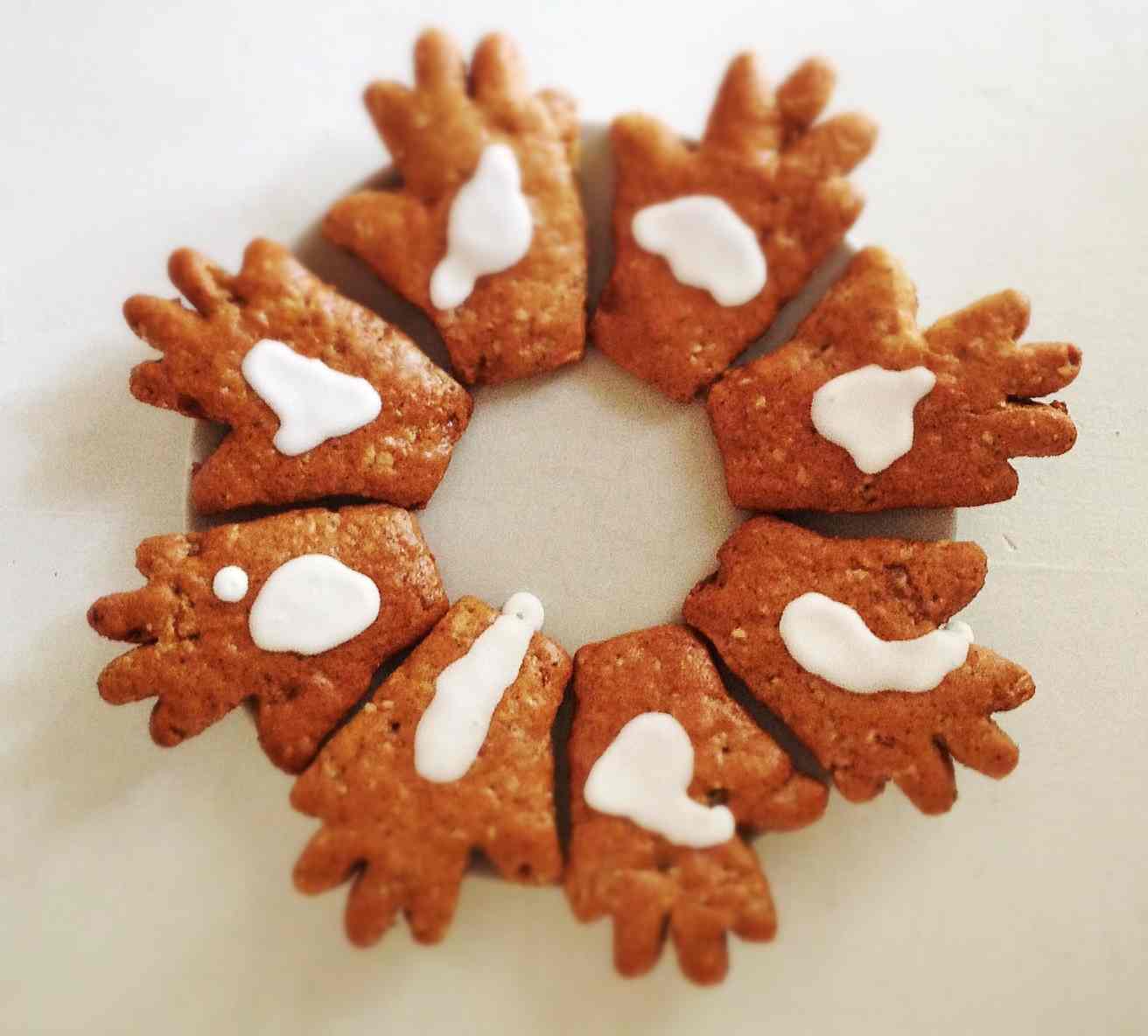
Royal icing is one of the traditional decorations for these cookies and I doled it out in blocks, lines, stars, and other shapes on the thick slabs I made with half the batch and on the thinner stars, gingerbread men, and open-palmed hands. A little bit of rum in the icing isn't a bad thing. Alton Brown has as good a recipe as any. He uses vanilla extract, but a similar amount of lemon juice or —my choice — rum also works to loosen and flavor the icing.
For those who can read the old German script, here's the recipe:
 |
| Gunter glieben glauchen globen. Doesn't make any sense to you? Check out below. |
And if reading that doesn't come easily to you, here is my transliteration and adaptation for modern kitchens. The text of Frau Nietlispach's recipe follows for those who like to check against the original.
Elisenlebkuchen
(Rowley )
½
pound honey
½
pound sugar
100
g pork lard
1-1.25
pounds flour
½
pound peeled and grated sweet almonds
125
g finely cut mixed candied citron and orange peels
2
eggs
4 g
each of ground cinnamon, ground cloves, cardamom
15
g of potash (potassium carbonate, 2.5 tsp), dissolved with 2 Tbl of rum
4 g
hartshorn (ammonium carbonate, 0.75 tsp) dissolved with 2 Tbl of rum
Let
the honey, sugar and fat boil in a pot. In the bowl of a stand mixer combine
the spices, almonds, and one pound of the flour. Carefully add the hot honey
mixture and mix slowly to blend. Then add the eggs, potash, and ammonium
carbonate and continue mixing until the dough is smooth and shiny. Add
additional flour if necessary to achieve a dough that’s just barely tacky to the
touch.
Let
it rest, covered with plastic wrap, overnight in the refrigerator.
When
you are ready to cook, heat the oven to 350°F. Roll
out the dough, using flour as necessary to prevent sticking, in large slabs [5-10mm
thick] and cut into rectangles about 8 x 5 centimeters or round cakes roll
about 5mm and cut into shapes with cookie cutters.
Line a cookie sheet with parchment paper a silicone baking mat. Transfer individual
cookies to the sheets. Bake slabs 18-20 minutes or cut-out shapes 12-25 minutes.
Transfer to a wire rack to cool. After cooling, coat them with different glazes
to such as chocolate, sugar and raspberry glaze and decorate each cakes differently:
with [royal icing], finely chopped almonds, colored granulated sugar
(nonpareils), chopped, green pistachios, halved almonds, etc. [As an alternate
to lining cooking sheets] before baking, you can put the cookies on Oblaten [baking wafers].
Elisenlebkuchen
(Nietlispach)
1/2 Pdf. Bienenhonig, 1/2 Pdf. Zucker, 100 g Schweinschmalz, 1 Pdf. Mehl, 1/2 Pdf. geschälte und geriebene Süß Mandeln, 125 g feineschnittenes Zitronat, 2 Eier, 4 g gemahlener Zimt, Nelkenpulver, Kardamom, 15 g Pottasche, 4 g Hirschhornsalz, beides in etwas Rum aufgelöst — Honig, Zucker und Fett laßt man aufkochen, fügt Gewürze, Mandeln und Mehl zu dem heißen Honig, verrührt gut und kochen. Dann kommen Eier, Pottasche und Hirschhornsalz dazu, worauf man den Teig sehr gut verkneten muß. Ist er glatt und blank, rollt man in aus, sticht große, runde Kuchen aus und bäckt sie aus gefettetem Blech schnell bei guter Hitze. Nach dem Erkalten sind sie mit verschiedenen Glasuren: Schokoladen-, Zucker- und Himbeerglasur zu überziehen und jeder Kuchen anders zu garnieren: mit feingehackten Mandeln, buntem Streuzucker (Nonpareilles), gehackten, grünen Pistazien, halbierten Mandeln ufw. Man kann die Kuchen vor dem Backen auch auf Oblaten legen.
Goes well with:
- Elise Hannemann's Liverwurst, another old German recipe from the library here.
- Ginger comes up a lot at the Whiskey Forge. From Soulless Ginger Lemonade to Kentucky Mules, check out some of the other recipes.
- Want to make your own lard at home? It's easy as pie. Easier, even. Here're directions.
- Look for potash (Pottasche) and hartshorn (Hirschhornsaltz) among the baking ingredients at grocers catering to a German clientele; the brand I use is Alba Gewürtze. No German delis in your neighborhood? Try ammonium carbonate and potassium carbonate from GermanDeli.com.
Wednesday, December 5, 2012
Happy Repeal Day
In quite literally the last days of the 20th century, a hundred or so of us gathered in an old VFW hall just outside Chicago. My old friend Eric had gotten married and we were there to celebrate. On the wall behind the bar were pinned decades worth of yellowed and stiff permits allowing alcohol to be served for one-time events; weddings, Christmas parties, holidays.
 |
| Because you can: have a drink. |
Bar man and blogger Jeffrey Morgenthaler puts the importance of the date succinctly:
On December 5th, 1933, Utah, the final state needed for a three quarters majority, ratified the 21st Amendment, repealing Prohibition and restoring the American right to a celebratory drink.And so we did celebrate that day, first with Champagne and later with gin and tonic (which later still led to what became dubbed the Pants Dance). He goes on:
The thirteen years of Prohibition were a dark time for the United States, as the criminalization of alcohol led not only to a rise in civil delinquency and organized crime, but also to the loss of customs associated with the production, preparation, and consumption of alcohol.
We celebrate Repeal Day because December 5th marks a return to the rich traditions of craft fermentation and distillation, the legitimacy of the American bartender as a contributor to the culinary arts, and the responsible enjoyment of alcohol as a sacred social custom.So you don't know Eric and don't give a damn about his anniversary? There's still Repeal Day to celebrate. How, though? Why, it couldn't be easier: have a drink. Morgenthaler lays it out:
There are no outfits to buy, costumes to rent, rivers to dye green. Simply celebrate the day by stopping by your local bar, tavern, saloon, winery, distillery, or brewhouse and having a drink. Pick up a six-pack on your way home from work. Split a bottle of wine with a loved one. Buy a shot for a stranger. Just do it because you can.For more, check out www.repealday.org.
Friday, November 30, 2012
Whisky Advocate Runs Feature Story on White Whiskey by...Oh, Hey. Me.
You have to look at white whiskey
on its own merits.
If you judge it
compared to aged whiskeys,
it fails.
Every time.
~ Darek Bell
Corsair Artisan Distillery
 |
| Shea Shawnson pours Double and Twisted light whiskey at Elixir |
As grain spirits come off the still, in- dustry insiders call the heady, limpid distillate new make or white dog. Every whiskey distiller in the world makes it and almost all of it is destined for barrels. Some, though, trickles out to the public. Lately, distillers and consumers alike have taken to calling it white whiskey. Marketers trumpet it as a hot new thing. In truth, the wheel has been around longer. And fire, of course. But new make was old hat when Johnnie Walker took his first wobbly steps.
What is novel is that until about 2005, few dreamt a market still existed for the stuff.My travels brought me up the west coast of the United States. From tiny sheds up dirt roads to a distillery in an old Air Force hangar, I met with men and women making, selling, drinking, and mixing white whiskeys.
Bars and restaurants from New York to Seattle offer white whiskeys as a matter of course, even pride. White Manhattans and albino Old Fashioneds abound. If whiskey cocktails unblemished by oak are insufficiently exotic, trendy tipplers can ask for them “improved” 19th-century style with a few dashes of absinthe.
Despite growing awareness and acceptance, the category is dogged by three recurrent questions. Two are worth addressing in passing: (1) Is white whiskey moonshine? and (2) Is it any good?I tackle those in about 500 words, but the third question, the one people should be asking and which fills the bulk of the article, is what do we do with it? Pick up the Winter 2012 issue of Whisky Advocate for some of the answers — including arguments that the way many white whiskeys are made is completely wrong — or download a PDF of It's a Nice Day for a White Whiskey here.
Interviews, insight, and recipes from Thad Vogler of Bar Agricole and Shea Swanson of Elixir in San Francisco, Darek Bell of Corsair Artisan Distillery (and author of Alt Whiskeys), Jim Romdall of Vessel in Seattle, Ian and Devin Cain of American Craft Whiskey distillery, barber and distiller Salvatore Cimino, 13th generation master distiller Marko Karakasevic from Charbay, and, midwife to the modern tiki renaissance, Jeff "Beach Bum" Berry.
Here's a bonus recipe that didn't make the article from bartender Rhachel Shaw whom I ran into as a customer at rum bar Smuggler's Cove. Shaw pays tribute to Elizabeth Taylor (whom one can only presume guzzled staggering quantities of raw whiskey) with a drink named for the late movie star's perfume:
White Diamonds
1.5 oz. Koval Chicago Rye
.75 oz. Cocci Americano
.5 oz. Maraschino
1 dash Bitterman's Grapefruit Bitters
Stir on ice. Strain. Garnish with grapefruit peel.
Monday, November 26, 2012
Crispy Moonshine Onion Rings

Alcohol in pastries is nothing new. We’ve seen, for instance, that Polish Mardi Gras doughnuts known as paczki are sometimes made with vodka and pie crust recipes using vodka have been floating around for years. It’s not there as a flavoring or to get eaters drunk; vodka can discourage gluten formation in pastries, lending a crisp and flaky texture.
Lang is co-owner of the Original Moonshine brand which is why he specifies it but, as we all know, isn't actual moonshine. Not a value judgement; just a statement of fact. If you have some, use it. If not, you can easily substitute vodka, genuine moonshine, home-distilled neutral spirits, or any one of the lighter "white" whiskeys on the market. You can use mature whiskeys or even brandies — just be aware that they'll impart flavor you may not want in your onion rings.
The verdict? Yep; they are crispy and tasty. Break out the ketchup, malt vinegar, and aioli. Just be sure to eat these little buggers while they're hot because even when they're crispy, cold onion rings are best left for dogs and stoners.
Crispy Moonshine Onion Rings
8 cups peanut oil
3 large Spanish onions cut into ½”-thick slices and separated into rings
1 cup milk
2 cups all-purpose flour
2 teaspoons sea or kosher salt
plus more for sprinkling
2 teaspoons freshly ground
black pepper
Batter
4 large egg whites
1 c Original Moonshine, clear corn whiskey, or vodka
2 c cornstarch
2 tsp sea or kosher salt
2 tsp freshly ground black pepper
2 tsp cayenne pepper
About 4 cups panko crumbs
Heat the oil to 350°F in an 8-quart pot. Meanwhile, put the onions in a large bowl and pour the milk over them to moisten them; drain.
Put the flour in a large sealable plastic bag, add the salt and pepper, and shake to mix. Working in batches, add the drained onion slices to the flour, seal the bag, and shake vigorously to coat the slices, then spread on a baking sheet.
For the batter, whip the egg whites to soft peaks in a large bowl. Fold in the moonshine. Sift the cornstarch, salt, black pepper, and cayenne over the egg whites and fold in gently.
Spread the panko crumbs evenly on a baking sheet. Line another baking sheet with paper towels.
Working in batches, add the onion rings to the batter, then, one at a time, toss onto the panko crumbs and flip over to coat with crumbs; repeat until you have filled the baking sheet with a generously spaced layer of onions.
One by one, drop the coated onions into the hot oil, without crowding, and cook until golden brown, 3 to 4 minutes. Remove with a spider or slotted spoon, transfer to the lined baking sheet to drain briefly, and sprinkle with salt, then transfer to a mesh cooling rack (this will prevent the onion rings from becoming soggy). Repeat with the remaining onion rings and serve.
Adam Perry Lang (2012)
Charred & Scruffed: Bold New Techniques for Explosive Flavor on and off the Grill
280 pages (paperback)
Artisan
ISBN: 1579654657
$24.95
Goes well with:
- Even the Ten Dollar Whore Sneered at Me — make-believe moonshines and white whiskeys have become darlings of distillers and drinkers alike in the last six years, but it wasn't that long ago in New Orleans that they could raise another response entirely.
- It's a Nice Day for a White Whiskey — including video of newbies trying to drink the stuff
- Just Some Ice Cubes, My Good Man — white whiskey at New York's 21 Club.
Sunday, November 25, 2012
Ernie Button's Vanishing Single Malt Scotch
Put that back. You can't just take any crap.
Now. Single malt, 16 year old, taut, full flavor, warmer, not aggressive.
Peaty aftertaste.
Takes out the fire but leaves in the warmth.
~ Frank (Brendan Gleeson)
28 Days Later
 |
| Abelour 103 |
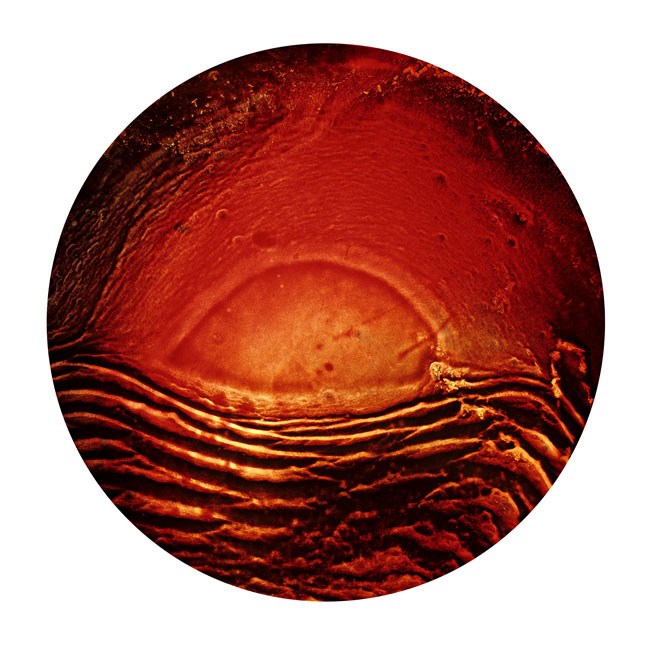
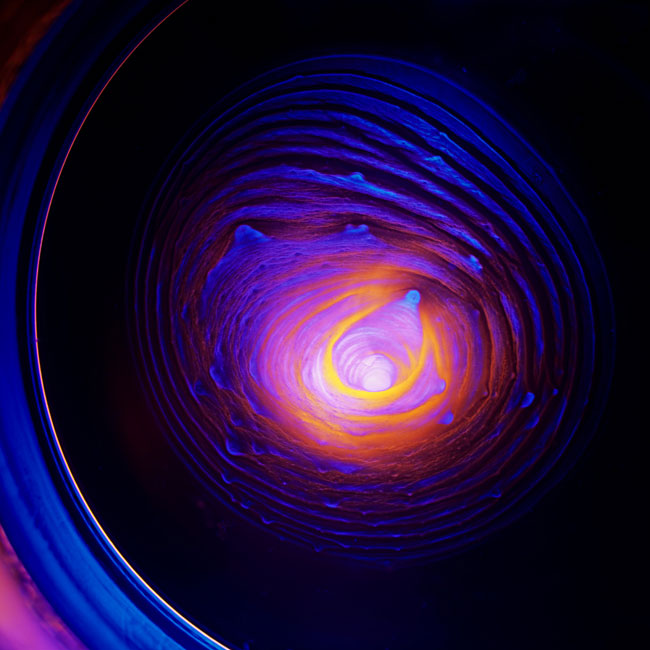
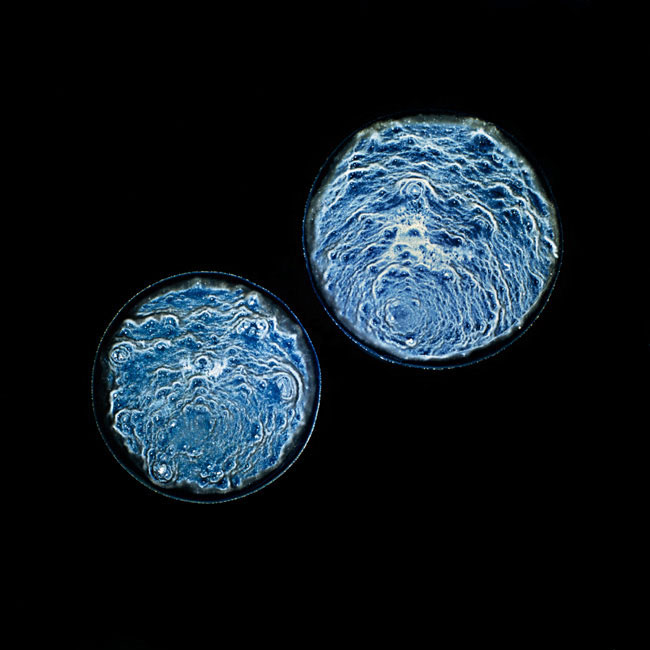
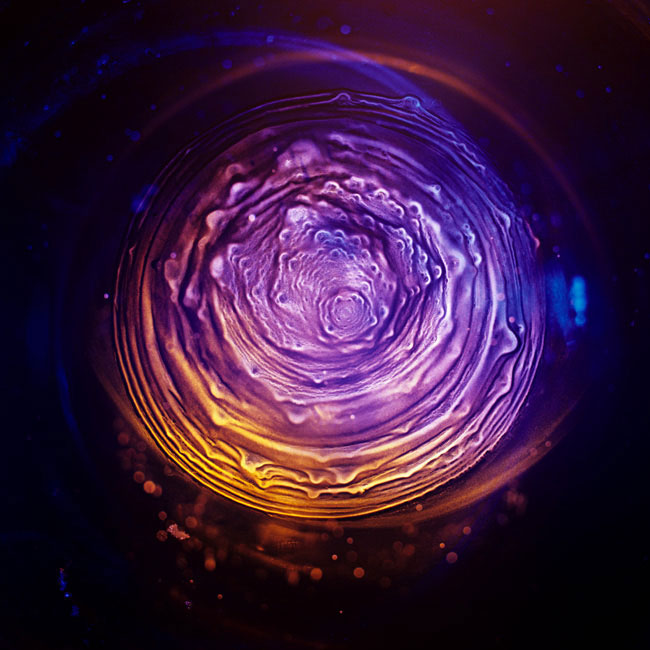
What I found through some experimentation is that these patterns and images that you see can be created with the small amount of Single-Malt Scotch left in a glass after most of it has been consumed. The alcohol dries and leaves the sediment in various patterns. It’s a little like snowflakes in that every time the Scotch dries, the glass yields different patterns and results. I have used different color lights to add ‘life’ to the bottom of the glass, creating the illusion of landscape, terrestrial or extraterrestrial. Some of the images reference the celestial, as if the image was taken of space; something that the Hubble telescope may have taken or an image taken from space looking down on Earth. The circular image references a drinking glass, typically circular, and what the consumer might see if they were to look at the bottom of the glass after the scotch has dried. A technical note about this project. The images were titled with the specific Scotch that the rings were created with. The number is a 3 digit number that has nothing to do with the age of the scotch. Merely a number to help differentiate between images.
To my eye, Button's vanishing single malt images look as much like photos taken from celestial telescopes or by undersea Arctic explorers than they do photos of something so warm, comforting and homey as single malt Scotch. A link to the project in his portfolio is below.
 |
| glenlivet-137 |
 |
| Balvenie 125 |
 |
| Specimen - Glenfiddich 15 |
 |
| Macallan 103 |
 |
| Dalwhinnie 122 |
Goes well with:
- Photographer Ernie Button's series, Vanishing Spirits – The Dried Remains of Single Malt Scotch.
- The Purpose of Good Liquor, in which I ship out a bunch of nice Scotch for no other reason than it would make someone happy.
Wednesday, November 21, 2012
Our Creeping Ruralism
For some years in the 1980's, I volunteered at the Lakeside Nature Center, a rehabilitation refuge for Missouri wildlife. There, I helped feed and care for possums, owls, rattlesnakes, falcons, turtles, eagles, and a host of injured animals that needed to recuperate before being released. A few, such as Bubo, the blind great horned owl, were unable ever to return to the countryside. The thing is, "the countryside" in this case was Kansas City; over two million people lived within a twenty minute drive in any direction. Back then, identifying fox tracks and owl pellets in the wooded parts of town felt like possessing some secret knowledge. No matter how tall our buildings, I realized, "the country" is right there in their shadows.
Only now, the country is coming out of the shadows. And it's not just because Americans have a growing awareness of untamed animals in our midst. People are actively cultivating rural sensibilities in cities. In a search for sustainability, self-reliance, and a growing concern to know the origins of their foods, homeowners are uprooting lawns — both front and back — to install edible gardens. Some have begun raising modest numbers of livestock like chickens, rabbits, honey bees, and goats (San Diego has a new ordinance; one may own two goats — no more, no fewer). Pickling, jam-making, and meat curing classes are the hot new thing and where better for alumni of these classes to sell their surplus than at local famers' markets that are cropping up like field mushrooms? Writing in The Gaurdian, Paula Cocozza makes clear that this creeping ruralism is not confined to the United States:
"Look," I interrupted. "Here's the deal. If it doesn't end up on my plate or in my glass, I don't want it in my yard." She froze, hand in mid-gesture. "OK. Message received." Then she smiled: "Where in the country are you from?"
Where in the country? Why, Southern California, of course.
While we figure out the plant situation at the Whiskey Forge, check out David Mitchell (in a bit for The Mitchell and Webb Situation) after he gets bit by the farming bug and cannot believe the money to be made at it:
Goes well with:
 |
| Fuckin' 'ell! David Mitchell goes farming (video below) |
Everywhere you look, the countryside has crept into cities and towns – the way we shop, eat, read, dress, decorate our homes, spend our time. Street food is sold out of revamped agricultural trucks, or from village-delivery style bicycles. City-dwellers are booking into a growing number of courses on rural life; urban bees and chickens are commonplace (though do keep up: ducks are where it's at now). And when Rebekah Brooks wanted to get the prime minister's attention? "Let's discuss over country supper soon."Of course, as the guy who penned a how-to guide on home distilling, it's probably no surprise that I'm right along with them. When we met recently with a landscaper who tried so hard to push for succulents all over the property, she pushed back when I said they weren't for me. "They're drought-resistant," she explained. "They'll grow in your soil..."
"Look," I interrupted. "Here's the deal. If it doesn't end up on my plate or in my glass, I don't want it in my yard." She froze, hand in mid-gesture. "OK. Message received." Then she smiled: "Where in the country are you from?"
Where in the country? Why, Southern California, of course.
While we figure out the plant situation at the Whiskey Forge, check out David Mitchell (in a bit for The Mitchell and Webb Situation) after he gets bit by the farming bug and cannot believe the money to be made at it:
Goes well with:
- A trip to the Lakeside Nature Center in Kansas City.
- The new ruralism: how the pastoral idyll is taking over our cities, Paula Cocozza's piece from The Guardian.
- I've Never Eaten Paw Paw, a look at some of the fruit tree choices I'm weighing for the yards, including paw paw, a fruiting tree of my native Missouri that sometimes has a...distinctive...odor.
Monday, November 19, 2012
Alistair McAlpine, Chuck Cowdery, and the Distiller of the Year
In his 1992 book, The Servant, Alistair McAlpine espoused unswerving commitment to both a Prince and an idea — an idea so powerful that it is the Idea. Now retired from political life, Lord McAlpine held the office of treasurer and Deputy Chairman of Britain's Conservative party and was a close advisor to Margaret Thatcher. The Servant is his complementary riposte to Nicolo Machiavelli's The Prince and a fascinating read on the motivations and machinations of a ruthless, amoral fanatic.
 I was reminded this morning of one of McAlpine's maxims while reading Chuck Cowdery's recent piece on Wine Enthusiast magazine naming Michter's Distillery Distillery of the Year. In a line that has been embedded in my brain for the better part of twenty years, McAlpine opined:
Goes well with:

In order to establish in the Prince's mind that the Servant is a specialist, it is important for him to comment only on his subject, and to assert, when asked of other matters, "I know too little to be of help."This is, as is much of McAlpine's advice, disingenuous or at least a facet of the duplicitous public persona, the myth, a Servant must forge. A Prince's Servant after all exerts considerable influence, even in those fields for which he professes ignorance. But the sentiment is at the heart of Cowdery's beef with Wine Enthusiast. The problem, as he explains, is that the wine enthusiasts stumbled when they ventured into the unfamiliar realm of spirits. In fact, the modern brand Michter's is not a distillery — though a Pennsylvania distillery did once bear that name. It is that bugbear of brands laying claim to being actual distilleries to which the spirits writer has taken great exception over the last few years, a marketing creation he dubs a Potemkin Distillery. Writes Cowdery:
Michter’s today is what is known as a Potemkin Distillery. The façade is quite elaborate. They even have a person with the title of master distiller. His resume includes Brown-Forman, a major distillery owner and operator, except he wasn’t a distiller there. Wine Enthusiast Spirits Editor Kara Newman claims that Michter's is a distiller even though she acknowledges they “don't have their own brick-and-mortar facility.”
“Like a great many smaller producers,” she insists, “they have used stills at other facilities.” Newman claims that Michter's “selects the mash bill, yeast, etc. and oversees the physical distillation and other production details, right down to figuring out the best bottling strength and aging times.” From this she concludes that Michter's “is not working with whiskey made by anybody else.”
What she describes is a fanciful explanation of contract distilling, but it’s doubtful Michter’s even does that much. More likely they buy bulk whiskey, selecting from whatever is available. The whiskey Michter’s sells is good and making those selections is an important job, but it’s not distilling.Read the rest of Chuck's piece — How Can A Non-Distiller Be Distiller Of The Year? — and his explanation of why such a move offends some here.
Goes well with:
- Cowdery is not the only one to note that many modern spirits brands hide behind non-existent distilleries, but he did bestow upon them the fitting moniker "Potemkin" distillery. Here's his thinking behind the name.
- The Faber & Faber edition — my introduction to McAlpine's writing — of The Servant is out of print, but it is reproduced along with The Prince and Sun Tzu's The Art of War in the edited volume The Ruthless Leader: Three Classics of Strategy and Power (ISBN: 471372471, Wiley, $36.50).
Subscribe to:
Posts (Atom)