Monday, April 30, 2012

Rip It. Dip It. Sip It.

When people ask me "Who do you write for?" my stock and somewhat glib answer is "Whomever pays me." The food and drink jobs undeniably are some of the most fun work, but I write and edit for physicians, politicians, film directors, governments, universities, museums, other authors...if there's a paycheck involved, we're halfway there.

Through it all, I drink tea. Hot tea, iced tea, Assam, Earl Grey. If it's Camellia sinensis, I'm in. Now, when I'm at the keyboard, I myself am never bothered by thoughts that drinking all this tea is somehow unmanly, some effete affectation. I do, however, understand that lesser men occasionally may be plagued by such doubts. For them, I offer a short video and words of inspiration: Empires will fall! The steam will rise!

Are you man enough to watch?


Goes well with:

Saturday, April 28, 2012

Tales of the Cocktail Update. I'm Out; Rupf and Heugel Are In

Missing a Tales of the Cocktail weekend is not something I do lightly. Yet for the first time in years, I'm out. Whether I'm at the podium or in the audience, the annual fête in New Orleans has been one of my must-do events for almost a decade. If you look at the schedule for this year's sessions, you will find me listed once again as a presenter, this time with Paul Clarke of Imbibe magazine and the Cocktail Chronicles.

Well, grab onto your seats, kids — the lineup just changed. The session on American non-grape brandies is still on, but if you've already bought a ticket with hopes of seeing me in New Orleans, you just got an upgrade; Paul will be joined by not one but two others on the mic.

Bobby Heugel of Anvil
First up is Houston bartender Bobby Heugel, co-owner of Anvil Bar & Refuge. Bobby will be on hand to offer the thirsty crowd brandy-based libations and a bar owner's perspective on using these American fruit spirits. We've mentioned him before for his rum, Averna, buttermilk (yeah, buttermilk), and Chartreuse cocktail, the Vanderbilt Fugitive.

Jorg Rupf and Lance Winters next to an Arnold Holstein
Paul and Bobby will be joined by pioneer California distiller Jorg Rupf. Rupf founded St. George Spirits in Emeryville, California in 1982, twenty-five years before most of today's distilleries even existed. His masterful eaux de vie are exemplars of the craft and have racked up award after award. Twenty years after the founding of the distillery, he and distiller Lance Winters blended American wheat and viognier grapes to create a new vodka they dubbed Hangar One.

You may have heard of it.

Rupf is now officially retired. But some people just can't leave work behind when they call it quits; we are pleased that he still has some skin in the game and will be sharing over three decades of distilling knowledge.

Regrettably, a conflict has arisen that precludes my joining this august triumvirate in New Orleans. A shame. It sounds fantastic.

Wednesday, April 25, 2012

Cinco de Derby

Pool season is creeping up on us. Party invitations are starting to trickle in. Haven't thought at all about what to wear, but I'm already planning out the drinks menus — and polishing my drinking silver. One of the first harbingers of San Diego's pool season is Cinco de Mayo. This year, it falls on Derby Day, a holiday lesser-observed in these coastal environs, but dear to my own heart. The confluence of the two form a sort of Cinco de Derby that only happens once every few years.

¡Viva la Revolución, y'all!
Now, Derby Day — for our friends beyond the shores of these United States — is the final day of the two-week Kentucky Derby Festival held in Louisville, Kentucky every year. It is the day on which the Kentucky Derby is held and when a great deal of money changes hands depending on whose pony is fastest. One is apt to see enormous hats on the women, much linen and seersucker on the men, and enormous quantities of bourbon consumed by each.

Cinco de Mayo, as it's observed in the US, is a sort of general celebration of Mexican heritage; it is not, as many would have you believe, the Mexican Independence Day. Rather, it's a commemoration of the French army's defeat at the hands of the Mexicans at Puebla in the latter part of the nineteenth century.

And this year, they each fall on Saturday, May 5th. At Derby Day parties throughout the country, a galling number of execrable mint juleps will be downed (and sometimes hauled back into the light of day) and inordinate amounts of tequila will be shot into (and out of) the drinking pubic. May 6th might as well be I'm Never Drinking Tequila Again Day.

Let' us leave behind the overdrinking occasioned by both and bind the holidays with a slightly more civilized glue: the tequila julep.
Tequila Julep

2 oz reposado or añejo tequila
1 Tbl agave nectar OR 1-2 tsp rich simple sugar (made with 2 parts demerara sugar to 1 of water)
10-12 spearmint leaves, stripped from their stems
Sprig of mint
Crushed ice

Muddle the mint gently with the syrup in the base of a julep cup or a short tumbler. Add the tequila and stir to combine. Top with crushed ice to fill the cup and form a short dome over the rim. Spank the mint against the palm or back of one hand (to help release its aroma), then insert the sprig through the ice into the drink. If using metal julep cups, allow the drink to rest undisturbed until its exterior is well frosted.

Serve either with short metal straws or plastic straws that have been trimmed to just an inch or so longer than the cup is tall — the idea is that drinkers will have to bury their noses in the fresh leaves while drinking and thus get a extra wallop of mint aroma.
You're on your own for anything after the first.

Goes well with:
  • The Maine Julep, Irvin S. Cobb's derisive, Kentuckicentric tirade against what passes for a julep in points north, including a "crowning atrocity" of allspice.

Tuesday, April 24, 2012

When I Say Oo, You Say Long

I've slurped up a cuppa from an elephant's trunk 
With a couple of monks who utterly stunk 
I've had bourbons with sultans and creams with queens 
And I've bathed in Earl Grey — I'm really that keen.

And missionaries dismiss me for my single epiphany
The diff between him and me is a simple sip of British tea! 
So when times are hard and life is rough, 
You can stick the kettle on and find me a cup.

~ Professor Elemental

My idiocy reveals itself in stages. Casual acquaintances may, if my guard is down, catch a glimpse of this rare creature, but it's not generally on display. They do not know, for instance, that when my attention flags (or I'm under deadline), I take on the personalities of others. I'll sing the theme song for the 1980's television show The Facts of Life, for instance...in the style of Tom Waits. Or I'll pull a deadpan exsanguination of Jingle Bells, draining it of life and joy as only Jeremy Irons can do. Just this weekend, I could not shake the image of Joe Pesci recast in the role of the android Bishop in Aliens ("You ast me, them A2s always was a little twitchy.") nor of Don Rickles as Lt. Ellen Ripley ("Get away from her, you hockey puck!").

But that all pales to the vocal styling of Professor Elemental. Here, the pith-helmeted Professor gets a little steampunk and throws down Victorian rhymes in Cup of Brown Joy.


Goes well with:
  • Professor Elemental's website. 
  • At the end of the video, you'll note that the good Professor is off for a bit of Battenberg. Some what? Is it bitters akin like Underberg? No; it's cake, a very British checkerboard cake. Robert L. White explains.
  • My own obsessions over the brown stuff (iced? hot? buttered? in punch?) are well established.
  • Also noting his fondness for tea, and akin to Professor Elemental, check out Mr. B, The Gentleman Rhymer strumming his chap hop ukelele in a 2008 performance. Be warned, however, that the rivalry between the two is legendary.

Sunday, April 22, 2012

Weekend Grillades and Grits

I dote on grillades. Whenever I'm in New Orleans, I try to squeeze in at least one meal of the long-simmered veal — or sometimes pork — slices served over grits. Even, as it occasionally happens, if they're dished out over plain buttered rice, they're a fantastic way to ease a languid morning into a lazy afternoon.

Elizabeth's in the Bywater neighborhood serves a respectable, chunky version (get a side order of praline bacon). Any number of places in the French Quarter serve them; Green Goddess, for instance, or Arnaud's. EAT New Orleans, just a block down from Good Friends (site of the notorious Chicken Drop from Chickenshit Afternoon), is another good one.

Perhaps the best, though, I ever had was when chef (and James Beard Award winner) Ann Cashion cooked a batch one morning when we were in town for Carnival. Cashion was visiting as well and she cooked up a stunner of a New Orleans breakfast for a group of mutual friends. A pot of stone-ground grits burbled and plopped quietly to one side of the stove while a huge old Magnalite oval roaster held  perhaps two gallons of long-simmered chunks of tender meat in a dark brown sauce.

Yeah, yeah. Yellow grits was all I had. Still good.
It is possible, though not likely, that Ann, too, will come to your house to cook grillades. In the event that she doesn't, I have a solution that's a very good second choice and that still puts smiles on my family's faces. In fact, they've been observed moaning barely articulate sacrilegious oaths while tucking into broad bowls of the grillades I make at home. 

When there's a crowd to feed for a weekend breakfast and I want to get a taste of New Orleans, I work up a big batch of grillades that's based on John Besh's door-stopper of a cookbook, My New Orleans. Besh calls for boneless veal shoulder, a traditional choice. Slightly adapted from his, here's how we're making grillades around the Whiskey Forge.

That is, at least until Cashion comes a'calling and takes over my stove while I mix drinks.
Slow-Cooked Grillades

4 pounds boneless pork [or veal] shoulder, sliced into thin cutlets
Salt
Freshly ground black pepper
2 cups flour
2 teaspoons basic Creole spices
¼ cup rendered bacon fat
1 large onion, diced
1 stalk celery, diced
1 red bell pepper, diced
2 cloves of garlic, minced
2 cups canned whole plum tomatoes, drained, seeded, and diced
2 cups basic chicken stock
leaves from one sprig fresh thyme
1 teaspoon crushed red pepper flakes
1 bay leaf
1 tablespoon Worcestershire
Tabasco*
Two green onions, chopped
Prepared grits

Season the pork cutlets with salt and pepper. Whisk the flour together with the Creole spices in a medium bowl. Dredge the cutlets in the seasoned flour and shake off excess. Reserve a tablespoon of seasoned flour.

Melt the bacon fat in a large skillet over high heat. Fry the cutlets, several at a time, until golden brown on both sides. Take care not to overcrowd the skillet. Remove cutlets from skillet and continue to cook in batches until all the pork has been browned. Set the pork aside while you continue making the sauce.

Reduce the heat to medium-high, add onions to the same skillet, and cook, stirring with a wooden spoon, until they are a deep mahogany color, about 20 minutes. Add the celery, bell pepper, and garlic, reduced the heat to moderate, and continue cooking, stirring often, for about 5 minutes. Sprinkle the 1 tablespoon of reserved seasoned flour into the skillet and stir to mix it into the vegetables.

Increase heat to high, stir in the tomatoes and stock, then cook until it comes to a boil. Reduce the heat to moderate and stir the thyme, pepper flakes, bay leaf, and Worcestershire into the vegetables. Add the pork cutlets, cover, and simmer until the feel is fork tender, about 45 minutes.

Season with salt, pepper, Tabasco, then add the green onions. Serve over grits.
 *Besh serves this over cheese grits flecked with jalapenos and calls for Tabasco. We go for Cholula hot sauce and, like Cashion, omit the jalapenos. Normally, I use white grits, but today all we had were yellow. Still very good.

Goes well with:
  • Long-simmered stone-ground grits are what you want here. Anson Mills will ship theirs right to your door. My advice? Save on shipping by ordering ten pounds and split the costs with a friend or two.
  • Don Rockwell has an online AMA-type interview with Cashion here.
  • John Besh's My New Orleans is not the last word on New Orleans cooking. But it's an excellent place to start. I drop a few plaudits on his book is here.
  • Sara Roahen's Gumbo Tales is a must for understanding food and local mentality in post-Katrina New Orleans.

Wednesday, April 18, 2012

John Wright's Homebrew from the Hedgerow Series

My "May blossom rum" is simply hawthorn blossoms, 
covered with white rum and left in a jar for a week. 
The petals are removed and the result bottled. 
The flavour and bouquet is almost exactly that of 
May blossom itself with a surprising 
overtone of almonds.

~ John Wright

John Wright’s niche is foraged food and he has penned a number of handbooks for the British market on his expertise in the field, including The River Cottage Hedgerow Handbook, Edible Seashore, and Mushrooms. But last year, he launched a column for The Guardian that keeps me coming back again and again. In it, he covers country wines, local liqueurs, backyard apéritifs, and other hedgerow homebrews close to my heart.

Recently, he’s explored smoked vodka. Ok, maybe that’s not to everyone’s taste. But his DIY solution involving a can, some tubing, and sawdust is readily replicable and can be applied to a variety of spirits. His earlier piece on the sea buckthorn fizz made me remember that, while we don’t seem to have sea buckthorn around these parts, a store nearby carries liter cartons of the requisite juice which I nabbed within the hour.

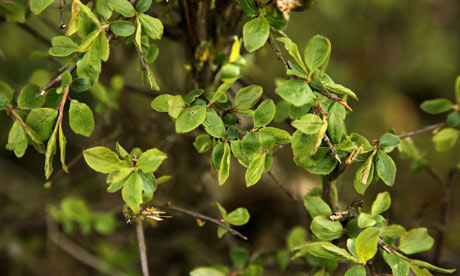
Blackthorn leaves. Photograph: John Wright
Americans will quibble over — and flat-out disagree with — some of Wright’s pronouncements. When he writes, for instance, that white rum has “no real flavour of its own,” let’s cut the man some slack. He is a forager, after all, and not a bartender or boozer whose job it may be to identify any number of white rums in blind tastings. But his takes on orange beer, parsnip wine, rhubarb wine, chestnut liqueur, cider, blackberry whiskey, dandelion and burdock beer, and so much more have inspired me to pay closer attention to the seasons here in San Diego and what’s flowering and fruiting when in the parks nearby. Lemons, grapefruit, and rosemary are everywhere here; it's the keen eye that spots rose hips, lemonwood flowers, and feral nasturiums, just there for the taking.

From his most recent article, here’s Wright’s verbatim scaled-down version of épine, a French aperitif that’s a very close cousin to sloe gin since it uses the leaves of the blackthorn bush rather than the sloe fruits familiar to us. We are told that in France friends of his friend who supplied the recipe are ignorant of sloe gin and leave the fruits to rot on the shrubs. Sacré bleu!
Épine apéritif
2½ litres of red wine or homemade red fruit wine such as blackberry or elderberry
Half a bottle of brandy or eau-de-vie
500g sugar
About half a litre of blackthorn leaves (don't use more leaves than I recommend because blackthorn, like all the plum species, produce traces of cyanide as a byproduct of the almond flavour it imparts)
Put all the ingredients into a food quality plastic container, stir and fit the lid tightly. Leave for two weeks, stirring occasionally. Transfer to clean bottles using a funnel and some doubled-up muslin cloth to filter out the bits. As with nearly all drinks it improves with age. Santé!

Goes well with:
  • The entirety of John Wright’s Homebrew from the Hedgerow series is here.
  • Sloe what? Sloe gin? Yup. Check out what Irish poet Seamus Heaney says about it here. 
  • The River Cottage Preserves Handbook is a great little tome. I write about it here and include a recipe for beech leaf noyau. 
  • About those feral nasturiums. They'll be coming into seed soon enough. Here's a recipe for pickling the pods. 

Monday, April 16, 2012

Moonshine Monday

A new hashtag popped on my Twitter radar today: #MoonshineMonday. So far there's just the smallest trickle of action. In my mind, a proper Moonshine Monday stands a good chance of ending up a bit like this:


But I'm willing to ride this hog and see where it goes. Even if all you can get is the pretend moonshine from the liquor store, you can still join in, but why not knock back a little sub rosa liquor today and see where it leads you?

Sunday, April 15, 2012

The Maine Julep

Derby season is nearly on us and, as every year, readers will be subjected to odes and plaudits for that Kentucky stalwart, the mint julep. Now, my father is a Kentucky Colonel and I myself enjoy a bracing mint julep on occasion; the julep was for years and years the standard drink in our house. But I do not engage in the kinds of blowhard battles over their proper preparation that passed as performance art in years past. Your julep is yours and mine is mine.

Perhaps no greater bullshitter than Irvin S. Cobb waxed (and waxed and waxed) eloquent over the julep, however, any chance he was given. Cobb (1876–1944) was a journalist and humorist — and a renowned drinker. His 1936 pamphlet for Frankfort Distilleries details his supposed encounter with “a criminal masquerading as a barkeeper” that may ring a bell with anyone who’s brushed against particularly florid examples of the craft of modern cocktologists.
And once, in Farther Maine, a criminal masquerading as a barkeeper at a summer hotel, reared for me a strange structure that had nearly everything in it except the proper constituents of a julep. It had in it sliced pineapple, orange peel, lemon juice, pickled peaches, sundry other fruits and various berries, both fresh and preserved and the whipped-up white of an egg, and for a crowning atrocity a flirt of allspice across that expanse of pallid meringue. When I could in some degree restrain my weeping, I told him things. "Brother," I told him, between sobs, "brother, all this needs is a crust on it and a knife to eat it with, and it would be a typical example of the supreme effect in pastry of your native New England housewife's breakfast table. But, brother," I said, "I didn't come in here for a pie, I mentioned a julep; and you, my poor erring brother, you have done this to me! Go," I said, "go and sin no more or, at least, sin as little as possible."
Julep or Pie?
Irvin S. Cobb (1936) Irvin S. Cobb’s Own Recipe Book. Frankfort Distilleries, Incorporated, Louisville.

Goes well with:
  • The Barkeeper's Favorite Weapon, in which New Orleans maestro Chris McMillian wields a massive hammer and recites poetry while mixing a perfectly acceptable, non-pastry, mint julep.
  • Mint Abomination. Ok, maybe I do take offense at some attempts at mint juleps. So does Portland bar man Jeffrey Morgenthaler. Here's a short bit (with video) of how not to do it. Whether or not Woodford Reserve is your go-to whiskey, that's no way to treat a bourbon.

Friday, April 13, 2012

Not Unlike the Dude, Pimento Cheese Abides

Fundamentally, it just feels good in your mouth.
~ Ted Lee

Canned pimentos? Roasted red peppers? Miracle Whip? Mayonnaise? People get mighty particular about their pimento cheese — and profess dismay and horror over some of the variants out there. Pimento what? Pimento cheese? Oh, come off it. You know what pimento cheese is. I ate it as a kid in Missouri and it's so widespread that even the local Trader Joe's carries tubs of the stuff in sunny San Diego.

Early 20th century pimento cheese box, packed for A&P

Regardless of its modern geographic promiscuity, pimento cheese (or minnow or menner cheese or a few other pronunciations) is a touchstone of Southern eating. The spread has been around for a little more than a century and really got a boost when farmers around Griffin, Georgia began growing Spanish pimientos (we usually drop the second "i" in English) in the early 20th century. At its most simple, pimento cheese is a blend of shredded cheddar cheese, cooked red peppers or pimentos, and mayonnaise. After that, things get personal. Shredded or minced onion gets added. Garlic, pickle juice or relish, curry powder, cumin, cilantro, red and black peppers, Worcestershire sauce, and even liquor are not unheard of.

Mississippi pastry maven and chef Martha Foose politely disapproves: "Oh, I've seen so many affronts to pimento cheese through the years."

Foose and others, including Lisa Fain (Homesick Texan), Ted Lee (the bespeckled half of the Lee Brothers), barbecue pit master Carey Bringle, Robert Stehling of Charleston's Hominy Grill, and Jason "Oh, God, No" Alley of the restaurant Comfort in Richmond, Virginia are featured in the short film Pimento Cheese, Please! by documentarians Nicole Lang and Christophile Konstas.

For a look at what the stuff is, where it came from (New York what?), and what it means to some Southerners, check out the film:

Tuesday, April 10, 2012

Bookshelf: Micro-Distilleries in the US and Canada

In 2011, more than 250 craft distilleries dotted the American distilling landscape. Fewer than half of these are listed in David J. Reimer’s 2011 purported guidebook on the same.

Oh, sure, you’ll find profiles on distilleries familiar to modern American drinkers. There’s Tuthilltown, St. George Spirits, Piedmont Distillers, and Celebration Distillation (makers of Old New Orleans Rum). But where are the magisterial brandies of Osocalis? The award-winning peach and pear brandies of Peach Street Distillers? Want to know more about Salvatore Cimino’s game-changing poitin? Look elsewhere. They aren’t here. Clear Creek Distillery, perhaps the original modern American craft distillery, is on page...oh, wait. No. Nevermind. It’s not included. How about the 2012 edition? Nope. Not there, either.

Profiles of distilleries that did make the cut include the name of each, the owners’ names, contact information, websites, social media accounts where applicable, the types of spirits produced, awards, and other details that help to flesh out our understanding of each.

To say that the guide is incomplete — while true — misses the larger point: the book’s value is marginal at best. Missing punctuation, inconsistent layout, and phantom words that appear as if vestiges of earlier versions of the same sentence collude to make it seem as if the manuscript had not been proofread.

The photos and logos are of such low resolution that they give the impression of merely having been lifted from websites. Many very clearly have been. In fact — and here is its most grievous flaw — the feel of the entire book is of one that’s been cobbled together from press releases, newspaper articles, and sell sheets. Readers are treated to chestnuts like this: “Pear Brandy is made from the freshest pears grown in the Hudson Valley.” Why does that seem so familiar? Oh, yeah: it’s lifted nearly verbatim from the website of Harvest Spirits, maker of the brandy in question.

This begs the question: what makes a pear “fresh?” Further, of what value is a fresh pear compared to one that’s less “fresh” (whatever that means)? Here’s a great opportunity to educate readers — just a brief sidebar — on the aging or curing of fruits that some distilleries do before pressing. Apples can be stored before pressing; pears tend not to be. Why?

Don’t look here for the answer (or even the question). Instead, we get uncritical regurgitation of advertising copy.

While I don't know this to be true, there's no sense at all that the author has actually tasted any of the spirits. Yes, there are tasting notes, but they are generic and once more feel culled from others rather than experienced. Recipes for mixed drinks using the spirits are included at many points, but we are given ounces, oz, cups, “parts,” “shots,” and other diverse measurements. This suggests that they were taken at face value from other sources, sometimes credited, sometimes not.

Clip. Paste. Repeat.

A guidebook for American craft distilleries is a fantastic idea, but we don’t have one yet. While I deeply admire many of the companies and distillers profiled in Reimer’s book, my advice to readers interested in the American craft distilling scene is to save your money and download the American Distilling Institute’s far more complete directory (for free; PDF is here) then visit the websites of each distilling company that interests you. I’ll wager you find a lot of the same copy, anyway.

David J. Reimer, Sr. (2011)
Micro-Distilleries in the US and Canada
301 pages (paperback)
Sunbury Press
ISBN-13: 9781934597439
$24.95