Showing posts with label cordials. Show all posts

Thursday, September 26, 2013

Dry Curaçao Ancienne Méthode

Brad Farran's Julius Orange
We like orange liqueurs at the Whiskey Forge. For decades, we’ve relied on those two old stalwarts, Cointreau and Grand Marnier. Cointreau in particular is a workhorse around here. When Mandarine Napoleon showed up on local shelves, I added that to the rotation. Solerno, a blood orange liqueur, is an interesting twist; we like it in cobblers. But perhaps my favorite of the lot is Dry Curaçao Ancienne Méthode from Cognac Ferrand.

Ferrand’s curaçao, a blend of cognac, vanilla, and citrus peels, is based on a 19th century recipe and made in consultation with drinks historian, David Wondrich. The Floating Rum Shack gives the backstory of how the brand came to be. We use it in punches, Mai Tais, with gin, with whiskey. It’s just a beautifully balanced, superbly well-done orange liqueur that’s earned a permanent place on our copper-topped dry sink.

New York bartender Brad Farran gave a recipe for Orange Jul…erm…Julius Orange in a Wall Street Journal piece last summer. I admit; the result is a lot like a boozy version of that shopping mall favorite.

Julius Orange 
2 oz Pierre Ferrand Dry Curaçao Ancienne Méthode
½ oz Cruzan Single Barrel Rum½ oz lemon juice
½ tsp vanilla syrup
½ tsp sugar cane syrup
1 dash orange bitters
½ oz heavy cream
Freshly grated nutmeg 
Combine liquid ingredients in a cocktail shaker, adding cream last. Shake hard with ice. Strain into a rocks glass over crushed ice. Garnish with nutmeg.
Something lighter, without the sugar and cream, is the Alabazam. I pinched the recipe from 19th century bartender William “The Only William” Schmidt and upped the curacao just a bit to really bring it forward. For the original, see his 1891 bartending manual, The Flowing Bowl.
Alabazam 
2 oz brandy
.75 oz lemon juice
.5 oz Pierre Ferrand Dry Curaçao Ancienne Méthode
.25 oz simple syrup
Two dashes Angostura bitters
Soda water (Q or Fever Tree)
Fill a tall highball glass two-thirds with crushed ice. Shake all the ingredients except the soda water with ice. Strain into the serving glass, top with soda, and stir.
Goes well with:

  • If Orange Julius-type drinks get you going, but you'd prefer one without the booze, try Kenny Shopsin's take on them with fresh orange juice, powdered egg whites, powdered sugar, and crushed ice.
  • That cobbler with Solerno I mentioned? It's very nice with Lillet, as served from time to time at San Diego's Polite Provisions. 

Monday, March 18, 2013

Bottling the Pamper Moose: Homemade Vin de Pamplemousse with Bergamot

This year's label
It's been said that San Diego's seasons can be divided roughly into four: Early Summer, Summer, Late Summer, and Next Summer. As local flowers start to bloom, nights remain chilly and one still does see young women wearing hot pants, scarves, and fleece-lined boots, but it's undeniable that Early Summer is on us once more. Summer can't be far off — and with it comes a craving for lighter and more bitter drinks. Whether that bitterness comes from hops, citrus peel, quinine, wormwood, or more esoteric bittering agents, count me in. This weekend I got a leg up on Summer by bottling a faintly bitter grapefruit aperitif for our yard drinks in the coming months.

The vin d'orange, a bitter orange wine I put up last month, is still maturing in big glass jars and will be for another several weeks, but a grapefruit version of essentially the same aperitif, vin de pamplemousse, only took a month to macerate. Yesterday I bottled six liters of the traditional before-dinner drink. The recipe isn't wholly traditional, however. Oh, the grapefruit (pamplemousse in French) is legit. Even the sweet oranges I sliced and threw in to soften the wine a bit wouldn't raise every eyebrow in France. However, I'd gotten my hands on a load of bergamot oranges and included one in the mix, an addition that may cause purists to sniff in disdain. Ah, well. Their loss.

Racked, clear, and bottled: grapefruit wine
Bergamot, tea fanciers know, is a type of sour orange that lends its distinctive, almost lavender-like aroma to Earl Grey tea. The fruit looks a bit like a lemon, but unlike a lemon's, the volatile oils in its skin are so potent that they easily overwhelm food and drink if not treated with care. The juice is mild enough and can be used much like lemon juice, but truly, a small amount of skin or zest goes a long, long way. Two common precautions against its dominance in cooking and preserves making are (a) to use small amounts relative to the other ingredients and (b) to blanch each fruit before use. I chose the former: only one bergamot to every six grapefruit and two oranges.

Even in southern California, bergamots can be hard to track down during their late-winter Early Summer season. If you have access, use one. If not, just toss in an extra sliced grapefruit.

Vin de Pamplemousse with Bergamot

2 white grapefruit
4 ruby red grapefruit
1 bergamot
2 navel oranges
1 2" piece of vanilla bean, split lengthwise and cut into thirds
4.5 L crisp white wine such as Sauvignon Blanc (e.g., Trader Joe's coastal)
750ml 80 proof (40% abv) vodka
1.75 cups/350 g sugar

Cut each piece of citrus into an upper and lower half. Slice each half into half-moon shapes, about 1/4"/6mm thick, saving any juice. Combine all the ingredients (including any juice from slicing) into a single two-gallon/8L nonreactive container with a sealable lid such as a jar or carboy.

Stir or shake it, then allow it to rest in a cool, dark place (a closet is fine: no need to refrigerate). Strain after one month into a similar large container. After one day, rack the cleared liquid off the  cloudy residue at the bottom of the container. Strain this through cheesecloth or other clean filter, and bottle in clean, sterilized wine bottles. Seal with new corks and label. Let rest a few months in a cool, dark place.

Makes about six liters.

Goes well with:

  • That vin d'orange I mentioned. Good stuff. 
  • Each year, I try to make a batch of creme de noyau using crushed peach pits and a recipe from an old, old Creole cookbook. I don't always get around to it, but when I do make some, here's the recipe I use. 
  • If light wines aren't your speed, how about fifty oranges and a gallon of corn whiskey?
  • Fany Gerson's recipe for pasita, a dark raisin cordial from Mexico.
  • Finally, more old recipes: three separate recipes for syrup of violets spanning nearly 250 years. 


Wednesday, February 6, 2013

Making Vin d'Orange with the Last of the Seville Oranges

Now that winter has hit full stride, the citrus offerings could hardly be better. We’ve been making marmalades, lemon curds, desserts, and cocktails with the aromatic bounty. In the kitchen now, I’ve got 5 kilos of navel oranges, a box of Meyer lemons, a bowl of blood oranges, several dozens each of limes and Eureka lemons, a bowl of bergamots — and three Seville oranges.

Those last three bitter oranges may end up as the base for ice cream or a cake. Maybe syrup. Perhaps a tincture. Not entirely sure. I’ll have it figured out by dinner. The rest of them are soaking in wine.

Unlike relatively sweet Washington or Valencia oranges typical of American supermarkets, the rough-skinned Seville oranges are an older bitter/sour variety with limited availability in the US. Centuries ago, when members of the English and French aristocracies grew trees in their glass-enclosed orangeries, these were the fruits they grew. In Florida today, grocery stores and fruit stands may sell them as sour oranges or naranjas agrias — a core component of Cuban mojo, a ubiquitous (and delicious) marinade. In Spain, most of the bitter orange crop is exported to the UK where it is turned to classic orange marmalade. The dried peels of Caribbean harvests remain the building blocks of numerous famous orange liqueurs.

Lumpy-ass bitter oranges, freshly washed
But it is France, where bitter oranges are known as bigarades, that inspired me this weekend to convert a batch into a simple orange-infused aperitif called vin d’orange. The instructions below may seem proscriptive, but in truth, it’s a flexible recipe with room for adjustments. Do you prefer a drier result? Use less sugar and a drier wine. Like something more full-bodied? Try it with red wine rather than the rosé I used. If white wine is your thing, who’s to stop you from using white? Precedents exist for each. You could even ditch the bitter oranges entirely and make vin de pamplemousse with grapefruit.

By early summer, the wine will have taken on the ethereal taste of vanilla and bitter orange. Balanced with the sweetness of cane sugar, it will be just the thing for our pre-meal drinks outdoors. And, of course, if you want to play with it as an alternate to sweet vermouth or Lillet, you’d be on solid ground.
Vin d’Orange

8-10 Seville oranges (about 1 kilo or 2-2.5lbs) quartered lengthwise and sliced in smallish chunks — peel, pith, seeds, and all
2 entire lemons, sliced similarly
6 (750ml each for a total of 4.5 liters) bottles of cheap but decent rosé wine (see below)
1 liter vodka 80 proof/40% abv
2 vanilla beans, split lengthwise and cut into thirds
700g-1 kilo sugar (1.5-2.2 lbs)

If you have a container large enough to hold 2 gallons, put everything in it. If, like me, you use two smaller jugs, split the ingredients evenly between them.

I'll get to you when I return from Kentucky.
Put all the ingredients into one (or two) jars. Seal, shake. The sugar won't all dissolve at first. Patience; it will over time. Put the jars in a dark spot such as a cabinet, closet, or basement. Give it a shake or two every day for two weeks. Just to show it who's boss. Then every week or so do the same. So it doesn't forget.

After a rest of 30-60 days (I find better extraction at 60 days, but even an hour shows marked improvement on taste and some impatient souls simply can't wait two months), strain the mixture into a large clean bucket, carboy, fermentation tub or what have you. Cover it and let it settle a day, then line a funnel with several layers of cheesecloth and rack the heady wine into the clean bottles you saved, leaving any sediment behind in the bucket.

Done. Label it, date it, store it in a cool, dark place. One bottle should go into that cool, dark place known as the fridge.
Equipment note: You’ll need one or two large glass jars or stainless steel containers for the long infusion. Make sure they are airtight. I used 5-liter glass jugs with swing tops and gasket closures. When the time comes to bottle, you’ll also need clean glass wine bottles. My suggestion: wash and save the ones you emptied into the jugs.

Goes well with:

Friday, September 21, 2012

Peach Ratafia; There's Still Time

I didn’t make noyau this year — but when Jane Lear broke out a vice and a quart of brandy, she reminded me that it’s not too late to get a batch ready by Thanksgiving.

Still Life: Jane Lear's Recursive Ratafia
Lear is the features director at Martha Stewart Living, was an editor at Gourmet before the magazine folded, and has a stack of cookbooks to her name. Recently, she emailed about peach ratafia, thus confirmed a long-held belief that a note from Jane is a reason to smile. The recipe she’d followed, from Helen Witty’s book Fancy Pantry, is close enough to the ratafia aux noyau recipe we make (usually) around here that they can be used interchangeably in cocktails, aperitifs, and baking.

In her post Obsession: Peach Ratafia, she makes a distinction between familiar wine-based ratafias and those based on brandy:
The peach ratafia I’m talking about is different. Based on brandy and peach pits (for color and an almondy flavor), it has more in common with the ratafias of the Georgian and Regency eras, which today have their own Facebook pages. I would kill to have a conversation with Jane Austen or Georgette Heyer about that fact.  
But instead I turned to Gerald Asher, Gourmet’s wine editor for 30 years and the author, most recently, of A Vineyard in My Glass, for context. ”Ratafia was originally the unfermented sweet grape juice preserved and stopped from fermenting by adding brandy,” he explained. That brandy, he noted, was usually young, fiery stuff, not aged Cognac. “The French—women, mostly—drank a small glass of ratafia as an aperitif, in the same way the French drink a small glass of ruby port, or concoctions like Lillet or Dubonnet.” 
Fortunately, noyau can be made year-round, even with out of season peaches, since its defining marzipan and almond tastes are derived from kernels within the peach pits. Lear’s peach ratafia, however, calls for fresh peach slices in addition to cracked pits from those fruits.

Now that our days are growing shorter, decent peaches are becoming scarce, but if you can lay your hands on some, try her version. The advantage of Lear's approach over mine? Her's yields a batch of brandied peaches as well as the cordial. Not, it should be noted, a horrible thing.

Sunday, May 6, 2012

South Carolina Orange Cordial

200 Years of Charleston Cooking was first published in 1930. If you were to flip through the edition in my library, you will find a recipe for homemade orange cordial using not brandy as one might expect, but “good corn whiskey.” Should you have access to a gallon of corn whiskey and the patience to gather the pith-free peelings of fifty oranges, then you are in business.

The original headnote calls this recipe “doomed to go untried.” In 1930, you see, Prohibition was still the law of the land and beverage alcohol was illegal. In spite of this, I suspect the good people of Charlestown, South Carolina wouldn’t have had great difficulty, if they were so determined, getting their hands on even as much as a gallon of corn squeezin’s.
Orange Cordial 

Another recipe doomed to go untried reads: 
"Take the thinnest parings of fifty oranges to a gallon good corn whiskey. Leave two months, then pour off and add a thin syrup made of two and one-half pounds of first white sugar and one pint water boiled until it commences to thicken." 

 — Bluff Plantation, Cooper River

Wednesday, April 18, 2012

John Wright's Homebrew from the Hedgerow Series

My "May blossom rum" is simply hawthorn blossoms, 
covered with white rum and left in a jar for a week. 
The petals are removed and the result bottled. 
The flavour and bouquet is almost exactly that of 
May blossom itself with a surprising 
overtone of almonds.

~ John Wright

John Wright’s niche is foraged food and he has penned a number of handbooks for the British market on his expertise in the field, including The River Cottage Hedgerow Handbook, Edible Seashore, and Mushrooms. But last year, he launched a column for The Guardian that keeps me coming back again and again. In it, he covers country wines, local liqueurs, backyard apéritifs, and other hedgerow homebrews close to my heart.

Recently, he’s explored smoked vodka. Ok, maybe that’s not to everyone’s taste. But his DIY solution involving a can, some tubing, and sawdust is readily replicable and can be applied to a variety of spirits. His earlier piece on the sea buckthorn fizz made me remember that, while we don’t seem to have sea buckthorn around these parts, a store nearby carries liter cartons of the requisite juice which I nabbed within the hour.

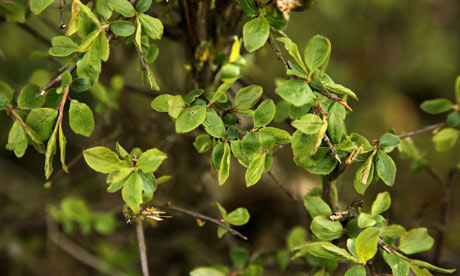
Blackthorn leaves. Photograph: John Wright
Americans will quibble over — and flat-out disagree with — some of Wright’s pronouncements. When he writes, for instance, that white rum has “no real flavour of its own,” let’s cut the man some slack. He is a forager, after all, and not a bartender or boozer whose job it may be to identify any number of white rums in blind tastings. But his takes on orange beer, parsnip wine, rhubarb wine, chestnut liqueur, cider, blackberry whiskey, dandelion and burdock beer, and so much more have inspired me to pay closer attention to the seasons here in San Diego and what’s flowering and fruiting when in the parks nearby. Lemons, grapefruit, and rosemary are everywhere here; it's the keen eye that spots rose hips, lemonwood flowers, and feral nasturiums, just there for the taking.

From his most recent article, here’s Wright’s verbatim scaled-down version of épine, a French aperitif that’s a very close cousin to sloe gin since it uses the leaves of the blackthorn bush rather than the sloe fruits familiar to us. We are told that in France friends of his friend who supplied the recipe are ignorant of sloe gin and leave the fruits to rot on the shrubs. Sacré bleu!
Épine apéritif
2½ litres of red wine or homemade red fruit wine such as blackberry or elderberry
Half a bottle of brandy or eau-de-vie
500g sugar
About half a litre of blackthorn leaves (don't use more leaves than I recommend because blackthorn, like all the plum species, produce traces of cyanide as a byproduct of the almond flavour it imparts)
Put all the ingredients into a food quality plastic container, stir and fit the lid tightly. Leave for two weeks, stirring occasionally. Transfer to clean bottles using a funnel and some doubled-up muslin cloth to filter out the bits. As with nearly all drinks it improves with age. Santé!

Goes well with:
  • The entirety of John Wright’s Homebrew from the Hedgerow series is here.
  • Sloe what? Sloe gin? Yup. Check out what Irish poet Seamus Heaney says about it here. 
  • The River Cottage Preserves Handbook is a great little tome. I write about it here and include a recipe for beech leaf noyau. 
  • About those feral nasturiums. They'll be coming into seed soon enough. Here's a recipe for pickling the pods. 

Friday, March 9, 2012

Seamus Heaney's Sloe Gin

I detest poetry. Shameful for an Irishman to admit, but there it is. From Virgil's soporific arma virumque cano to the contemptible J. Alfred Prufrock, I hate it all. Even as I devoured all the pages of Tolkien when I was young, my eyes went dull when he dredged out those horrible, hoary short lines. Lovecraft, so gifted with language, was at his worst when he set to rhyming. It's not that I haven't been exposed to verse; I've translated Ovid and Beowulf, memorized German poetry (yes, there is such a thing), and had an appreciation for the structure of literature crammed into my head by well-meaning Jesuits.

Poetry, though, springs from some alien mindset I simply do not possess. Perhaps this is something diagnosable ("Patient's psychopathy presents clearly in his inability to appreciate neither iambic pentameter nor dactylic hexameter...") or perhaps it's somehow connected to my weird speech.

But ~ if the lines in question pertain to food or drink, I can put aside my revulsion for the genre long enough to understand that others may enjoy it. The barbecue poems of Jake Adam York, for instance. If my eyes glazed reading them, it was at least a tangy barbecue glaze. Give me barbecue over barbecue poems any day, but the world is big enough for both.

Then there's the Nobel Prize-winning Irish poet Seamus Heaney. His poem Sloe Gin is one of the rare ones that caught my eye, if not my imagination. Sloes are tart, plum-like fruits culled from hedgerow bushes called blackthorn. In rural parts of the British Isles and isolated spots in North America, the berries are pricked (or sometimes frozen to break down cell walls), then immersed in sugar or syrup and gin, vodka, or other spirits for a long maturation. Regardless of the spirit used, the resulting cordial is a stillroom favorite always dubbed sloe gin.

Here's Heaney.

Sloe Gin

The clear weather of juniper
darkened into winter.
She fed gin to sloes
and sealed the glass container.

When I unscrewed it
I smelled the disturbed
tart stillness of a bush
rising through the pantry.

When I poured it
it had a cutting edge
and flamed
like Betelgeuse.

I drink to you
in smoke-mirled, blue-
black sloes, bitter
and dependable.

-- Seamus Heaney (1984) Station Island

If you've made it this far, pour yourself a glass of sweet sloe nectar and listen to the poem in Gaelic.


What is he going on about? Mortality? Sex? Lost love? Don't ask me; I just drink the stuff. 

Monday, October 3, 2011

Kruidnoten Liqueur, A Genever Recipe

Hiram Walker makes a gingerbread liqueur, biscotti-flavored cordial is not unheard of, and in his The Joy of Mixology Gaz Regan gives a recipe for a Jägermeister-spiked Oatmeal Cookie cocktail. Americans, though, simply don’t make cookie-flavored cocktails and cordials at home. Not often, anyway.

Fitting then, that the Dutch — who, after all, ran the first commercial still in America in the 17th century and gave us our word cookie — have a recipe combining the two. In a post last month, Lizet Kruyff relates a recipe for kruidnotenlikeur from Maak van de noot een deugd (roughly “Make a virtue out of nothing”), a new Dutch cookbook devoted entirely to cooking with kruidnoten.

Kruidnoten are tiny gingerbread cookies, cousins to the Christmastime specialty peppernuts. A direct translation is "spice nuts" but "nuts" refers to their diminutive size; they are no more likely to contain nuts than are peppernuts (or doughnuts, for that matter). Typical spices in the little cookies include ginger, cinnamon, nutmeg, cardamom, white pepper, cloves, and coriander, but such things vary with the baker.

With the help of Renée de Vries, an internet specialist at the University of Amsterdam, I tracked down online excerpts from the book. Why? Well, because Kruyff’s blog calls for 12 liters of genever, a Dutch spirit enjoying a modest renaissance in the US. Even counting my personal stash of current and vintage bottlings, there are probably not 12 liters of the stuff in our entire neighborhood. Plus only 500 grams of sugar to make a cordial with that much liquor? Something is not right. A look at the original reveals that her "12" liters is actually "1/2" liter. Big difference.

My somewhat loose and streamlined translation follows. For sticklers, see the original recipe below. Kruyff suggests both using white rum as an optional base spirit and, if you're so inclined, adding a splash of cream after the maceration. The original recipe notes that you can use cane sugar for a "warmer" taste and darker color.
Kruidnoten Liqueur

1/2 liter jonge genever or vodka
3 handsful of kruidnoten
200ml water
500 grams of cane sugar

Push the kruidnoten through the bottle's opening. Put the bottle away for about six weeks in a dark closet. Give the bottle a shake now and then to show it who's boss and so that the flavors can blend. Do not worry if it looks nasty.

After six or seven weeks, strain through cheesecloth or a clean tea towel into another bottle. Do this again if you doubt whether particles remain.

Make the syrup. Put the sugar and water in a saucepan with a thick bottom. Bring to the boil, stirring. Stir until all sugar is dissolved. Let cool, mix with the kruidnoten infusion and pour into a pretty bottle.
Proost!

Karin Sitalsing, Marije Sietsma en Helga de Graaf (2011)
Maak van de noot een deugd: koken met kruidnoten
120 pages (hardback)
Loopvis
ISBN: 9081764802
€ 17,95

Sunday, February 13, 2011

Bookshelf: My Sweet Mexico

My entire life — other than occasional stints in Europe — has been spent in the company friends whose families hail from Oaxaca, Baja California, Sonora, and other parts of Mexico. Even today, I live a mere eighteen miles outside Tijuana. Some ascribe the affinity between Irish- and Mexican-Americans to similar Catholic upbringings. While not denying that possibility, I prefer to think that it is testament to how susceptible those of us with freckles are to the siren call of Mexican cookery.

I have, for instance, dispatched an incalculable number of pigs in the form of tacos, guisados, sopas, tortas, enchiladas, chorizos, and various antojitos. My lust for fresh, dried, and smoked chiles leads to eating amounts that would shock (and likely render ill) my pale ancestors. Yet Mexican sirens are not all chiles and pork. Some of them sing songs of sweetness.

One such sirena is Fany Gerson, a Mexican-born pastry chef and author of My Sweet Mexico. Oh, sure, you may know about caramel-topped flan or the long, ridged donuts known as churros, but there’s a wealth of desserts, candies, sweet beverages, and snacks that, while ingrained in Mexican culture, just don’t get much play in the US. Gerson’s here to fix that. Rightly.

Traveling around her native country, the author gathered recipes for dulces de convento (sweets from convents), dulces de antaño (“heirloom” sweets) pan dulce (the ubiquitous sweet morning breads), fruits, various desserts, and frozen treats such as margarita ice, rose petal sherbet, and sorbets made of quince, tamarind, lime, and cucumber.

If you’re the slightest bit interested in Mexican food or sweets in general, Gerson’s book is a knockout. It has recipes for both traditional sweets (want to make your own Mexican chocolate tablets? Instructions included) and more complex modern desserts such as an original lime tart with tequila-plumped “drunken” cherries.

My Sweet Mexico brings together in one place a trove of the kinds of recipes you would have to cobble together from dozens of English-language cookbooks devoted to Mexican cooking. The tone is light, erudite, and engaging: the voice of an expert and one whom I would want to have over for dinner (and not just because she may bring dessert). 

Drinks are not ignored. Sure, there’s an entire chapter devoted to bebidas, but pastry chefs, after all, are used to judicious use of spirits in their work. Gerson puts a Mexican spin on that tradition. Consider her recipe for gaznates (“windpipes”), light, cannoli-like shells filled with Italian meringue: the shells are made with brandy or rum — and the filling? Spiked with mezcal.

Don’t like windpipes? Try the jamoncillo de leche, a fudge-like milk confection that can be flavored with chocolate, lime, coconut — or reposado tequila. 

Gerson’s recipe for pasita, a raisin cordial, was inspired by a bar in Puebla that serves its namesake tipple in a shot glass topped with a skewer of salty cheese and a raisin.
Pasita
(a raisin liqueur)

1.5 c/340g sugar
1 c/250ml water
3 c/750ml brandy
2 c/300g dark raisins

Combine the sugar and water in a pot over medium heat, and cook, stirring, until the sugar dissolves. Pour into a large container. Stir in about 1 cup of the brandy, add the raisins, and let macerate until the raisins plump, about 20 minutes. Add the remaining 2 cups brandy and cover tightly. Store in a dry, dark place for 2 weeks, Stain through a fine-mesh sieve or cheesecloth and store in a sterilized jar.

“Although this drink is typically served,” she adds “at room temperature, I like it a bit chilled. It will keep about 2 months in the refrigerator.”

~ Adapted from My Sweet Mexico to include metric measures.
Though well-researched throughout, Gerson tips her scholarly hand at the end by including a bibliography of nearly thirty titles, most from Mexico and nearly all in Spanish: a goldmine for those who want to read more.

Fany Gerson (2010)
My Sweet Mexico: Recipes for Authentic Pastries, Breads, Candies, Beverages, and Frozen Treats
224 pages, hardback
Ten Speed Press
ISBN: 1580089941
$30.00

Goes well with:
  • Fany Gerson’s site My Sweet Mexico
  • Amazon sells the book here
  • Gerson’s soon-to-open paleta company, La Newyorkina. Paletas are typically Mexican and often fruit-heavy popsicles that sometimes come in arresting flavors such as mango/chile or roasted corn. Try them: the good ones are very good indeed.

Friday, November 19, 2010

Do it to Julia! Pink Cloves and Gin at the Chestnut Tree Café

Under the spreading chestnut tree
When I held you on my knee,
we were happy as can be
Under the spreading chestnut tree.

Under the spreading chestnut tree
I'll kiss you and you'll kiss me
Oh how happy we will be
Under the spreading chestnut tree.

~ traditional British song

Some months ago my friend Scott Heim asked me about pink clove cordial. He is, in his own words, a bit of a gin purist and his interest in this old obscurity was an outgrowth of his cocktail-centric tippling habits. I confessed I had none. We agree on the virtues of good gin, but I’m slightly leery about adding cloves to it. Since I had not seen the cordial in the US, I sent him for advice to London boozer Jay Hepburn writing at Oh Gosh!

Turns out that pink clove cordial is common enough in the UK where J.R. Phillips makes — among its several cordials — a 5.3% abv clove version. Of this one, cocktailingredients.co.uk writes it is “…still one of Devon's most popular imbibes. Pink Cloves adds a rosy hue and great flavour to punches, gin or vodka.” Seems most British online shops sell it for around £8/700ml.

I admit a certain degree of interest in the stuff, though — honest to god — a little clove goes a long way.

Scott’s question sprang to mind recently because I’ve been pecking at a first British edition George Orwell’s Nineteen Eighty-Four on and off for a few weeks. Because I like to attack a topic from a few angles, I also watched the 1984 film adaptation with friends. At the end of the novel, Heim’s gin and cloves show up as the habitual drink of protagonist Winston Smith. It’s a taste that’s been knocking around, it seems, since at least the middle of the last  century.

After Smith’s brutal torture in the bowels of the Ministry of Love, he settles in at the shabby Chestnut Tree Café, where broken traitors and thoughtcriminals go to eke out their days. In the film the café’s grubby and disinterested waiter delivers room temperature government-issue gin — and three dashes from a bottle. I expected the little dasher to be bitters at first, but the book reveals it’s “saccharine flavoured with cloves.”

Smith getting his dose of gin and cloves
In that dark and drab 1984 film version of the story, John Hurt plays Smith and Richard Burton plays his nemesis and savior O’Brien. It’s a harrowing view of humanity. You may or may not care for the Eurythmics musical score. But after reading the entire novel, Orwell’s original description of Smith in the café is chilling:
The Chestnut Tree was almost empty. A ray of sunlight slanting through a window fell on dusty table-tops. It was the lonely hour of fifteen. A tinny music trickled from the telescreens.

Winston sat in his usual corner, gazing into an empty glass. Now and again he glanced up at a vast face which eyed him from the opposite wall. BIG BROTHER IS WATCHING YOU, the caption said. Unbidden, a waiter came and filled his glass up with Victory Gin, shaking into it a few drops from another bottle with a quill through the cork. It was saccharine flavoured with cloves, the speciality of the cafe.
By dragging Orwell into it, I don’t mean to suggest that Phillips’ pink clove cordial is anything less than good and wholesome. The serendipitous connection between Heim and Orwell — two writers I admire — amused me, is all. In fact, I hope to get my hands on several varieties of Phillips cordials one of these days for experimentation…and studiously to avoid any place even resembling the Chestnut Tree.

Goes well with:

Oh, rats. Do it to Julia.

Sunday, October 24, 2010

Chartreuse Hot Chocolate

In Southern California, some stereotypes hold true. Some of us do keep surfboards at the office. Our local produce is, generally, fantastic. We do eat avocados and oranges right off the trees. Our temperate weather means the grill operates year-round. But it’s a mistake to think that we have no seasons here, as some assert. We have them. They are more subtle than in other places, perhaps, but we have them.

Our recent spate of bracing, wet weather was a reminder of that. In particular, it made me reminisce about foods I used to eat when I lived places with more distinctly unpleasant seasons. Last week’s egg noodles and pork ragout were one outgrowth of that nostalgia. Another has been hot chocolate spiked with Chartreuse.

The Pères Chartreux — the Carthusian monks who make Chartreuse — currently make several varieties of spirits, including genepi, walnut and fruit liqueurs. Although an 80 proof yellow version of their famous herbal liqueur is available, the monks’ green Chartreuse is most commonly mixed into drinks. At 110 proof, this ancient liqueur packs a punch and lends lovely vegetal notes to drinks. Since moving to California, I have never been without a bottle of the green. Never. The yellow? Harder to find on store shelves here.

I was prodded to add Chartreuse to hot chocolate on reading Madeline Scherb’s A Taste of Heaven. The book is part travel guide and part cookbook of meals one may find in abbeys — and convents — around the world. Given the brewing and distilling/rectifying traditions of many monasteries, it’s not surprising that abbey beers and a few liqueurs show up in recipes; beer soup with Achel, chicken livers over apples with an Orval reduction, caramelized bananas with Westmalle tripel and dark rum.

Chartreuse is such an assertive spirit that I can identify it by smell even from several feet away. I happen to love the smell and the taste. If you’re not certain you will, don’t use the whole amount called for below. Instead, start with less. If you like it, add more. Scherb calls this Christmas Cocoa. I’ve tweaked her proportions just a bit, but I say there’s no need to restrict it to Christmas.

Chartreuse Hot Chocolate

8-12 oz good quality hot chocolate
1 oz green Chartreuse (or less, see above)

Warm a mug with hot water. Toss the water and pour the hot chocolate into the warmed mug. Add green Chartreuse and stir. Breathe deeply as you drink. Let the aroma get into your lungs. Not the drink, of course. Chartreuse is fantastic, but there's no call to drown in the stuff.

Madeline Scherb (2009)
A Taste of Heaven: A Guide to Food and Drink Made by Monks and Nuns
240 pages, paperback
Tarcher/Penguin
ISBN: 1585427187
$15.95

Sunday, June 27, 2010

Bookshelf: The River Cottage Preserves Handbook

Ten Speed Press has released an American edition of Pam Corbin’s The River Cottage Preserves Handbook. For five days, it barely left my side.

I toted it in my briefcase and in my backpack. I brought it out at coffee shops and flipped through it before bed. A handbook in the truest sense, the small book fits in my (admittedly oversized) hands, but contains a wealth of information about pickling, candying, putting up, and otherwise preserving ephemeral produce. Although not a bartenders’ guide by any means, its sensibilities about capturing seasonality in glass speak volumes to modern cocktail enthusiasts.

Originally a British title, the current incarnation has a few odd moments with measurements — as do most European cookbooks adapted to the American market. Understand that "1.1 pounds" of an ingredient was originally "half a kilo" and the recipe flows more easily. Measuring that pesky 0.1 pound exactly then becomes slightly less imperative.

The Handbook contains the usual recipes one finds scattered throughout other books on preserves. It has, for instance, recipes for fruit butters, for chutneys, herbal vinegars, marmalades, jellies, jams, and pickles of various sorts. For those who just can’t keep booze out of the kitchen, there are syrups, sloe gin, elderflower cordial, sage elixir, and a rummy shrubb or two.

Clearly, Corbin knows her subject well and has brought together dozens that would otherwise take some research to unearth. Many show an experimental stamp on otherwise venerable recipes with plenty of riffs on basic ideas. With a solid discussion of what makes good preserves and how to stave off spoilage, it’s a book I’d recommend to beginners as well as advanced preservers. As Fearnley-Whittingstall puts it in the introduction, “…she will show you the ropes and then give you the reins.”

The book’s recipes evoke homey and comforting memories of foods that perhaps we’ve never even eaten, but wish we had, all infused with Corbin’s pragmatic take on making the most of one can — there’s even a Compost Heap Jelly recipe, using up apple scraps and citrus skins. Oh, hush; it’s little more than a strained marmalade. Like many River Cottage recipes, however, it does make one pause to think about untapped potential for eating well.

For the first time in years of living in Southern California’s nearly eternal Spring, I found myself wistfully musing over seasons, almost – but not quite – missing the changing of leaves, the onset of cooler nights, and Winters huddled inside, bundled up against the cold, with a pot of tea and jars of my own lemon curd and jams to remind me of the Summer that had past and which will yet come again.

Of course, my senses returned to me and I’m reminded that we do not “enjoy” distinct seasons as other parts of the world. I don’t have to draw close the shutters and light a fire to enjoy a pot of tea and my own lemon curd, nor is it necessary where we live to put up foods as talismans against a harsh, barren Winter. But I do it anyway. Making my own preserves, my own chutneys, marmalades, and jams somehow does allow me to feel as if I am laying in protection against hard times. Even if everything else goes South, I seem to think to myself, we will never go hungry. As God it is my witness and all that.

In a less reflective moment, I admit that I just like the taste of my own preserves. Inspired by the book, I have indeed made, among other things, new batches of lemon curd. Last week, four pounds of blueberries transformed into two sheets of fruit leathers. Following Corbin’s general instructions, it was simplicity itself.

The European beech (Fagus sylvatica) is a separate species from the North American F. grandifolia. Haven’t tried a drink made from either, but Corbin offers a take on an old French cordial I’ve written about before.
Beech Leaf Noyau

One loosely packed grocery bag full of soft young beech leads, sufficient to pack tightly into a 2 ½ to 3-cup jar
2 cups gin
1 ½ cups granulated sugar
Brandy


Pack beech leaves into an earthenware or glass jar until it’s about nine-tenths full. Pour the gin over the leaves, making sure they are well covered (they will oxidize and turn brown if exposed). Let steep for 7-10 days so the leaves can release their striking green pigment. Strain the infused June through cheesecloth or a jelly strainer bag.


Put the sugar and 1 cup of water into a saucepan and heat gently to dissolve the sugar. Allow to cool completely or adding to the infused gin. Add a couple of capfuls of brandy too.


Put a couple of fresh beech leaves into a sterilized screw-top or stoppered bottle, then add the noyau and seal.


Wait for a cold winter night, then partake of this potent liqueur. Use within years (it may darken in color over time).

Pam Corbin (2010 American edition)
Introduction by Hugh Fearnley-Whittingstall
The River Cottage Preserves Handbook
216 pages, hardback
Ten Speed Press
ISBN: 9781580081726
$22.00

Goes well with: 
.

Friday, June 4, 2010

Mistela de Chimajá or Chimayo Whiskey, an Old New Mexico Recipe

Another wild substitute favored by Santa Fe cooks is chimajá, but its dried leaves and ground roots are not widely available. The root was the main flavoring for Chimayó whiskey, one of the stuffs of New Mexican drinking legends.

~ Huntley Dent
The Feast of Sante Fe

Chimayo whiskey, chimajá whisky, or mistela de chimajá — whatever you care to call it, I can’t make any. Not right now. We have plenty of whiskey, but we don’t have any chimajá around here and, as far as I can tell, the season for gathering it has passed. The chimajá, that is, not the whiskey. Also called spring parsley, the wild-harvested plant grows in New Mexico, Arizona, Colorado, and Utah.

I’ve never made it. Can’t vouch for it. But homemade liquors are a huge draw regardless of where they come from. This recipe for Mistela de Chimajá comes from Erna Fergusson’s 1945 Mexican Cookbook. In this context, Mexican is understood as New Mexican. For those with access to spring parsely, I offer…
Mistela de Chimajá

1 gallon whisky
1 quart water
2 cups dried chimajá root
1 pound sugar new line for sticks cinnamon
1 whole dried orange peel

(Orange peel must be very dry; otherwise a bitter taste will result.)

Boil sugar, cinnamon, orange people, chimajá root, and water for ½ hour. Strain and add whisky. After two weeks the drink is ready, but it improves steadily with age. It attains about the consistency of a liqueur. It was the inevitable Christmas drink.

Some recipes call for no boiling. The ingredients were mixed and set aside in a jug which was shaken well each day for two weeks. The liqueur was then drained off and was ready.


Works Cited
Dent, Huntley (1993) The Feast of Sante Fe. Fireside, New York.
Fergusson, Erna (1945) Mexican Cookbook. University of New Mexico Press, Albuquerque.

Thursday, December 31, 2009

Liqueur du Grapillon

One of the most important things
that distinguish man from other animals
is that man can get pleasure from drinking
without being thirsty.

~ Fernand Point

Not long ago, I plucked a 1974 copy of Fernand Point’s Ma Gastronomie from the shelf. Point was the French chef/restaurateur of La Pyramide, a renowned temple of gastronomy south of Lyon. I was looking for his recipe for a sort of simple French milk punch. Though he died in 1955, his life and work continue to inspire chefs today. Marc Vetri, for instance, whose restaurant Vetri Mario Batali claimed was possibly the best Italian restaurant on the East Coast, used to keep the same copy of Ma Gastronomie in his kitchen. Thomas Keller, no slouch in the kitchen, has written an introduction to a new edition of the cooking classic and it’s worth tracking down if, like me, you're into food as well as drinks.

The recipe I was hunting (from the oversized yellow-jacketed 1974 edition) is for a homemade liqueur that Point used to take with him as he went to survey the quality and maturity of the grapes of the Côte Rôtie. Reputedly, he would stop now and again on the steep slopes of the vineyards and take a swig of a tasty little pick-me-up he called Liqueur du Grapillon (or “Liqueur for the Grapes”).

The recipe calls for an entire lemon, cut into quarters, to be thrown in with brandy, milk, and vanilla. Citrus and dairy in the same drink can lead to some chewy disasters. They can be—and often are—combined without incident, but keep this formula in mind: [citrus + milk] = [curds + whey]. Fortunately, since the lemon is not squeezed into the mix and, as this mixture sits in the dark for almost two weeks, any curds formed are very small and easily strained out.

The result is a smooth, thick and mildly sweet liqueur, similar to egg nog but not as thick and without the eggy overtones, tasting of whole milk, vanilla, and cognac. After a few days of macerating, I tasted the drink and was leery: the lemon was overpowering, sharp, and biting. Resisting the temptation to yank it out of the jar (after all, presumably Point knew something about successfully combining tastes), I left it in and was rewarded after another week with a mellowed liqueur that no longer tasted like furniture polish.

On the last day of the decade, I poured myself a short glass, grabbed some dried sausage and a pocket knife, and moseyed out to the patio to read the paper and soak in the beautiful sun of Southern California. There are no grapes to survey, but the palm trees look mighty fine.

Liqueur du Grapillon
(“Liqueur for the Grapes”)

Combine sixteen ounces of milk, eight ounces of sugar, sixteen ounces of very good eau de vie or brandy and add a lemon cut in thirds and a vanilla bean. Let the mixture stand, stirring from time to time. After 12 days, strain and serve.
~ Fernand Point (1974) Ma Gastronomie. Lyceum Books, Wilton, CT.


Ingredient Notes: I’d used the vanilla pod in this recipe to make vanilla syrup as well as vanilla sugar, so a little bit of its moxie had been spent. To compensate, I used a pod and half, then, at bottling time, squeezed out all the remaining tiny black seeds as if from a tube of toothpaste into the strained liqueur.

For milk, use whole milk, preferably unpasteurized. It really does make a difference. Don't even bother with 1%, 2%, or soy abominations. The brandy I used was Claude Chatelier VS, about $20/750ml at Trader Joe's. If using a waxed lemon, give it a good short scrub in hot water to remove as much of the coating as possible. Pluck it from the backyward if, like me, you live in places where mixers grow on trees.

Secondhand editions of Point's book are still around, but if you want to score the new edition, here's the skinny:

Fernand Point with introduction by Thomas Keller (2008)
Ma Gastronomie
240 pages, hardback
Publisher: Overlook/Rookery
1585679615
$40.00

.

Tuesday, December 29, 2009

Tracking Old Family Cordial Recipes

Americans may have forgotten some of the finer points of making tonics, tinctures, and infusions at home but we are, bit by bit, figuring them out again.

Take cocktail bitters. Hats off to all the bartenders making their own (and, please, keep doing so) but housemade bitters no longer raise eyebrows. Not because they are dull or passé, but because, more and more, we are coming to expect a level of applied curiosity in our bartenders. Bitters are one of the more familiar expressions of that trend.

As part of unboxing our own curiosities about the nation’s drinking past, older homemade beverages such as dandelion wine, sloe gin, and cherry bounce are showing up here and there. It’s a trend worth encouraging.


Tracking down those old recipes takes some legwork. Oh, sure you can find reprints of plenty of old bartending manuals for the 19th-century recipes, but sometimes our own friends and families can be surprising sources of information. I can’t even count the number of friends—city dwellers and professionals—who talked to me about my research into moonshine, found it totally alien, then reported back sometime later surprised to find that their own uncle, grandfather, cousin, or mother had first-hand experience making or moving applejack, corn liquor, or other black-market hooch.

I assure you, it’s the same with cordials, ratafias, tonics, and other homemade alcoholic beverages in your own family. While the holidays are still under way, ask around your own families and office parties to see who’s been making what. And, if anyone demurs with “Oh, that old stuff,” press ahead. It’s how my mother’s rumtopf recipe ended up in my moonshine book under the title The Stuff squared off against a recipe for curtido y mistela, a recipe from Chiapas from my good friend Noe. Who gave him the recipe? His mother.

That his mother supplied a recipe for homemade cordial isn’t surprising. Keep in mind that, from Charlemagne’s France through Elizabethan England to today, women tend to be the keepers of these recipes. Of course, men make boozy concoctions, but odds are, if there’s a written recipe for homemade drinks, it’s in a woman’s hand, so talk to aunts, grandmothers, and the extended networks of cousins. Below are some thoughts for tracking down older cordial recipes. And, remember, it's not just the ounces of this and the pints of that—the meat of the stories lies in how and when they were used and by whom:

  • Ask about holiday parties from years past
  • Browse through old family Bibles or journals for spare recipes tucked in between the pages
  • Go through handwritten recipe books or cards with the woman who wrote or inherited them, asking about drinks recipes
  • Ask how your older relatives kept cool in the summer (Do they remember August before air conditioning? Did they have a cellar with home-canned goods? What else was down there?)
  • Ask how they kept warm in the winter (tactfully, now—you aren’t suggesting that they are coeval with dinosaurs)
  • Ask what they did with wine/liquor bottles once they’d been emptied
  • If they keep gardens or fruit bushes/trees, ask where it all goes at the end of the season
  • Ask about traditional drinks brought from ancestors who immigrated to your country (anything from French vin cuit to Puerto Rican coquito)
  • Was there a special bottle that kids weren’t supposed to get into? Ask about it.
  • Ask what would be a good drink to put up on a child’s birth for his 21st birthday
For the record, my recipe for cherry bounce is posted over at Tuthilltown spirits. Very nice when made with corn whiskey, but bourbon is just fine…

What does your family put up in bottles and jugs?
.

Sunday, September 20, 2009

Potka, Part II

Straight wash is very, very strong, and very soporific.
The first time I tried some, I drank 2.5oz
and smoked a 0.3 of oil.
It took me 2 HOURS to get of my couch
and go to bed once my movie ended!!


~ genkisan
stonerforums.com


Think listening to stoners talk tries your patience? Try reading stoner recipes. They tend to wander off, lost in the intricacies of their own details.

As a follow up to Friday’s post in which I talked about moonshine and pot, I’ve learned more about the technical aspects of producing potka in the last three days than in the last decade. Leave it to Volodimir “Wal” Pavliuchuk to pick up the potka theme, though, and run with it in his typically scholarly way.

Pavliuchuk, whose book of cordial recipes I wrote about back in April, posted several links over on Yahoo Distillers concerning the blend of ethanol and marijuana. Even though legal marijuana is readily available where I live, it’s just not one of my vices. For those who are curious, however, Wal has aggregated links that give an overview on marijuana-infused liqour.

You’ve heard of limoncello, the lemon cordial from the Amalfi coast? What of marjiuancello? Zoomata reports that Manlio Chianchiano’s plans for marijuana macerated in alcohol in Naples were scrapped when police investigated reports of marijuana growing at his home.

Wal links to The Marijuana Foods Handbook and its guidelines for producing sinsemilla liqueurs and in using ascorbic acid as a clearing agent. There’s also the stonerforum recipe quoted above that goes into overly stoner detail.

From an actual distiller’s point of view, however, see Rev. David M. Cunningham’s notes.

As always, send me whiskey and bring me brandy. But potka? I’ll pass. I’m sleepy enough as it is.

Photo: ANSA.


.

Monday, August 24, 2009

Syrup of Violets, Three Ways

“My God, have mercy upon me! " and, uttering a fearful cry, Barrois fell back as if he had been struck by lightning. D'Avrigny put his hand to his heart and placed a glass before his lips. "Well!" said Villefort. "Go to the kitchen, and get me some syrup of violets."

~ The Count of Monte-Cristo (1893)
Chapter 79: The Lemonade
Alexandre Dumas

Given the number of bottles laced with violets at Tales of the Cocktail this summer, smart money says we'll be seeing more floral drinks mixed at some of our favorite watering holes. Obscure-spirits wrangler Eric Seed of Haus Alpenz already imports a 20% abv Crème de Violette made from Alpine Queen Charlotte and March violets. Rob Cooper—whose St Germain elderflower liqueur has achieved such popularity that it’s been called “the ketchup of bartenders”—showed his Crème Yvette, a liqueur that also incorporates violets. It should be hitting shelves this fall.

Violets have an aroma that reminds some of old ladies’ perfume. Yet Crème Yvette is a core ingredient in classic cocktails such as the Blue Moon of which Ted Haigh waxes to eloquently in his Vintage Spirits and Forgotten Cocktails. Marleigh Riggins over at Sloshed! teases us with a sampling of Blue Moons which—for a while at any rate—will be difficult to create at home until Crème Yvette achieves wider distribution. She presents a version with Crème de Violette.

Until then, I offer a workaround: Syrup of violets. Alexandre Dumas knew of violet syrup over a hundred years ago, but this erstwhile kitchen staple has an older history in English cookery. Though I haven’t tried these recipes, I suspect adding spirit to a violet syrup base may make an interesting addition to the bartender’s arsenal, especially if the spirit is Grand Marnier or another orange liqueur, vanilla-infused rum, or other liquors with more character than vodka or plain neutral spirits. Clearly, these aren't substitutions for either Crème Yvette or crème de violettes, but nonalcoholic bases from which to experiment.

First off is Eleanor Parkinson who gives this 1844 version in The Complete Confectioner, Pastry-cook, and Baker:

Syrup of Violets—One pound of violet flowers, one quart of water, four pounds of sugar. Put the flowers cleared from their stalks and calx, into a glazed earthen pan; pour on the water boiling hot, and stop the pan quite close; let it remain in a warm place for a day, then strain off the infusion through a thin cloth; add the sugar, and place in the bain-marie: stir it well and heat it until you can scarcely bear your finger in it; then take it off, and when cold, bottle.

English botanist Nicholas Culpepper offers us in his Complete Herbal (1814) a recipe that’s essentially the same—down to the glazed vessel—but without heating.

Syrupus Violarum

Take of Violet flowers fresh and picked, a pound, clear water made boiling hot, two pounds, shut them up close together into a new glazed pot, a whole day, then press them hard out, and in two pounds of the liquor dissolve four pounds and three ounces of white sugar, take away the scum, and so make it into a Syrup without boiling.

Going back another two centuries, Elinor Fettiplace, in her handwritten 1604 recipe book, gives directions To Make a Sirrop of Violetts:

Elinor Fettiplace’s Sirrop of Violetts

First make a thicke sirop of sugar and clarifie yt well, then take blew violets and picke them well from the whights then put them in the sirrop, let them lye in yt 24 howres keepinge yt warme in the meane time, then straine these violets out and put in fresh, so do 4 times then set them on the fire, let them simper a good while but not boyle fast put in some Juice of limonds in the boyleinge then straine yt and keep yt to yor use.

Both Fettiplace and Parkinson hit on a detail sometimes missed by those who don’t often make floral infusions: they remove parts of the flower before infusing. Naturally, the stems have no place in a delicate syrup such as this, but neither does the whole petal. The “whights”—or white part of the flowers—are removed before the infusion. Rosewater and rose syrup recipes often call for the same procedure. The idea is to eliminate bitterness that can result from including the white parts of the flowers.

Now all I need is a gallon or so of unsprayed, aromatic violets and a pair of sharp scissors.


Goes well with:

  • Hilary Spurling (1986) Elinor Fettiplace’s Receipt Book: Elizabethan Country House Cooking. Viking Press, New York. Spurling, wife of a modern relation to the 17th-century Fettiplace, has admirably presented the cookery styles, concerns, patterns, and recipes of a housewife at an age when England enjoyed immense power and wealth (yet still had trouble putting down those pesky Irish). The book is out of print, but well worth tracking down for an understanding of household management, including the products of stillrooms.
  • Diane Ackerman's Natural History of the Senses includes a discussion of violets and their peculiar effect on human smell: unlike, say, the aroma of steak or cigar smoke, humans' ability to smell that of violets is not constant. Our perception of their smell comes in waves. Ionone, one of the flower's components, temporarily short circuits our sense of smell. After a few minutes, we can smell violets again and their aroma comes on clearly and strongly. Buy Ackerman's book here or check it out in your local library. Then get some flowers and try it for yourself.

Blue Moon photo courtesy of Marleigh Riggins.

.

Tuesday, February 3, 2009

Quitten Time: Quince-Infused Brandy


They dined on mince, and slices of quince,
Which they ate with a runcible spoon;

~ The Owl and the Pussycat
Edward Lear


Fill a bowl with quince—hard, knobby little buggers—and their heady aroma will perfume an entire room. The smell is distinct, but tricky to nail down precisely; it’s something like guava mixed with ripe pear or occasionally pineapple. It’s that exotic, old-timey smell tempts me every year to do a quince-and-liquor mashup. Vodka, moonshine, brandy, cognac, and whiskey all yield tasty results, though neutral spirits seem to want more spices added to the mix. I’ve yet to try mixing them up with rum.

In German, quince are called Quitten and, when fermented and distilled, known generically as quitten brand. They are, frankly, a pain in the ass to distill for they must be de-fuzzed of their grey downy mantels and even then yield little juice. But the samples I’ve had are sublime. I strongly encourage each and every still owner to make homegrown quince brandy.

No still? No problem. You can still wrest some of those elusive aromas and taste from these fruits by cold infusions. Here’s what I’m working on now.

Here in California, quince start cropping up at local farmers’ markets in early Autumn—Champion, Orange, Pineapple (the most prominent at market and one of the more heavily scented examples), Smyrna, and Van Deman. We’re near the tail-end of the season now. They all look a bit like malformed yellow pears, and about the same size, though some can grow to into grapefruit-sized monsters. When I stumbled across a bin of them for $0.69, I snagged a load.

Raw, the hard and puckery quince are practically inedible. But cooked, most turn a dark crimson and may become the basis for toothsome little sweetmeats such as membrillo (Spanish quince paste, a nice foil to sheep milk cheeses) and pâte à coing (dark red and sugar-encrusted squares and cubes of French quince).

Me? Come on, now, you already know this: I put ‘em in liquor.

For the past week or so, I’ve given a daily shake to a two-liter jar of shredded quince and Jepson Rare alembic brandy. Two sticks of cinnamon are jammed down in there, too. The goal is that within six weeks I’ll strain off part of the liquid and have a quince-infused brandy for adding specifically to my sidecar cocktails. Maybe with an unorthodox hit of noyau. At some point after that, I’ll strain the remainder, add some palm sugar syrup and have a nice little quince cordial in time for the autumn. This is one cordial that bears a long maturation.

For the base infusion, I washed and thoroughly de-fuzzed four quince, then shredded them with a grater, pitching the hard woody little center with the seeds. This yielded about 700g of flesh. Into a 2-liter jar with two cinnamon sticks and 750ml of brandy. Keep it in a cool, dark place and shake-shake-shake now and again. Age at least six weeks before straining off for quince brandy. For a cordial, strain off the shredded quince and add a sugar syrup to taste, then age at least six months to let it mellow and go all velvet at the edges.

.

Thursday, November 6, 2008

If I Had a Hammer: Ratafia aux Noyau Just in Time for Christmas

God bless Michael McGuan.

McGuan, our neighborhood wurstmacher at the San Diego restaurant The Linkery, emailed not long ago to say that he had collected a container full of peach pits for me. Unfurl that brow—this is hardly on par with saving last week’s Penny Saver or a clutch of candy bar wrappers. This was an actual favor, something that would have taken me a whole season of snarfing down cobblers, pies, crumbles, grunts, slumps, betties, smoothies, ice cream, and sangria. On a restaurant scale, however, such a collection of peach pits doesn’t take nearly as long. And, as they were destined for my house, they were wed with alcohol once they got here. Naturally.

Peach pits, also called stones and bunkers, have more value than might seem obvious at first blush. In a variety of forms—charred, split, still adhering to fruit flesh, fresh, dried, etc—they have long been added to moonshine, brandy, whiskey, and other distillates for the amber color and peachy-almond flavor they can impart.

Even more appealing are the kernels once those pits are cracked open. Peach kernels (noyaux in French) taste and even look a bit like small almonds. The smell strongly suggests both almond extract and fresh marzipan. That almond taste is readily surrendered to alcoholic solvents for a cordial with a decidedly old-fashioned taste of almonds and vanilla. Recipes for noyau, ratafia aux noyau, and crème de noyaux abound in older American household account books, recipe books, and homemade beverage collections where they almost always go by the French name. One still finds them in contemporary French cookbooks.

So, let’s make a batch!

Oh. Wait. Forgot something. Peach kernels, along with those of apricots, plums, cherries, and other members of the extensive family Rosacea, contain cyanogenic glycosides. Big whoop, you say, I need a drink, Pops, not a chemistry lesson. I hear you. Lord knows I’m not an environmental chemist, but those who know about such things say that on ingestion, these glycosides break down into prussic acid, also known as hydrogen cyanide (HCN), a substance listed under Schedule 3 of the Chemical Weapons Convention.

Right there, smack dab on your bar cart.

You might recognize hydrogen cyanide as the primary component of the German gas chamber extermination agent Zyklon B. So, no fooling, crème de noyaux carries an element of danger.

Now, do you want to make a batch? I do. In small doses, noyaux does not seem to have ill effect—New Orleans Creoles have reputations for many things, but regularly keeling over from cyanide poisoning with a cocktail glass in hand is not among them. As Erik Ellestad writes over at Underhill Lounge in regard to apricot kernels, “Please take anything I say here as simply conclusions and choices I have drawn for myself. Make your own choices and draw your own conclusions.” I couldn’t agree more.

From the 4th edition of Picayune’s Creole Cook Book (1910), here’s the original recipe and proportions for this old New Orleans classic:
Peach Kernel Ratafia
Ratafia aux Noyau de Peches ou d’Abricots
¼ pound each of peach or apricot kernels
4 pints of brandy
2 ½ pounds of sugar

2 pints of water

Pound the peach or apricot kernels – some also pound peach stones – steep them for one whole month in four pints of brandy in an earthen jar, and at the end of that time add a syrup made of two and a half pounds of sugar and 2 pints of water. Mix all well together, and then filter as directed above
[sic: below], and bottle and seal, and keep in a cool, shady place.

Ratafia aux Noyau is one of the standing Creole drinks, that is most agreeable, the taste being of a delicate vanilla and almonds combined.

A note on procedure: Peach pits are hard and cracking them takes some force. I use a hammer and rap the bunkers firmly on concrete outside until they split in half, then just pry out the kernels. Hammer the pits on a cutting board and you'll just deboss their images into the wood. I heard someone might have done that one time. If you like, put them in a towel before hitting to contain any flying bits, but controlled smacking should prevent peach shrapnel.

I cut the recipe in half (not for lack of brandy, but for the limited amount of kernels) and am macerating the crushed kernels and half their stones cracked and crushed into small bits in a brandy bottle. Come December, I'll add the syrup, let it mellow bit and see what we get. Here's hoping I don't take a big dirt nap...

Also from the same edition of Picayune’s Creole Cook Book:
How to Filter Cordials and Ratafias.

The filtering is of the utmost importance. A good home-made filter may be improvised by fitting pieces of felt into a funnel, very closely. Some use flannel, but the felt is far better. Filtering paper is sold by all druggists. Put the funnel in the mouth of the bottle, fit in the paper, pour in the mixture and let it filter slowly. Again, others use the ordinary brown or white paper, but this allows the aroma to evaporate, and the taste of the paper clings to the cordial. If you wish the cordial to be very transparent, take very dry, clear, transparent isinglass, and cut it very, very thin. Then dissolve it with white wine until it is perfectly liquid. Put it into bottles and preserve for use. When needed, coat the inside of the strainer with this, using a light brush or sponge. It will form a glue around the funnel. Pour the cordial or liqueur through this, straining several times, again and again, until it becomes perfectly transparent. Strain it the last time into bottles, and seal very tight. You will then have a clear, limpid cordial or liqueur that will not have lost its aroma by evaporation.

This simple method may be understood by even a child, and homemade cordials are not only very delightful, but far less expensive than the imported ones. Always have the Cognac as old as possible.

Goes well with:
.