|
| A little royal icing with rum is no hateful addition |
I've just returned from a week in Kansas City where, among other errands, I delivered a small load of German yuletide spice cookies known as
lebkuchen. Don't know it? You've heard of gingerbread? Same deal. Well, close enough to get the idea, anyway. Like its Anglo-American and French cousins, gingerbread and
pain d'épices, lebkuchen has been around for centuries. A tipoff that it hails from another age is the ancient use of honey rather than sugar for sweetening. Not that lebkuchen is terribly sweet — just enough to satisfy a late morning/mid-afternoon craving with a cuppa tea. The glugs of rum in the icing and dough itself don't hurt.
 |
| The cold dough is stiff |
Made with ground almonds and candied citron, the fancy version I baked is more properly dubbed
Elisenlebkuchen (perhaps St. Elisabeth's lebkuchen, but German bakers have no consensus on the meaning). The recipe comes from a Weimar-era German cookbook: Frau F. Nietlispach's
Das Meisterwerk der Küche (Bong & Co, Berlin, 1932). If honey weren't sufficient, the cake-like cookie calls for three additional ingredients that firmly anchor it in another age:
potash,
hartshorn, and
lard.
As I reviewed Nietlispach's recipe, I flipped through the contents of our pantry in my mind. The
lard (
Schweinschmalz) was no stranger in my baking repertoire. For the candied citron (
Zitronat), I used a diced mix of homemade candied orange peel and the last of my candied
Buddha's Hand/Cthulhu Head citron.
A quick check with
my old pal Michael McGuan revealed that he had just rendered lard the day before; within 40 minutes I'd gotten my hands on 200 grams of it. More than enough for this recipe. The cooked pork smell rolling off the creamy white lard gave me pause. Would it be too strong for cookies? I forged on anyway without any attempt to refine it. The porkiness, in fact, faded away to the barest nothing after baking, a faint savory porcine whisper that complemented the spices.
 |
| Thinner shapes cooling on the rack |
But what about the potash and hartshorn?
Potash is a particularly old ingredient and may refer to a number of substances that include potassium. Originally made from leaching wood ash and reducing the potassium-rich residue in pots, potash was a important source of income for colonial Americans who cleared and burned forests as if the trees were without end. The alkaline salt is used in glass-making, fertilizer manufacturing, and occasionally to inhibit certain enzymes in beer brewing, but its use in baking is what interests us here. Along with hartshorn (see below), potassium carbonate (
K2CO3) is a chemical leavening agent that helps give loft and lightness to somewhat stiff doughs. Baking soda commonly substitutes for it in modern recipes.
 |
| Brokeback Lebkuchen |
Hartshorn or hartshorn salt [
Hirschhornsalz, (NH4)2CO3] is also known as baking or baker's ammonia. With the advent of baking soda and baking powder, it fell from favor in the US, but traditional baking recipes from northern Europe, Poland, and Scandinavia still employ it. Although it was once actually obtained from shavings of deer antlers, industrial sources assure that woodland animals are no longer culled for cookie ingredients. At least not on a commercial basis. While baking, hartshorn releases ammonia gas that expands the dough. Although the gas dissipates fairly quickly, the lebkuchen may have a whiff of smelling salts about it right out of the oven. Don't be alarmed; it doesn't last.
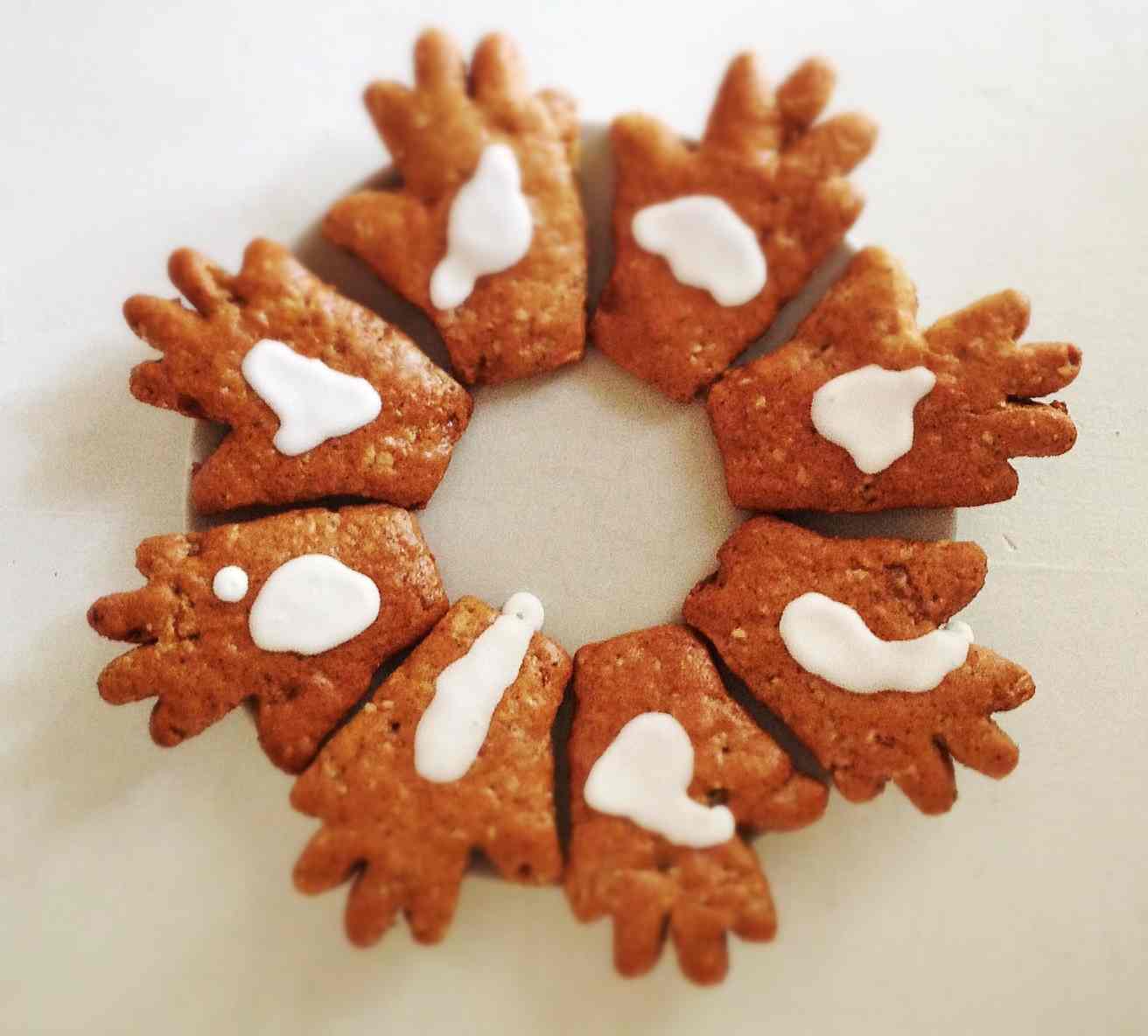
Royal icing is one of the traditional decorations for these cookies and I doled it out in blocks, lines, stars, and other shapes on the thick slabs I made with half the batch and on the thinner stars, gingerbread men, and open-palmed hands. A little bit of rum in the icing isn't a bad thing.
Alton Brown has as good a recipe as any. He uses vanilla extract, but a similar amount of lemon juice or —my choice — rum also works to loosen and flavor the icing.
For those who can read the old German script, here's the recipe:
 |
| Gunter glieben glauchen globen. Doesn't make any sense to you? Check out below. |
And if reading that doesn't come easily to you, here is my transliteration and adaptation for modern kitchens. The text of Frau Nietlispach's recipe follows for those who like to check against the original.
Elisenlebkuchen
(Rowley )
½
pound honey
½
pound sugar
100
g pork lard
1-1.25
pounds flour
½
pound peeled and grated sweet almonds
125
g finely cut mixed candied citron and orange peels
2
eggs
4 g
each of ground cinnamon, ground cloves, cardamom
15
g of potash (potassium carbonate, 2.5 tsp), dissolved with 2 Tbl of rum
4 g
hartshorn (ammonium carbonate, 0.75 tsp) dissolved with 2 Tbl of rum
Let
the honey, sugar and fat boil in a pot. In the bowl of a stand mixer combine
the spices, almonds, and one pound of the flour. Carefully add the hot honey
mixture and mix slowly to blend. Then add the eggs, potash, and ammonium
carbonate and continue mixing until the dough is smooth and shiny. Add
additional flour if necessary to achieve a dough that’s just barely tacky to the
touch.
Let
it rest, covered with plastic wrap, overnight in the refrigerator.
When
you are ready to cook, heat the oven to 350°F. Roll
out the dough, using flour as necessary to prevent sticking, in large slabs [5-10mm
thick] and cut into rectangles about 8 x 5 centimeters or round cakes roll
about 5mm and cut into shapes with cookie cutters.
Line a cookie sheet with parchment paper a silicone baking mat. Transfer individual
cookies to the sheets. Bake slabs 18-20 minutes or cut-out shapes 12-25 minutes.
Transfer to a wire rack to cool. After cooling, coat them with different glazes
to such as chocolate, sugar and raspberry glaze and decorate each cakes differently:
with [royal icing], finely chopped almonds, colored granulated sugar
(nonpareils), chopped, green pistachios, halved almonds, etc. [As an alternate
to lining cooking sheets] before baking, you can put the cookies on Oblaten [baking wafers].
Elisenlebkuchen
(Nietlispach)
1/2 Pdf. Bienenhonig, 1/2 Pdf. Zucker, 100 g Schweinschmalz, 1 Pdf. Mehl, 1/2 Pdf. geschälte und geriebene Süß Mandeln, 125 g feineschnittenes Zitronat, 2 Eier, 4 g gemahlener Zimt, Nelkenpulver, Kardamom, 15 g Pottasche, 4 g Hirschhornsalz, beides in etwas Rum aufgelöst — Honig, Zucker und Fett laßt man aufkochen, fügt Gewürze, Mandeln und Mehl zu dem heißen Honig, verrührt gut und kochen. Dann kommen Eier, Pottasche und Hirschhornsalz dazu, worauf man den Teig sehr gut verkneten muß. Ist er glatt und blank, rollt man in aus, sticht große, runde Kuchen aus und bäckt sie aus gefettetem Blech schnell bei guter Hitze. Nach dem Erkalten sind sie mit verschiedenen Glasuren: Schokoladen-, Zucker- und Himbeerglasur zu überziehen und jeder Kuchen anders zu garnieren: mit feingehackten Mandeln, buntem Streuzucker (Nonpareilles), gehackten, grünen Pistazien, halbierten Mandeln ufw. Man kann die Kuchen vor dem Backen auch auf Oblaten legen.
Goes well with:
- Elise Hannemann's Liverwurst, another old German recipe from the library here.
- Ginger comes up a lot at the Whiskey Forge. From Soulless Ginger Lemonade to Kentucky Mules, check out some of the other recipes.
- Want to make your own lard at home? It's easy as pie. Easier, even. Here're directions.
- Look for potash (Pottasche) and hartshorn (Hirschhornsaltz) among the baking ingredients at grocers catering to a German clientele; the brand I use is Alba Gewürtze. No German delis in your neighborhood? Try ammonium carbonate and potassium carbonate from GermanDeli.com.
 The last time I snarfed a tablespoon of butter behind the couch, Elvis still performed for sell-out crowds. While my tastes have evolved, my relationship with food remains just as intense; every once in a while, old memories and primal cravings rise to the surface of my thoughts with sudden, compelling urgency.