Showing posts with label brandy. Show all posts

Thursday, September 26, 2013

Dry Curaçao Ancienne Méthode

Brad Farran's Julius Orange
We like orange liqueurs at the Whiskey Forge. For decades, we’ve relied on those two old stalwarts, Cointreau and Grand Marnier. Cointreau in particular is a workhorse around here. When Mandarine Napoleon showed up on local shelves, I added that to the rotation. Solerno, a blood orange liqueur, is an interesting twist; we like it in cobblers. But perhaps my favorite of the lot is Dry Curaçao Ancienne Méthode from Cognac Ferrand.

Ferrand’s curaçao, a blend of cognac, vanilla, and citrus peels, is based on a 19th century recipe and made in consultation with drinks historian, David Wondrich. The Floating Rum Shack gives the backstory of how the brand came to be. We use it in punches, Mai Tais, with gin, with whiskey. It’s just a beautifully balanced, superbly well-done orange liqueur that’s earned a permanent place on our copper-topped dry sink.

New York bartender Brad Farran gave a recipe for Orange Jul…erm…Julius Orange in a Wall Street Journal piece last summer. I admit; the result is a lot like a boozy version of that shopping mall favorite.

Julius Orange 
2 oz Pierre Ferrand Dry Curaçao Ancienne Méthode
½ oz Cruzan Single Barrel Rum½ oz lemon juice
½ tsp vanilla syrup
½ tsp sugar cane syrup
1 dash orange bitters
½ oz heavy cream
Freshly grated nutmeg 
Combine liquid ingredients in a cocktail shaker, adding cream last. Shake hard with ice. Strain into a rocks glass over crushed ice. Garnish with nutmeg.
Something lighter, without the sugar and cream, is the Alabazam. I pinched the recipe from 19th century bartender William “The Only William” Schmidt and upped the curacao just a bit to really bring it forward. For the original, see his 1891 bartending manual, The Flowing Bowl.
Alabazam 
2 oz brandy
.75 oz lemon juice
.5 oz Pierre Ferrand Dry Curaçao Ancienne Méthode
.25 oz simple syrup
Two dashes Angostura bitters
Soda water (Q or Fever Tree)
Fill a tall highball glass two-thirds with crushed ice. Shake all the ingredients except the soda water with ice. Strain into the serving glass, top with soda, and stir.
Goes well with:

  • If Orange Julius-type drinks get you going, but you'd prefer one without the booze, try Kenny Shopsin's take on them with fresh orange juice, powdered egg whites, powdered sugar, and crushed ice.
  • That cobbler with Solerno I mentioned? It's very nice with Lillet, as served from time to time at San Diego's Polite Provisions. 

Tuesday, July 30, 2013

Applejack in the Church Lemonade

There are few compounds that are more sinful than the applejack of New Jersey. The name has a homely, innocent appearance, but in reality applejack is a particularly powerful and evil spirit. The man who intoxicates himself on bad whisky is sometimes moved to kill his wife and set his house on fire, but the victim of applejack is capable of blowing up a whole town with dynamite and of reciting original poetry to every surviving inhabitant.

~ "A Wicked Beverage” New York Times, April 10, 1894

We like apple brandies around here. In fact, ten or twelve bottles from various American and French producers are in rotation now and won't last long. We'll put them in cocktails, in cider, punch, toddies, and straight up in glasses. In particular, we like the American style apple brandy known as applejack. It is at times — especially when new-born — as clear as water. That has its place, but when it's been put down on oak for several years, it transforms into a brown spirit that Americans have used as they might whiskey for hundreds of years.


While prowling through old papers recently, I came across strong praise for the stuff coming from — of all places — Salt Lake City. Seems a report of applejack getting into the lemonade at a church function in New Jersey made it all the way to Utah. The unnamed author writes: "Applejack never caused a lewd feeling to enter the heart of anyone. Applejack is not that sort of liquor. Good applejack carries with it the smell of the blossoms in the orchard. When one gets intoxicated on applejack he or she doesn’t want to kick at all; they want to lie down and sleep and dream of green fields and running brooks and little birds and wildflowers."

Perhaps a different sort of applejack was circulating in Salt Lake City in those days; I, for one, can testify that the stuff has spurred lewd feelings more than once. From the August 26th, 1905 issue of Truth, here's the rest:

From the editorial columns of the Ogden State Journal article for the following which was evidently pilfered by the excellent newspaper; but which is worth printing just the same. ”At a church festival recently held in the town of Annandale, N.J., one of the provisions for refreshing the inner man and in parking a cheery yet seemingly air of conviviality as an esteemed eastern exchange puts it, was a large jar or can of lemonade, of which the young men present partook freely. Thereby hangs the tale of religious Annandale’s present great disturbance and perplexity.

”Lemonade is one of the mildest of beverages and at that commonly encountered the church festivals and similar gatherings is, as a rule, rather milder than the average decoction. But this Annandale brew, for reasons yet undiscovered, reversed all rules and precedents. For proportionately with in the lowering of the bowl a strange air of liberty and abandon, noticeable in some of the young people early in the proceedings gradually developed into a mistakable symptoms of the finest joy and exhilaration, which reached a climax when a number of young women previously noted for prudent behavior, did a skirt dance with high kicking on the church lawn, to the Internet scandal of the deacons and the glee of ribald onlookers in the street, who applauded the dancers and incited them to wild feats of agility.

”Subsequent analysis of the lemonade disclosed the presence of a large infusion of applejack, one of the most powerful exhilarants known to science – as the Rev. Sam Small, who was once floored by it while on a temperance tour in Vermont, can testify. The great question now is, who doctored the lemonade and an investigating committee of elders is on a still hunt of discovery. It seems a little odd that the taste of the applejack was not detected before the stuff got in its deadly work on the congregation. This is not the least mysterious feature of the affair, and suggests that, in the absence of a positive clue, the old theological explanation of a trap set by the evil one might be resorted to. Satan was frequently caught at just such pranks in the good old times when there was a more vivid realization of his personality and in these days of doubt and rationalism, so-called.”

I rush to the defense of applejack. It wasn't applejack that was mixed with that lemonade; it was something else. Applejack never made a “prudent woman” behave like that. There is nothing in applejack to cause a demure young lady to wish to point one foot at high noon while the other stands at six o’clock. That lemonade was doctored with champagne. Applejack never caused a lewd feeling to enter the heart of anyone. Applejack is not that sort of liquor. Good applejack carries with it the smell of the blossoms in the orchard. When one gets intoxicated on applejack he or she doesn’t want to kick at all; they want to lie down and sleep and dream of green fields and running brooks and little birds and wildflowers. The whole atmosphere is perfumed with the scent of the honeysuckle and the Sweet Williams. The sky is blue, and minus a cloud. The hills take on a purple haze and the sun moves across the heavens surrounded by a halo of crimson and gold. The waters of the creek sing a love song and the chant of the feathered songster in the tree is an echo of the harmony from on high. The soul is at peace and never runs riot as did these previously well behaved females at the church fair. No sir, that lemonade was never doctored with applejack. It was mixed with the vintage of France, that puts fire in one’s veins and makes one think he is born to dance and raise the devil generally. Applejack is not guilty.

Goes well with:
  • Applejacked Hessians and the Jack Rose, a tale of revolutionary-era mercenaries being overtaken by the hospitality of a host who provided them with the local spirit — with commentary from Will Elsbury, a military specialist librarian at the Library of Congress.
  • American Apple Spirits, my overview of historic and current offerings of apple spirits — from brandy to absinthe — from American distillers.
  • Speaking of lemonade: here's my recipe for our house lemonade (with a ginger-spiked variant). There's also pink lemonade (empinkened with bitters) and "circus" lemonade, the Honorable William T. (Cocktail) Boothby's 1908 jab at the charlatans offering nearly lemonless lemonade at circuses, fairs, and churches.


Monday, June 24, 2013

19th Century Rose Brandy from Virginia

Within days of moving into the new house, I uprooted all the rose bushes. This was partly because I wanted to make room for herbs in that spot (indeed, wormwood, basil, parsley, and more grow there now). I uprooted them also because they weren’t healthy bushes and I would rather coax something to life there rather than nurse them back to health. But mostly I ripped them out because I can’t abide the overpowering smell of fresh roses. Not in a vase, not in a garden, not as a gift — and for God’s sake, never even near the dinner table where their overpowering odor would ruin any meal.

That’s fresh roses. Roses preserved are another matter. The suffocating, cloying smell of fresh roses can be tempered through skillful distillation, infusion, and preserving in sugar that leaves their distinctive floral notes in place, but smooths out the high notes. Candied rose petals strewn across a cake? Fine. Looks pretty, too. Rosewater in cocktails? Sure, Champagne and mild bourbons can — with a restrained hand — sometimes become the base of delicious rosy drinks. Odds are, I’d rather enjoy that bourbon without the rosewater, but if some bartender wants to show off, why not?

And then there’s baking. Desserts, puddings, pies ~ this is where rose flavors can shine and, apart from the occasional cocktail, where I tend to use rose as a flavoring. A hand pie, filled with stewed dried apples, palm sugar, and rosewater then fried and tossed in sugar is a sublime thing indeed. Good rosewater and even rose syrups are available in Middle Eastern markets and well-stocked liquor stores, but I am tempted to try a batch of 19th century rose brandy. This recipe hails from Virginia, but the technique is nearly identical to older French recipes.

From Mary Stuart Smith’s 1885 Virginia Cookery-Book, here is a rose brandy specifically for flavoring cakes and other desserts. And, hey, maybe a few cocktails.
Rose Brandy for Flavoring 
Gather leaves from fragrant roses, without bruising; fill a pitcher with them, and cover them with French brandy; next day pour off the brandy, take out the leaves, and fill the pitcher with fresh ones, and return the brandy. Do this until it is strongly impregnated; then bottle it. Keep the pitcher closely covered during the process.
Now if only I hadn't ripped out all those rose bushes...

Goes well with:

Tuesday, April 2, 2013

Medals Awarded for ADI's 2013 Annual Judging of Artisan American Spirits

The American Distilling Institute announced medal winners in Denver this evening for its 7th annual judging of artisan American spirits. As in years past, I was one of those judges (see last year's winners here). 140 distilleries submitted a total of 317 spirits. The tastings were blind — that is, judges did not know who made the spirits. Each glass in each flight was labeled simply A, B, C, et cetera. Only at the end of the second day of evaluations, when each panel of judges was allowed to view the bottles, did we learn who made what.

Rum expert Martin Cate was on hand.
Smart judges who had taken note of their favorite A, D, F, or whatever samples during the tasting took even more notes on those bottles when we were let into the pouring room — and set out to find those bottles when they returned home. Below, you'll see some of those favorites for yourself.

Judging instructions for these spirits (almost entirely from American distilleries) are slightly different from those of other competitions. Part of the purpose of the judging of these spirits is to encourage American craft distillers, some of whom are accomplished, some of whom are still learning the business. In addition to numeric scores, judges give each sample additional tasting notes, suggest improvements, note what they like about the spirit, and — when appropriate — identify particular flaws such as high fermentation temperatures or scorched tastes that come in part from improper filtration. Understanding some of those specific flaws can help distillers improve their spirits.

While individual spirits are assigned scores on a hundred-point scale, medals are not strictly awarded according to that score, nor was the highest-scoring spirit in each category made the gold. Scores between 80 and 89 do not automatically yield, for example, silver medals, nor are those that score from 70-79 awarded bronze. Rather, the rubric the four panels of judges used for awarding medals took into consideration additional questions:

Gold medal — Would you happily buy this spirit for yourself?
Silver medal — Would you give this spirit as a gift to a valued friend or loved one?
Bronze medal — Would you be happy getting this as a gift?

Some classes didn't have winners of every medal. Some had multiple bronze or silver medals. So let's get to it. Here they are — the spirits the judges wanted for our greedy selves, the ones we'd buy our moms, and those worthy bottles we'd like someone to drop on our desks now and then.

First, the BEST OF CLASS winners:

Whiskey
Ballast Point Spirits - Devil’s Share Malt Whiskey
Gin
Valentine Distilling Co. - Liberator Gin
Rum
Balcones Distilling - Texas Rum
Moonshine
Ole Smoky Tennessee Moonshine - Apple Pie Moonshine
Brandy
Jepson Vineyards - Old Stock Mendocino Brandy

Now on to the categories, as broken down by ADI staff:

WHISKEY
Clear Whiskey

Best of Category - Silver Medal
Myer Farm Distillers - White Dog Corn Whiskey
Silver Medal
Dark Horse Distillery - Long Shot White Whiskey
Bronze Medal
Middle West Spirits - OYO Rye Whiskey
High West Distillery - Silver Whiskey - Western Oat
Indian Creek Distillery - Elias Staley
Cornelius Pass Roadhouse Distillery - White Owl Whiskey
Asheville Distilling Co. – Troy and Sons Platinum Heirloom Moonshine

Aged Corn Whiskey
Best of Category - Silver Medal
Balcones Distilling - True Blue

Bourbon (under two years)
Best of Category - Gold Medal
Yellow Rose Distilling - Yellow Rose Outlaw Bourbon
Silver Medal
Kings County Distillery - Kings County Bourbon
Bronze Medal
Rock Town Distillery - Arkansas Young Bourbon Whiskey
Cacao Prieto - Bloody Butcher Bourbon Whiskey

Straight Bourbon
Best of Category - Gold Medal
Balcones Distilling – Fifth-Anniversary Texas Straight Bourbon
Silver Medal
Dallas Distilleries - Herman Marshall

Rye Whiskey
Best of Category - Gold Medal
Grand Traverse Distillery - Ole George Rye Whiskey
Silver Medal
Mountain Laurel Spirits - Dad's Hat Pennsylvania Rye Whiskey
Bronze Medal
Distillery 291 - Colorado Rye Whiskey
Catoctin Creek Distilling - Roundstone Rye Cask Proof

Malt Whiskey (under 2 years)
Best of Category - Gold medal
Balcones Distilling – Texas Single Malt
Gold Medal
Deerhammer Distilling Company - Down Time Single Malt Whiskey
Bronze Medal
Long Island Spirits - Pine Barrens Single Malt Whisky

Straight Malt Whiskey
Best of Category - Gold Medal
Ballast Point Brewing & Spirits - Devil's Share Straight Malt Whiskey
Silver Medal
New Holland Artisan Spirits- Zeppelin Bend Straight Malt

Wheat Whiskey
Best of Category - Gold Medal
Middle West Spirits - OYO Wheat Whiskey
Bronze Medal
American Craft Whiskey Distillery - Low Gap Whiskey Single Barrel No. 1
American Craft Whiskey Distillery - Low Gap California Whiskey

Whiskey non-typical
Best of Category - Silver Medal
Glacier Distilling Company - Wheatfish Whiskey
Silver Medal
Rogue Spirits - Dead Guy Whiskey

Smoked Whiskey
Best of Category - Silver Medal
Corsair Artisan - Wildfire
Silver Medal
Corsair Artisan – Salamander

Hopped Whiskey
Best of Category - Silver Medal
Corsair Artisan - Demeter
Silver Medal
Corsair Artisan - Falconer’s Flight
Bronze Medal
Corsair Artisan - Centennial
Corsair Artisan - Pacifica
Corsair Artisan - Titania
Corsair Artisan - Amarillo

Flavored Whiskey
Best of Category - Bronze Medal
Sons of Liberty Spirits Company - Seasonal - 2012 Winter Release

MERCHANT BOTTLED WHISKEY
Straight Bourbon

Best of Category - Silver Medal
Cacao Prieto Distillery - Widow Jane Bourbon Whiskey
Silver Medal
Tatoosh Distillery & Spirits - Tatoosh Bourbon

Bourbon (cask finished)
Best of Category - Bronze Medal
Hillrock Estate Distillery & Malthouse - Solera Aged Bourbon
Bronze Medal
Big Bottom Whiskey – Straight Bourbon Whiskey, Zinfandel Cask

Straight Rye Whiskey
Best of Category - Silver Medal
35 Maple Street - Masterson's 10-Year-Old Straight Rye Whiskey

Malt Whiskey
Best of Category - Bronze Medal
Virginia Distillery - Virginia Highland Malt Whisky

GIN
Classic Distilled Gin

Best of Category - Silver Medal
Rock Town Distillery - Brandon's Gin

Classic Rectified Gin
Best of Category - Gold Medal
Captive Spirits Distilling - Big Gin
Gold Medal
Bull Run Distilling - Aria Portland Dry Gin
Silver Medal
Veracity Spirits – Vivacity Native Gin

Contemporary Distilled Gin
Best of Category - Silver Medal
Myer Farm Distillers - Myer Farm Gin
Silver Medal
Dancing Pines Distillery - Gin
Dancing Tree Distillery - Gin
Treaty Oak Distilling - Waterloo Gin
Bronze Medal
Corsair Artisan - Steampunk
Maine Distilleries - Cold River Traditional Gin
StilltheOne Distillery - Jarhead Gin

Contemporary Rectified Gin
Best of Category - Gold Medal
Valentine Distilling Co. - Valentine Liberator Gin
Gold Medal
Maison De La Vie - Golden Moon Gin
Silver Medal
San Juan Island Distillery - Spy Hop Gin
Bronze Medal
Sweetgrass Farm Distillery - Back River Gin
Southern Artisan Spirits - Cardinal American Dry Gin
Spring 44 Distilling – Spring 44 Gin

Genever
Best of Category - Bronze Medal
Oregon Spirit Distillers - Merrylegs Genever Style Gin
Bronze Medal
Corsair Artisan - Genever

Navy Strength Gin
Best of Category - Silver Medal
Few Spirits - Standard Issue Gin

Old Tom Gin
Best of Category - Gold Medal
Ransom Spirits - Old Tom Gin
Silver Medal
Downslope Distilling - Ould Tom Gin
Bronze Medal
Corsair Artisan - Major Tom

Barrel-Aged Gin
Best of Category - Gold Medal
Corsair Artisan - Barrel Aged Gin
Silver Medal
Wood's High Mountain Distillery - Treeline Gin, Barrel Aged

RUM 
White Rum
Best of Category - Silver Medal
Cape Spirits - Wicked Dolphin Rum - Silver
Bronze Medal
Dancing Pines Distillery - Rum
Donner-Peltier Distillers - Rougaroux Sugarshine

Amber Rum
Best of Category - Silver Medal
Ballast Point Spirits – Barrel Aged Three Sheets Rum
Silver Medal
Montanya Distillers - Montanya Oro Rum
Van Brunt Stillhouse - Due North Rum

Dark Rum
Best of Category - Silver Medal
Real McCoy Spirits - The Real McCoy
Bronze Medal
Turkey Shore Distilleries - Old Ipswich Lab & Cask Reserve

Overproof Rum
Best of Category - Gold Medal
Balcones Distilling - Texas Rum
Gold Medal
New Holland Artisan Spirits- Freshwater Superior

Flavored Rum
Best of Category – Silver Medal
Dogfish Head – Brown Honey Rum

Spiced Rum
Best of Category - Silver Medal
Dancing Pines Distillery - Spice

Merchant Bottled Rum
Best of Category - Silver Medal
35 Maple Street - Kirk and Sweeney

MOONSHINE
Clear Moonshine

Best of Category - Gold Medal
Dark Corner Distillery - Moonshine Corn Whiskey
Silver Medal
King's County - Corn Whiskey
Bronze Medal
Deerhammer Distilling Company – Whitewater Whiskey

Aged Moonshine
Best of Category - Bronze Medal
Fog's End Distillery - Monterey Rye

Flavored Moonshine
Best of Category - Gold Medal
Ole Smoky Tennessee Moonshine - Moonshine Apple Pie
Silver Medal
Ole Smoky Tennessee Moonshine - Moonshine Blackberry
Bronze Medal
Pinchgut Hollow Distillery - Captain Mick
Pinchgut Hollow Distillery - Rise N Shine

BRANDY
Pear Eaux de Vie
Best of Category - Gold Medal
McMenamin's Edgefield Distillery - Pear Brandy
Bronze Medal
Peach Street Distillers - Jack and Jenny Pear Brandy
Harvest Spirits - Harvest Spirits Pear Brandy

Eaux de Vie
Best of Category - Silver Medal
Coppersea Distilling - Peach Eau de vie
Bronze Medal
Bellewood Distilling - Apple Brandy Eau de Vie

Applejack/Brandy
Best of Category - Silver Medal
Huber's Starlight Distillery - Huber's Applejack
Silver Medal
Tom’s Foolery - Applejack

Aged Brandy (Other than Grape)
Best of Category - Silver Medal
Peach Street Distillers - Pear Brandy

Aged Brandy - Other
Best of Category - Bronze Medal
Dakota Spirits Distiller - Bickering Brothers Neutral Brandy

Grappa
Best of Category - Gold Medal
Peach Street Distillers - Muscat Grappa
Gold Medal
Maison De La Vie - Golden Moon Colorado Grappa
Bronze Medal
Peach Street Distillers - Viognier Grappa
Magnanini Farm Winery - Magnanini Grappa

Brandy (Aged less than 6 years)
Best of Category - Gold Medal
Huber's Starlight Distillery - Huber's Brandy - Reserve
Bronze Medal
Colorado Gold Distillery - Colorado Gold Brandy

Brandy (Aged more than 6 years)
Best of Category - Gold Medal
Jaxon Keys Winery & Distillery - Old Stock Brandy
Silver Medal
Jaxon Keys Winery & Distillery - Signature Reserve Brandy
Jaxon Keys Winery & Distillery - Rare Brandy

Flavored Liqueur
Best of Category - Bronze Medal
Sidetrack Distillery - Nocino
Bronze Medal
Cacao Prieto – Chamomile Liqueur
Bottle Tree Beverage Company - Hoodoo Chicory

Fruit Infusion
Best of Category - Gold Medal
Huber's Starlight Distillery - Huber's Raspberry Infusion
Silver Medal
Huber's Starlight Distillery - Huber's Blueberry
Sidetrack Distillery – Cassis Liqueur
Bronze Medal
Stone Barn Brandy Works - Quince Liqueur

Excellence in Packaging
Craft Distilled Spirits
Sidetrack Distillery - Cassis Liqueur
Merchant Bottled Spirits
35 Maple Street - Kirk and Sweeney Rum

Thursday, February 14, 2013

An Old Distiller's Trick Revived in Oregon

In Hillsboro, Oregon, west of Portland, the Imbrie family erected a granary barn around 1855, a few years before Charles Darwin published The Origin of Species. With a handful of repairs here and there and a new concrete floor, it remains standing today. Inside, distiller Bart Hance makes whiskey and brandy on a still that's almost as old as the building itself.

Look closely: that's a metal can dangling in the middle.
The still is a French model, known in Cognac as an alambic Chartentais, typically used to make brandy and popular on the American west coast. This one was found in an old barn in France and shipped to Oregon where it stayed boxed for years before being installed in the granary. Other than a few brass fittings, the pot still is entirely copper and has a graceful, curving neck through which alcohol-rich vapor rises on its way to the condenser. At 160 gallons, it's not the biggest still one will find in the United States, but it is one of the more venerable. Unlike some modern stills, it has no sight glasses, no thermometers, no computerized reports indicating what's happening inside. On an old still like this, to know what's happening on the other side of the copper at any given moment, one must relies on sight, smell...and sound.

Sure, there's the sound of the gas fire. The intensity of that sound will indicate broadly how much heat is directed at the bottom of the pot. If the sound of the fire dies away unexpectedly, trouble — dangerous trouble — may be brewing. But attendees of a brandy distilling workshop sponsored by the American Distilling Institute learned from Hance to listen for another sound: the jarring clang of falling metal.

See, it takes a long time for wine or beer to heat up in the boiler of a pot still, especially if it's at the frosty room temperature of an old wooden barn. A distiller can't just sit there like a plate of biscuits waiting for the wash inside the pot to warm. There are forms to be completed, barrels to move, and a dozen other tasks involved in running a distillery. So, lacking readouts and internal thermometers common in some modern stills, Hance deploys an old French trick well-known to Cognac makers that allows him to do those other jobs while the still heats. He attaches a large, empty metal can to a string, then loosely wraps the string around the still's neck. With a dab of wax, the string stays in place.

And then the distiller walks away.

As the wash heats and vapor begins to rise, the copper (an excellent heat conductor) grows warm. Eventually, the neck grows warm enough to melt that dab of wax and — CLANG — the can drops and clatters onto the bricks below, sounds loud enough to be heard anywhere in the barn. That's the signal that Hance has perhaps ten minutes before liquids start trickling from the condenser and to wrap up whatever he's doing; there are cuts to be made.

Hats off, Hance; that right there is some old school merde.

Goes well with:

  • A visit to Cornelius Pass Roadhouse and Imbrie Hall. The former Imbrie homestead is now owned by McMenimins who were instrumental in getting the property listed on the National Register of Historical Places. The whiskeys, brandies, and other spirits made at Cornelius Pass and at the company's Edgefield distillery are not for sale in liquor stores, but are entirely for internal use at the various bars, hotels, and restaurants under the McMenamins banner. Imbrie Hall, however, offers a selection of bottles for take out.

Tuesday, February 12, 2013

2013 American Artisan Spirits Judges Announced

Hubert Germain-Robin nosing brandy at Huber's Starlight Distillery
The American Distilling Institute has announced its panels of judges for the 7th annual judging of American artisan spirits next month. The lineup includes active and retired distillers, bartenders, authors, industry consultants, and a few journalist types such as yours truly who may (or may not) fit into one or more of the above categories.

The judges will analyze and critique hundreds of spirits over two days at Huber's Starlight Distillery where we'll break out into separate panels: one for brandy, one for rum, and one (or possibly more) for whiskey.

It is fun? Hell, yes. Is it all fun? No. The days start early and end late. No perfume, no cologne. No scented hand soap. No coffee (at least, not at the table and not if you don't want a big Rowley stinkeye). Though invariably some spirits are excellent and some are flawed, we remain stoic and sit almost entirely in silence. No grunts, no groans, and — as Gene Wilder's young Frankenstein would have it — no yummy sounds.

The judges are:


Will I tell you the results on my return to sunny Southern California? No, I will not. For that, you'll have to wait until they are announced at ADI's annual meeting in Denver (April 1-4, 2013). And then I'll pass it on.

Now, about that yummy sound...

Monday, October 29, 2012

California XO Brandies Fare Well Against Cognac

Claret is the liquor for boys; 
port for men; 
but he who aspires to be a hero must drink brandy. 
In the first place the flavour of brandy is most grateful to the palate 
and then brandy will do soonest for a man what drinking can do for him.
 There are indeed few who are able to drink brandy. 
That is a power rather to be wished for than attained.

~ ascribed to Samuel Johnson in Boswell's 1791 Life of Johnson

Elin McCoy's recent piece for Bloomberg pits California brandies against Cognacs which for centuries has stood as France's ne plus ultra brandy. The subcategory under review is XO, the "extra old" brandies that spend at least six years (and sometimes decades) in barrels and which may be a blend of dozens of brandies.

McCoy writes:
With only five serious producers, California was the underdog in this competition against six French bottlings. Cognac is home to four giant global brands and hundreds of small family distilleries, and only brandy made there can be named after that region. Like producers in Cognac, the Californians double distill wine in traditional copper pot stills. The big difference is the grapes. Cognac is restricted to ugni blanc (for roundness), colombard (for depth) and folle blanche (for finesse). Any varieties can be used in California. 
For the blind tasting, she brought together Falvian Desoblin, founder of New York's Brandy Library, Jason Hopple, beverage director of New York’s North End Grill, and wine collector Stuart Leaf. The California distilleries represented in their blind tasting include Osocalis, Etude (which sells remaining XO inventory made by Remy Martin on the premises), Germain-Robin, Jepson, and Charbay. Their finding? A Cognac — Jean Fillioux XO Grande Reserve — just beat out the American offerings.

Here they are discussing the selections. Link to the original article with ratings and prices after the video.


Goes well with:

Sunday, October 28, 2012

30 Years Under the Influence, a Panel Discussion at St. George Spirits

In an era when new American spirits are hitting the shelves so fast that it's hard to keep straight what's on offer from whom, it's discordant to realize that within living memory fewer than a hundred distilleries operated legally in the United States. Though "new" no longer seems fitting for a company that was founded years before Ronald Reagan exhorted Mikhail Gorbachev to tear down the Berlin Wall, one of the nation's oldest new distilleries is St. George Spirits. Next month, distillers Lance Winters and Dave Smith will join St. George's founder Jörg Rupf for a panel discussion, 30 Years Under the Influence: St. George’s Tale of Liquid Courage, at the Alameda, California distillery under the auspices of the Commonwealth Club of California.


From the Commonwealth Club, here's the low-down on the event on Friday, November 30th:

30 Years Under the Influence: St. George’s Tale of Liquid Courage
Jörg Rupf, Founder, St. George Spirits
Lance Winters, Master Distiller, St. George Spirits
Dave Smith, Distiller, St. George Spirits
Bob Klein, Proprietor, Oliveto Restaurant - Moderator
When Jörg Rupf founded St. George Spirits in 1982, he was a lone wolf making elegant eaux de vie in a wine cooler world. In those days absinthe was illegal, craft-produced American gins were unheard of, and there was no such thing as an American single malt whiskey. In the decades since, hundreds of new craft spirits producers have followed suit, proof positive that the spirits movement has officially gone the way of micro brewing and coffee roasting - into the realm of the artisanal. Intrigued by the unknown and with a madcap approach to creation, the St. George team has inspired a modern spirits renaissance. Come drink in some history with the godfather of the artisanal distillation movement, Jorg Rupf, resident evil genius Lance Winters, mad alchemist Dave Smith, and other artisans changing the spirits conversation.
Tickets include: A grand tour of the St. George distillery; three specialty, decade-inspired cocktails; hors d’oeuvres; and the panel discussion and after party.
Location: St. George Spirits, 261 Monarch St., Alameda
Time: 7 p.m. check-in; 7:30 p.m. tour; 8:30 p.m. program; 9:30 p.m. after party
Cost: $75 standard, $60 members

Goes well with:
  • Get tickets to the event here.
  • The Commonwealth Club of California, the oldest public affairs forum in the United States, organizes over 400 events in the San Francisco Bay Area every year. The nonpartisan, nonprofit group was founded in 1903 and has sponsored speaking events across a range of political and cultural and cultural topics and affiliations. Past speakers include Teddy Roosevelt, Arnold "Get to da choppah" Schwarzenegger, Bill Gates, Ronald Regan, Nancy Pelosi, and Martin Luther King, Jr.
  • Jeff Levy (of Bread & Gin) joined distiller Lance Winters this past Spring for a pear-and-Bonal cocktail called A Fistful of Pears with pear brandy and pear liqueur. Here's the video and recipe. 

Friday, September 28, 2012

Coffee. Only Coffee. Nothing Else.

House rules. We know them. We largely abide by them. Most places that serve food or drinks — from McDonald's standard no-shirt-no-shoes-no-service policy to no-phone-calls-at-the-bar and keep-your-tongue-in-your-own-mouth rules at New York's PDT — have them.

A new Berlin coffee shop's rules, however, have some Berliners in a snit. The Barn — Roastery opened last week and almost immediately caused a furore lively discussion in the German press. At the heart of the debate is the cafe's no-stroller policy. Der Spiegel reports:
At the entrance to the café stands a one-meter (3 feet) high concrete post in the shape of a bowling pin that prevents parents from bringing buggies inside. In case the message wasn't clear enough, a sign on the window shows a pram with a line through it.
In fact, it's not just stollers that are verboten at the Barn — Roastery. Owner Ralf Rüller has instituted policies against pets, music, smoking, sugar, and, I'm hearted to read, ridiculous fake-Italian names for espresso-based milk drinks. Instead, order a 3, 6, or 10 oz cup. Laptops? A few are permitted at the media table. This, we are led to understand, is a place for coffee purists.

Rüller has been at pains online to clarify that the post can be removed for wheelchair access. As I mull over a trip to Berlin, his cafe is on my to-do list. But first, brandy distilling in another coffee-loving town: Portland.

The Barn — Roastery
Schönhauser Allee 8
10119 Berlin Mitte
Twitter: @THEBARNBERLIN 

Subway: Rosa-Luxemburg-Platz

Goes well with:

Wednesday, September 19, 2012

Hubert Germain-Robin Offers Brandy Distilling Class

Charentais still at McMenamin's Cornelius Pass Roadhouse Distillery 

Just over the transom from The American Distilling Institute comes word that Hubert Germain-Robin is leading a brandy distilling class this November in Portland, Oregon. Germain-Robin was co-founder with Ansley Coale of Germain-Robin distillery in northern California in the early 1980's, though his family has been in the cognac business for centuries.

Writes ADI president Bill Owens:
This week-long workshop will combine traditional techniques of Cognac-style brandies with three decades of experience in working with New World varietals to create new flavor profiles.
 

The workshop addresses the conditions a craft distiller must be mindful of in the vineyard, the winery and throughout distillation. In keeping with the traditional methods of distillation the participant is encouraged to use all their sensory perceptions in creating their product.

Participants will get hands-experience with fermentation, distillation, barrel management and blending. A variety of tastings will include eaux de vie from different varietals of grape, Cognac, Armagnac, American brandies, and wines appropriate for distilling brandy.

The course will be conducted on the Charentais alembic still at McMenamin's Cornelius Pass Roadhouse Distillery. Participants will stay November 4-9 at McMenamin's Crystal Hotel in downtown Portland.
I may try to get there. Haven't decided yet, but I've a weakness for Portland and deep respect for Hubert. [Update 9/21/12 I'm going; see you in Portland] Those attending need to get to Portland on their own, but the course fee runs $3,500 and includes "instruction, hotel, bus tour of local distilleries, and most meals." The ADI website does not yet include registration instructions. If you're keen to do hands-on brandy distilling with a master of the craft, keep an eye on the ADI's website (www.distilling.com) for updates or send them a check:

ADI
Box 577
Hayward, CA 94543


Sunday, June 10, 2012

Getting the Apple out of Apple Whiskey, 19th Century-Style

Among the papers of John Ewing held by the Historical Society of Pennsylvania lies an undated manuscript from about 1810. It describes a process for making a variety of ersatz liquors from a base of apple brandy, often called in early American idiom, apple “whiskey.” Once treated with charcoal and redistilled, such local orchard brandy could be made to seem like French brandy, Jamaican rum, Holland gin, etc. Emulating more expensive imported liquors using local goods was common throughout the colonial era, through the early Republic, and into the twentieth century. Time and time again, I come across recipes for faking one kind of spirit with another in household account books and recipe manuscripts. Though it’s less common these days, one still finds recipes to make, for instance, homemade gin from store-bought vodka.

From an unknown 19th century distiller, here’s
 To make gin out of apple whiskey

Fill hogshead of 100 or 120 gs. [gallons] with apple whiskey, into which pour a bushel of charcoal—stir the charcoal every hour for two days—stirring so often may not be necessary—then draw off whiskey and put it in a still—distill it and it will be found perfectly clear of the apple—In this state if mixed with French brandy, jamaica spirit or holland gin in the proportion of about one third whiskey to 2/3 of foreign liquors it will impart to the liquor any unusual taste or flavor. 

If in the distillation you add 15 or 20 lbs of juniper berries to the hogshead, it will make good gin. 

Before the still is filled 15 or 20 gallons of Water must be put in the still. 

 A 60 gallon still may be run out twice in the day—Charcoal must be made out of maple, chestnut or light wood—must never be wet—When taken out of the coal pit they should be put out by throwing dirt over it—burnt perfectly well—out at the top so as to let the smoke out—to be ground fine.

The manuscript goes on to calculate that the profit on 100 gallons of apple whiskey converted to gin is $16.30, or about $225 in today’s money. Not enormous profit, but if it were steady, one eventually could buy a house.
 
Me? I think it would be a shame to strip the apples from apple brandy, especially when so many good ones are coming back on the market. If you're curious about American non-grape brandies and happen to be in New Orleans next month, check out Paul Clarke's session Fruit of the Still at Tales of the Cocktail. 

Saturday, April 28, 2012

Tales of the Cocktail Update. I'm Out; Rupf and Heugel Are In

Missing a Tales of the Cocktail weekend is not something I do lightly. Yet for the first time in years, I'm out. Whether I'm at the podium or in the audience, the annual fête in New Orleans has been one of my must-do events for almost a decade. If you look at the schedule for this year's sessions, you will find me listed once again as a presenter, this time with Paul Clarke of Imbibe magazine and the Cocktail Chronicles.

Well, grab onto your seats, kids — the lineup just changed. The session on American non-grape brandies is still on, but if you've already bought a ticket with hopes of seeing me in New Orleans, you just got an upgrade; Paul will be joined by not one but two others on the mic.

Bobby Heugel of Anvil
First up is Houston bartender Bobby Heugel, co-owner of Anvil Bar & Refuge. Bobby will be on hand to offer the thirsty crowd brandy-based libations and a bar owner's perspective on using these American fruit spirits. We've mentioned him before for his rum, Averna, buttermilk (yeah, buttermilk), and Chartreuse cocktail, the Vanderbilt Fugitive.

Jorg Rupf and Lance Winters next to an Arnold Holstein
Paul and Bobby will be joined by pioneer California distiller Jorg Rupf. Rupf founded St. George Spirits in Emeryville, California in 1982, twenty-five years before most of today's distilleries even existed. His masterful eaux de vie are exemplars of the craft and have racked up award after award. Twenty years after the founding of the distillery, he and distiller Lance Winters blended American wheat and viognier grapes to create a new vodka they dubbed Hangar One.

You may have heard of it.

Rupf is now officially retired. But some people just can't leave work behind when they call it quits; we are pleased that he still has some skin in the game and will be sharing over three decades of distilling knowledge.

Regrettably, a conflict has arisen that precludes my joining this august triumvirate in New Orleans. A shame. It sounds fantastic.

Wednesday, April 18, 2012

John Wright's Homebrew from the Hedgerow Series

My "May blossom rum" is simply hawthorn blossoms, 
covered with white rum and left in a jar for a week. 
The petals are removed and the result bottled. 
The flavour and bouquet is almost exactly that of 
May blossom itself with a surprising 
overtone of almonds.

~ John Wright

John Wright’s niche is foraged food and he has penned a number of handbooks for the British market on his expertise in the field, including The River Cottage Hedgerow Handbook, Edible Seashore, and Mushrooms. But last year, he launched a column for The Guardian that keeps me coming back again and again. In it, he covers country wines, local liqueurs, backyard apéritifs, and other hedgerow homebrews close to my heart.

Recently, he’s explored smoked vodka. Ok, maybe that’s not to everyone’s taste. But his DIY solution involving a can, some tubing, and sawdust is readily replicable and can be applied to a variety of spirits. His earlier piece on the sea buckthorn fizz made me remember that, while we don’t seem to have sea buckthorn around these parts, a store nearby carries liter cartons of the requisite juice which I nabbed within the hour.

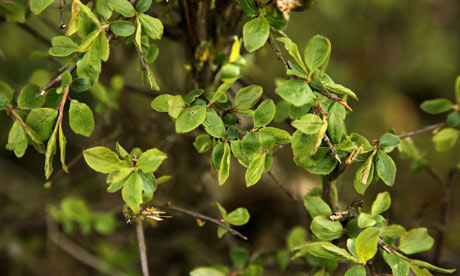
Blackthorn leaves. Photograph: John Wright
Americans will quibble over — and flat-out disagree with — some of Wright’s pronouncements. When he writes, for instance, that white rum has “no real flavour of its own,” let’s cut the man some slack. He is a forager, after all, and not a bartender or boozer whose job it may be to identify any number of white rums in blind tastings. But his takes on orange beer, parsnip wine, rhubarb wine, chestnut liqueur, cider, blackberry whiskey, dandelion and burdock beer, and so much more have inspired me to pay closer attention to the seasons here in San Diego and what’s flowering and fruiting when in the parks nearby. Lemons, grapefruit, and rosemary are everywhere here; it's the keen eye that spots rose hips, lemonwood flowers, and feral nasturiums, just there for the taking.

From his most recent article, here’s Wright’s verbatim scaled-down version of épine, a French aperitif that’s a very close cousin to sloe gin since it uses the leaves of the blackthorn bush rather than the sloe fruits familiar to us. We are told that in France friends of his friend who supplied the recipe are ignorant of sloe gin and leave the fruits to rot on the shrubs. Sacré bleu!
Épine apéritif
2½ litres of red wine or homemade red fruit wine such as blackberry or elderberry
Half a bottle of brandy or eau-de-vie
500g sugar
About half a litre of blackthorn leaves (don't use more leaves than I recommend because blackthorn, like all the plum species, produce traces of cyanide as a byproduct of the almond flavour it imparts)
Put all the ingredients into a food quality plastic container, stir and fit the lid tightly. Leave for two weeks, stirring occasionally. Transfer to clean bottles using a funnel and some doubled-up muslin cloth to filter out the bits. As with nearly all drinks it improves with age. Santé!

Goes well with:
  • The entirety of John Wright’s Homebrew from the Hedgerow series is here.
  • Sloe what? Sloe gin? Yup. Check out what Irish poet Seamus Heaney says about it here. 
  • The River Cottage Preserves Handbook is a great little tome. I write about it here and include a recipe for beech leaf noyau. 
  • About those feral nasturiums. They'll be coming into seed soon enough. Here's a recipe for pickling the pods. 

Friday, April 6, 2012

A Fistful of Pears

I recently heard a straight guy — a married man, with kids — declare about distiller Lance Winters "I would be that man's wife in a heartbeat." I'm not sure how Winters would feel about that. Or Mrs. Winters, for that matter. But I understand the sentiment. See, we have a deep and abiding respect for St. George Spirits here at the Whiskey Forge. More than once I've considered chucking my entire career, throwing myself at Winters' feet, and saying "Teach me." That hasn't happened yet.

Yet.

But this morning, that old thought resurfaced as I watched the new video A Fistful of Pears featuring Winters and Jeff Levy of Bread & Gin. Recipe for the brandy-and-Bonal drink is below. Meanwhile, here's the California distiller slinging liquor and smoking a cigar like he's doing it a favor:


A Fistful of Pears

1 oz Aqua Perfecta pear liqueur
1 oz Aqua Perfecta pear brandy
1 oz Bonal aperitif wine
Grapefruit peel for garnish

Stir brandy, liqueur, and Bonal in a mixing glass with ice, strain into a chilled glass. Rim with fresh grapefruit peel, drop in the peel.

Wednesday, April 4, 2012

Winners of ADI's 6th Annual Judging of Artisan American Spirits

Word has come this morning from Andrew Faulkner, judging director for the American Distilling Institute, that winners for the ADI's 6th Annual Judging of Artisan American Spirits have been announced in Louisville, Kentucky. Since I was one of the judges, I've known some of these results since last month, but this is the first time I'm seeing the whole list. 

This year the categories were brandy, rum, and whiskey. With no further ado, the complete list of winners:

Best of Class
Artisan Distilled Whiskey
Corsair Artisan Distillery - Grainiac 9 Grain Bourbon
Brandy
Jaxon Keys Winery & Distillery - Jepson Old Stock Brandy
Rum
Turkey Shore Distilleries - Old Ipswich Tavern Style Rum

Artisan Merchant Bottled
Smooth Ambler Spirits Co - Old Scout Straight Bourbon Whiskey

Excellence in Packaging
Huber’s Starlight Distillery - Brandy


WHISKEY

Clear Whiskey
Silver Medal
  • Copper Fox Distillery - Wasmund's Rye Spirit
  • Deerhammer Distilling Company - Whitewater Whiskey
  • Tennessee Distilling Company - Collier and McKeel Charcoal Mellowed White Dog
  • Dark Horse Distillery - Long Shot White Whiskey
Bronze Medal
  • High West Distillery - High West Silver Whiskey - OMG Pure Rye
  • Finger Lakes Distillery - White Pike Whiskey

Corn Whiskey
Gold Medal, Best of Category
  • Limestone Branch Distillery - T.J. Pottinger Moon*Shine
Silver Medal
  • Asheville Distilling Company - Troy & Sons Moonshine
  • Colorado Gold Distillery - Colorado's Own Corn Whiskey
  • Dark Corner Distillery - Moonshine Corn Whiskey
Bronze Medal
  • Balcones Distillery - Balcones True Blue
  • Kings County Distillery - Kings County Moonshine
  • Ole Smoky Moonshine Distillery - Corn Whiskey
  • Pinchgut Hollow Distillery - Corn Shine

Bourbon
Gold Medal, Best of Category
  • Corsair Artisan Distillery - Grainiac 9 Grain Bourbon
Silver Medal
  • Corsair Artisan Distillery - Nashville Bourbon
  • Tuthilltown Spirits - Hudson Whiskey Four Grain Bourbon
Bronze Medal
  • Kings County Distillery - Kings County Bourbon
  • Tuthilltown Spirits - Hudson Baby Bourbon
Straight Bourbon
Silver Medal, Best of Category
  • Colorado Gold Distillery - Straight Bourbon Whiskey
Silver Medal
  • Ballast Point Spirits - Devil's Share Whiskey
Bronze Medal
  • Peach Street Distillers - Colorado Straight Bourbon

Malt Whiskey
Gold Medal, Best of Category
Golden Distillery - Samish Bay Single Malt Whiskey
Silver Medal
  • Golden Distillery - Samish Bay Whiskey Reserve
  • Rogue Ales & Spirits - Oregon Single Malt Whiskey
Bronze Medal
  • Corsair Artisan Distillery - Pils American Malt Whiskey
  • New Holland Artisan Spirits - Double Down Barley
  • Rogue Ales & Spirits - Dead Guy Whiskey

Straight Malt Whiskey

Gold Medal, Best of Category
  • Ballast Point Spirits - Devil's Share Whiskey
Silver Medal
  • Edgefield Distillery - Hogshead Whiskey
  • New Holland Artisan Spirits - Zeppelin Bend
Rye Whiskey
Silver Medal, Best of Category
  • Breuckelen Distilling - 77 Whiskey
Silver Medal
  • 1512 Spirits - Aged Rye Whiskey
  • Corsair Artisan Distillery - 100% Rye
  • Corsair Artisan Distillery - Ryemageddon
Non-Typical Whiskey
Gold Medal, Best of Category
Balcones Distillery - '1' Texas Single Malt

Gold Medal
  • 1512 Spirits - Signature Poitin
Silver Medal
  • Corsair Artisan Distillery - Oatmeal Stout Whiskey
  • Corsair Artisan Distillery - PreProhibition American Malt Whiskey
  • Florida Farm Distillers - Palm Ridge Reserve
  • Koval Distillery - Lion’s Pride, 47th Ward Whiskey
  • Old Sugar Distillery - Queen Jennie Sorghum Whiskey
  • Glacier Distilling Company - Wheatfish Whiskey
Bronze Medal
  • Corsair Artisan Distillery - Quinoa & Barley Whiskey
  • Corsair Artisan Distillery - Triticale & Barley Whiskey
  • Koval Distillery - Lion's Pride Millet Whiskey
  • Middle West Spirits - OYO Whiskey
Smoked Whiskey
Silver Medal, Best of Category
Balcones Distillery - Brimstone

Silver Medal
  • Corsair Artisan Distillery - Oak Smoked Wheat Whiskey
  • Corsair Artisan Distillery - Cherrywood Smok
Bronze Medal
  • Corsair Artisan Distillery - Triple Smoke
  • Square One Brewery & Distillery - JJ Neukomm Malt whiskey
Hopped Whiskey
Gold Medal, Best of Category
Corsair Artisan Distillery - Citra Whiskey

Silver Medal
  • Spirits of St. Louis - Hopskey
Bronze Medal
  • Corsair Artisan Distillery - Elderflower Bohemian Whiskey
Flavored Whiskey
Bronze Medal
  • Corsair Artisan Distillery - Old Punk
Artisan Merchant Bottled Whiskey
Gold Medal, Best of Category
Smooth Ambler Spirits Co - Old Scout Bourbon Whiskey

Gold Medal
  • Bull Run Distillery - Temperance Trader Bourbon
Bronze Medal
  • Great Lakes Distillery, LLC - Kinnickinnic Whiskey


BRANDY

Eaux de Vie
Silver Medal, Best of Category
Clear Creek Distillery - Eau de Vie of Blue Plum (Slivovitz)

Bronze Medal
  • Westford Hill Distillers, LLC - Kirsch Eau de Vie
  • Peach Street Distillers - Jack and Jenny Peach Eau de Vie
Aged Fruit Brandies
Gold Medal, Best of Category
Peach Street Distillers - Peach Brandy

Silver Medal
  • Peach Street Distillers - Pear Brandy
Bronze Medal
  • Harvest Spirits LLC - Rare Pear Brandy
Apple Brandy
Gold Medal, Best of Category
Westford Hill Distillers, LLC - New World Aged Apple Brandy

Silver Medal
  • Clear Creek Distillery - 8 year. Eau de Vie de Pomme (apple)
  • Colorado Gold Distillery - Colorado Gold Brandy
Bronze Medal
  • Carolina Distillery LLC - Carriage House Apple Brandy
  • Huber's Starlight Distillery - Apple Brandy
  • Huber's Starlight Distillery - Apple Jack
Grappa
Gold Medal, Best of Category
Clear Creek Distillery - Grappa Muscat

Gold Medal
  • Clear Creek Distillery - Grappa Nebbiolo
Bronze Medal
  • Flag Hill Distillery - Graham's Grappa
Brandy from Grapes
Gold Medal, Best of Category
Jaxon Keys Winery & Distillery - Jepson Old Stock Brandy

Silver Medal
  • Jaxon Keys Winery & Distillery - Jepson Signature Reserve Brandy
  • Dakota Spirits Distillery - Bickering Brothers Neutral Brandy
Fruit Infusion
Gold Medal, Best of Category
Sidetrack Distillery - Raspberry Liqueur

Gold Medal
  • Clear Creek Distillery - Liqueur of Oregon Cranberries
Silver Medal
  • Huber's Starlight Distillery - Black Raspberry Infusion
  • Huber's Starlight Distillery - Raspberry Infusion
  • Clear Creek Distillery - Eau de Vie of Douglas Fir
  • Bloomery Plantation Distillery - Cello Cremma Lemma
Bronze Medal
Clear Creek Distillery - Liqueur of Oregon Cassis (Creme de Cassis)
Harvest Spirits LLC - Core Black Raspberry
Apollo Fine Spirits - Queen Esther Sweet Fire Liqueur


RUM

Clear Rum
Silver Medal, Best of Category
Ballast Point Spirits - Three Sheets White Rum

Silver Medal
  • New Deal Distillery - Distiller's Workshop Rum
Bronze Medal
  • Dancing Pines Distillery, LLC. - Dancing Pines Rum
  • Bull Run Distillery - Pacific Rum
  • Turkey Shore Distilleries - Old Ipswich White Cap Rum
Amber Rum
Gold Medal, Best of Category
Turkey Shore Distilleries - Old Ipswich Tavern Style Rum

Silver Medal
  • Desert Diamond Distillery - Gold Miner Spirits Barrel Reserve Rum
  • Ryan and Wood Distillery - Folly Cove Rum
Bronze Medal
  • Dancing Pines Distillery, LLC. -- Cask Barrel Aged Rum
  • Rogue Ales & Spirits - Dark Rum
  • New Deal Distillery - Distiller's Workshop Rum, Amber
  • Old Sugar Distillery - Cane and Abe Freshwater Rum

Overproof Rum
Silver Medal, Best of Category
Barrel House Distilling Co. - Oak Rum

Silver Medal
  • Privateer Rum - Privateer True American Rum
Flavored Rum
Silver Medal, Best of Category
Dogfish Head - Brown Honey Rum

Silver Medal
  • Duncan's Idea Mill, LLC - Dunc's Mill - Elderflower
Spiced Rum
Silver Medal, Best of Category
Dancing Pines Distillery, LLC. - Spice Flavored Rum

Artisan Merchant Bottled Rum
Silver Medal
  • New Holland Artisan Spirits - Huron Rum
Bronze Medal
  • Firefly Distillery - Sea Island, Java
  • Firefly Distillery - Sea Island, Spice
  • Spirit of Texas - Pecan Street Rum

Thursday, February 16, 2012

Judging Artisan Spirits, 2012

I'm off to Kentucky next week for the annual judging of American craft spirits. I'll be joined in Louisville by some cocktail types, including San Francisco barman H. Joseph Ehrmann of Elixir, Audrey Saunders of  Pegu Club fame, and Flavien Desoblin of New York's Brandy Library. There will be distillers on board as well, rum specialists, and booze hounds (and I mean that in the most respectful manner) aplenty. Thirteen judges in all.

Under the imprimatur of the American Distilling Institute, three panels of judges will evaluate 244 spirits from nearly 100 distilleries over the course of two days. That breaks out as:
  • 45 rums
  • 60 brandies
  • 139 whiskeys
Gins, absinthes, and other spirits rotate through during other years (I'll do my best to advocate for a bitter/amari category now that so many American examples are coming onto the market). I won't know until I arrive, but I suspect I'll be on the whiskey panel which will tackle not just craft bourbons, but malt, wheat, rye, corn, and clear whiskeys as well as a catch-all "other" category. The rum judges will nose, swirl, and spit in six categories while the brandies are broken into five groups; grappa, brandy from grapes, non-grape aged brandies, non-grape unaged brandies, and fruit infusions.

No, no, no. It will be nothing like this.

Even if I am with the whiskey group, I'll be getting into the brandies as, ahem, "research" for my upcoming Tales of the Cocktail session on American non-grape brandies with Paul Clark and Bobby Heugel.

Results of the ADI judging will be announced at the annual ADI conference this coming April 1-4 in Louisville. 

Thursday, February 2, 2012

Rowley & Clarke on American Brandy at Tales of the Cocktail 2012

Last July, Dan Farber objected — politely, gentlemanly, pointedly — to the tight focus of Paul Clarke's session on applejack at Tales of the Cocktail. Clarke, an avuncular editor of Imbibe magazine and a frequent speaker at Tales, stayed on topic. Where are the European-style eaux de vie in this conversation? the California distiller wanted to know. Where are the other orchard spirits that American distillers have been making?

Farber's challenges sounded an awful like like an invitation. Even at the time, I recall, Clarke beamed and responded with something like "You're absolutely right. That's a great idea for a session next year." I had already wrapped up my own standing room only session with Max Watman on new American distilleries and could only smile as Clarke and I exchanged glances. You see, I dote on bourbon, I drink an awful lot of rum, but brandy? Good brandy makes me go weak at the knees.

In the intervening seven months, the two of us kicked around the possibilities for a session on American brandies. Not the whole time, mind you, but enough to agree on a pitch. Word came from New Orleans yesterday: we're on.

Plenty of details to be ironed out in the next few months, but here's the session in broad strokes:
For much of the nation’s history, applejack, peach brandy and other fruit spirits were key characters in the realm of American drinks. Today, bartenders and craft distillers are rediscovering the appeal of fruit spirits, and this is the most dynamic era in generations for the production and use of these brandies.

This session will cover some of the background of spirits made from apples, peaches, pears and other fruits, and the ways these spirits were historically made and consumed. The session will also explore today’s realm of American-distilled fruit spirits, from the rich character of aged apple and peach brandies to ethereal eau de vie, with an emphasis on the ways these spirits are produced and a look at some of today’s most distinctive distillers of fruit spirits. Panelists will also discuss the use of fruit spirits in cocktails, from classic drinks made with aged apple and peach brandies to special considerations that should be taken when mixing with eau de vie.
Location, date, time, etc. to come in early March. All I know for now is that I'll be back in New Orleans' French Quarter this July 25th-29th.

[edit: The brandy session is still on, but there's been a change in the lineup. See here to see who's on deck.]

Goes well with:
  • Tales of the Cocktail is a nonprofit based in New Orleans dedicated — in its own words — to the advancement of the craft of the cocktail through education, networking and promotion. Check out its website and Twitter feed. Its name is also dropped occasionally as Shit Bartenders Say.
  • Dan Farber makes brandy in California, including a lovely French-style brandy made from California apples that's been sleeping in barrels since Roseanne last aired. Check out his distillery at Osocalis.com.
  • As @cocktailchron, Paul Clarke is also on Twitter. Paul's not only a friend of mine, but one of the first journalists who actually got the story right of what modern the American moonshine scene looks like in a 2009 issue of Imbibe. For that alone, a gold star always appears next to his name in my book.

Wednesday, December 21, 2011

Snapdragon: Playing with Fire

If you live in a hoary northern clime and it comforts you to think that those who move to sunny San Diego somehow miss the cold, then, by all means, wrap yourself warmly in that mantle of delusion. We don’t.

Though I had a deft hand at cold weather cooking and drinking, hot punch, mulled wine, and various toddies just don’t carry the restorative powers that they seem to in the darker months of those places plagued with “four distinct seasons.”

 
Snap-dragon
from Robert Chambers' (1879) Book of Days
But add a little fire to the booze rather than just warming it? Well, even self-satisfied San Diegans don’t turn our noses up at that. From the simply flamed orange peel over a cocktail to more elaborate preparations among the tiki crowd, the blazing romance of flames and alcohol is nothing new. In fact, one venerable bit of flaming foodways plays well in both temperate and more frosty climes — snapdragon.

Known to Charles Dickens, Samuel Johnson, and even further back to seventeenth century, the eating/drinking game snapdragon (or snap-dragon or occasionally flapdragon) has largely died out.

Let's walk through it and you'll understand why: First, kill the lights. Next, two to three raisins per person are placed in a broad, shallow dish. Warmed brandy is then poured over them — just enough to come up to their collars — and set alight. As blue and orange flames dance over the surface of the brandy and scamper across the raisins, guests take turns snatching single flaming raisins from the mix and popping them into their mouths, extinguishing the fire-robed fruit.

Around the time of the American Civil War, Anthony Trollope writes of the game in his novel Orley Farm:
'And now for snap-dragon,' said Marian.

'Exactly as you predicted, Mr. Graham,' said Madeline: 'blindman's buff at a quarter past three, and snap-dragon at five.'

'I revoke every word that I uttered, for I was never more amused in my life.'

'And you will be prepared to endure the wine and sweet cake when they come.'

'Prepared to endure anything, and go through everything. We shall be allowed candles now, I suppose.'

'Oh, no, by no means. Snap-dragon by candlelight! Who ever heard of such a thing? It would wash all the dragon out of it, and leave nothing but the snap. It is a necessity of the game that it should be played in the dark—or rather by its own lurid light.'
So, yes, darkness is essential, but speed is the real name of the game. For one, fire is hot and the faster you take your turn, the less chance of sustaining a burn. Second, the brandy won’t flame forever. The alcohol doesn’t burn off entirely (an old wives tale, a cooks’ inside joke), but it does burn until the proof lowers so much that it can’t sustain a flame.

You can understand why today’s safety-conscious parents would shut down a game of snapdragon before it ever began. Burned fingers, singed hair, booze for kids (yes, it was popularly, if not exclusively, a children’s game), burned table linens, and scorched floors get one reported to the authorities for child abuse. God forbid some antic soul should knock over accidentally a bowl of flaming alcohol onto the carpet, a pet, or another person and do some real damage.

Fortunately, I have no children. I do have raisins, however, a broad granite counter., and friends expected Christmas day. Brandy? You know I’ve plenty of brandy.

For obvious reasons, I suggest you not play snapdragon this winter. It died out for a number of reasons, not the least of which is safety. If my knuckles are bereft of hair the day after Christmas, though, you know what we’ve been up to over at the Whiskey Forge.

Monday, December 19, 2011

Drinking Advocaat

I think it is better always 
to have a drink before people arrive 
and that way, 
you’re just a bit more mellow...

~ Nigella Lawson

Now that we’ve established some semblance of a nomenclature and etymology for the egg liqueur advocaat, three questions arise:
  1. Who makes the stuff?
  2. Once you’ve got it, what do you do with it?
  3. If you can’t find it, is there an easy way to make it at home?
Last things first: yes, there’s an easy way to make advocaat at home. My own recipe with fresh eggs and VSOP brandy makes 1.4 liters of about 37-proof egg liqueur (see below).

If you’re put off by the prospect of making your own, though, three main brands are common enough to find on the shelf at your local boozery or through online vendors ; Bols (from Holland), Verpoorten (Germany), and Warninks (made by DeKuyper Royal Distillers in Holland). A bottle of any of these is readily available for $17-28.

Just as eggnog and even bourbon find their ways into a variety of desserts from cookies to cake, so, too, does advocaat. Most simply, it’s drizzled over ice cream. It’s also incorporated into cream fillings for cakes and pastries, sauce (just add it to vanilla sauce), folded into tiramisu, paired with baked fruit, and hundreds of other desserts.

In its drinking form (rather than the thicker, slightly cooked, incarnation), advocaat is indistinguishable from German eierlikör. One could easily slap alternate labels on the same product for different markets. Our European colleagues have been guzzling the infamous Snowball made with these egg liqueurs for some time. Popular — or at least well-known — in the UK, it’s simply one part advocaat to two parts lemonade (British lemonade, i.e., Sprite, 7-Up, or bitter lemon soda). Here, Nigella Lawson bangs one out:


Recipes for homemade advocaat typically call for anywhere from half to a full liter of alcohol per dozen eggs. I take a middle path with slightly fewer eggs and split the difference on the booze. The result? More boozy than some, not as much as others.

Here’s how we make drinking advocaat around these parts. For a thicker, spoonable, version, use whole eggs, ditch the milk, and heat the mixture in a double boiler.

The sweetened condensed milk is not traditional — or even strictly necessary — but it does creep up in some Dutch recipes. I like the additional smoothness and slightly cooked taste it lends to the finished drink, but feel free to omit it. Should you do so, add up to an additional ¾ cup of sugar. Likewise, if you just can’t get enough liquor inside you, this recipe will easily admit another 250ml/1 cup of 40% abv alcohol.

Rowley’s Authentic San Diego Advocaat

10 egg yolks
250g/1.25 c sugar
3-4 gratings of fresh nutmeg
A pinch of salt
1 tsp vanilla extract
14 oz can of sweetened condensed milk
750ml brandy, neutral grain spirits, or vodka

Strain the egg yolks through a medium sieve into a large mixing bowl to remove the chalazae (those repugnant, curled little white cords that attach the yolk to the shell). Add the sugar, salt, and nutmeg. Whisk gently to combine.

Stir in the vanilla extract, sweetened condensed milk and alcohol. Whisk vigorously, then pour into sterilized bottles. Seal. It's drinkable now, but better after two weeks in the refrigerator.

Makes about 1400ml of 18% abv advocaat.

Notes
  • Clear spirits such as vodka or NGS will not affect the color of the drink noticeably. Many people prefer them for this reason. I use aged brandy which lends a slightly darker cast to the drink.
  • Hold me in contempt if you will, but I use Paul Masson Grande Amber VSOP for this. Best brandy in the world? No, of course not. One of the best you'll ever get for under $10 per bottle, though. Recently, I scored a 750ml bottle at a local pharmacy for $8. Love those Christmas liquor sales...
  • Clean egg yolks and whites off kitchen and cocktail gear with an initial rinse of cool water. Hot water can cook the stuff and make it much harder to remove.

Saturday, October 29, 2011

Bookshelf: The American Cocktail

She was rather like one of those innocent-tasting American drinks which creep imperceptibly into your system so that, before you know what you're doing, you're starting out to reform the world by force if necessary and pausing on your way to tell the large man in the corner that, if he looks at you like that, you will knock his head off.

P.G. Wodehouse (1919)
My Man Jeeves

With Christmas less than two months off, we’re solidly into cookbook season. This year, that means cocktail books as well. Of those, a handful of new American drinks titles should be on the radar for the cocktail geek in your life (even if that happens to be you). We’ll take a look at some of them over the course of the next week.

First up is The American Cocktail by the editors of Imbibe magazine. Imbibe writing is spirits-heavy, but covers drinking broadly, so any given issue may have stories on tea, soda, coffee, wines, beer, cider, or even water. Producing a cocktail book was a natural course for them; I’m glad to see the editors finally got around to it.

Headnotes on fifty recipes in the book give historical context, ingredient notes, and drinks origins. The recipes themselves are from bartenders across the USA and are broken into areas of the country (The South, Northeast, Midwest, West, and West Coast) where regional ingredients from sassafras to huckleberries lend a sense of place to all of them. Without getting to the elaborate preparations of molecular mixology, the book gives a pretty representative look at what drinking looks like in craft cocktail bars around the country. Wisconsin Kringle syrup to liven up your brandy, anyone? What about a persimmon margarita?

An eight-page appendix of American craft distilleries is a particularly welcome addition, as is specifying particular spirits from local distilleries throughout the book. Yeah, yeah, distribution is limited for a lot of the spirits, so you can usually swap out the specific spirit with a similar one you’ve got on hand, but hats off to the bartenders and editors for making the point to call out local liquor in many of the recipes. Hunt around online; you can often find merchants willing to ship local wet goods to your door.

In the section on the South, spirits and wine director Shannon Healy at Crook's Corner in Chapel Hill — my old stomping grounds — deploys the North Carolina cherry flavored soda Cheerwine in a bittersweet cocktail called Big Bay Storm.
Big Bay Storm

1.25 oz Gosling's rum
.75 oz ounce pineapple juice
.75 oz fresh lemon juice
.75 oz Campari
Ice cubes
1 ounce Cheerwine soda

Combine the rum. Campari, lemon juice, and pineapple juice in a cocktail shaker, add ice, and shake vigorously. Strain into an ice-filled Collins glass. Top with the Cheerwine. Stir to combine and garnish with the orange wheel.
From Portland, Oregon comes Evan Zimmerman’s North by Northwest cocktail, balancing apples in three forms (local brandy from Clear Creek Distillery, fresh-pressed juice, and apple butter) with lemon juice and Averna, a dark Italian amaro we use to good effect in dark Manhattans from time to time.
North by Northwest

1.5 oz Clear Creek apple brandy
.75 oz fresh lemon juice
.75 oz fresh-pressed apple juice
1 tsp apple butter
Ice cubes

Combine the brandy, lemon juice, apple juice, Averna, and apple butter in an ice-filled cocktail shaker. Shake well and double strain into a chilled cocktail glass.

The Editors of Imbibe Magazine (2011)
Photos by Sheri Giblin
The American Cocktail: 50 Recipes That Celebrate the Craft of Mixing Drinks from Coast to Coast
144 pages (hardback)
Chronicle Books
ISBN: 081187799X
$19.95