Showing posts with label scotch. Show all posts

Thursday, January 17, 2013

Replacing that Worn Out Still — Every Ding and Dent?

Since the nineteenth century, the Forsyth family has made stills. By some estimates, they have fabricated nearly half of Scotland’s whisky stills. Their firm, Forsyths, specializes in larger distillery systems, but builds each model to order and has made some as small as 50 liters. I recently spoke with Richard Forsyth Sr., chairman of the company, about Forsyths’ presence in the North American market. Although their footprint in the US is modest, it covers some noteworthy distilleries, including Balcones Distilling, Distillery 209, Kings County Distillery, Philadelphia Distilling, and Woodford Reserve. Building stills, however, is not the firm’s bread and butter. Repairing them is.

Old copper stills wear out. Or is that a Dalek?
Most American distilleries were founded in the last decade and are simply too new to have to contend with worn-out stills. In Scotland, however, aging equipment is an ongoing concern. “Our main business,” reports Forsyth, “is replacement of worn stills. Distilleries can run 24/7 and run down pot stills quite quickly. We check the copper’s thicknesses on an annual basis in Scotland and home in on wear areas. We write reports and then sit down with each client to agree on a replacement program.” The traditional two-still process in Scotland is particularly hard on the equipment. A preliminary run on the first still produces low wines, a relatively low-alcohol liquid. These low wines are then run through a second still, often called a spirit still, which concentrates ethanol further yielding white dog or new make which, when aged, cut, and blended (or not), becomes the Scotch whisky we know.

The wear patterns on those stills are exactly opposite. Harsh low wines, explains Forsyth, corrode the upper parts of a still within 10-12 years, while the pot may last 30-40. On the second distillation, it’s the other way around. Low wines and feints corrode the boiler, but the spirits rising through the upper parts are much more refined, so upper parts like such as the Lyne arm and swan’s neck may last 30-40 years, but the pot only 10-12 years.

Rather than replacing the entire still — an expensive proposition — Forsyths craftsman cut away worn areas and replace them with new materials. Those apocryphal stories about Scotch distillers replacing old stills with brand new ones that exactly replicate every dump and dent so that distillers can faithfully reproduce whisky that is exactly the same every single time? Turns out that’s just a good story for gullible drinkers.

 “Replacing old stills down to the last ding, bump, and patch?” chuckled the chairman. “That’s not quite true; those old stills may have a dent or two. Rather than replace the entire still, we only replace the parts that require it. If we cut out a patch or replace a part, we will replicate angles and shapes religiously, so that the contours of the boiler or Lyne arm, for example, are exact duplicates. After all, if we built it, we still have the original plans. But every ding and bump? No, we don’t do that.”

So pour that in your glass and drink it.

Goes well with:

Sunday, November 25, 2012

Ernie Button's Vanishing Single Malt Scotch

Put that back. You can't just take any crap. 
Now. Single malt, 16 year old, taut, full flavor, warmer, not aggressive. 
Peaty aftertaste.
Takes out the fire but leaves in the warmth.

~ Frank (Brendan Gleeson)
28 Days Later

Abelour 103
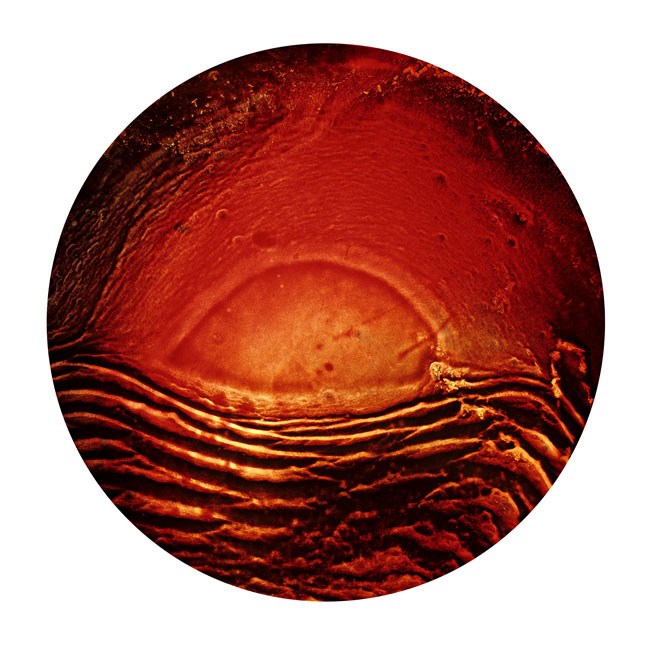
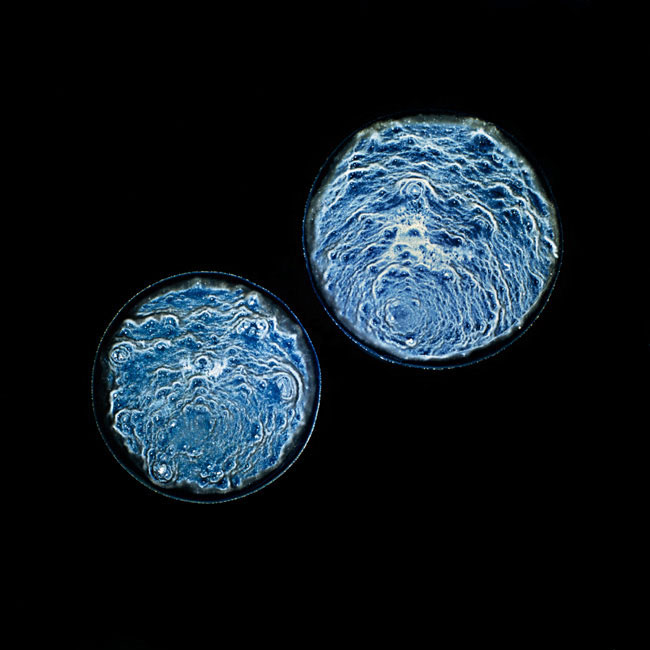
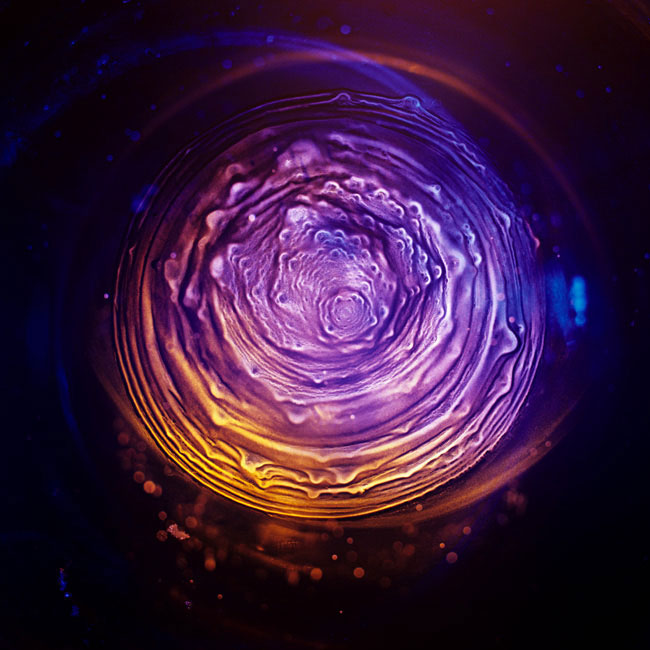
We've all cleaned glasses with residue of drinks in them, but Ernie Button realized that something other than dirty dishes — something beautiful — was happening under our very noses. While putting a glass that had held Scotch whisky in the dishwasher, Button noticed a film of residue with fine, lacy lines on the bottom. Closer examination led to a photography project, Vanishing Spirits – The Dried Remains of Single Malt Scotch.
What I found through some experimentation is that these patterns and images that you see can be created with the small amount of Single-Malt Scotch left in a glass after most of it has been consumed. The alcohol dries and leaves the sediment in various patterns. It’s a little like snowflakes in that every time the Scotch dries, the glass yields different patterns and results. I have used different color lights to add ‘life’ to the bottom of the glass, creating the illusion of landscape, terrestrial or extraterrestrial. Some of the images reference the celestial, as if the image was taken of space; something that the Hubble telescope may have taken or an image taken from space looking down on Earth. The circular image references a drinking glass, typically circular, and what the consumer might see if they were to look at the bottom of the glass after the scotch has dried. A technical note about this project. The images were titled with the specific Scotch that the rings were created with. The number is a 3 digit number that has nothing to do with the age of the scotch. Merely a number to help differentiate between images.
To my eye, Button's vanishing single malt images look as much like photos taken from celestial telescopes or by undersea Arctic explorers than they do photos of something so warm, comforting and homey as single malt Scotch. A link to the project in his portfolio is  below.
glenlivet-137

Balvenie 125
Specimen - Glenfiddich 15
Macallan 103
Dalwhinnie 122


Goes well with: 

  • Photographer Ernie Button's series, Vanishing Spirits – The Dried Remains of Single Malt Scotch.
  • The Purpose of Good Liquor, in which I ship out a bunch of nice Scotch for no other reason than it would make someone happy. 

Sunday, October 7, 2012

The Purpose of Good Liquor

My brother drinks coffee; I drink tea. He and I are two strikingly different men with divergent tastes in everything from politics to pets. He’s nearly a decade older than I and, except for our eyes, our laughs, and general build, there’s no reason to think we are related. Few things to my mind illustrate this more than our tastes in alcohol.

He likes white wines while I prefer reds. He detests gin; I dote on it (and its more aggressive Dutch cousin, genever). I’m a confirmed bourbon drinker, but Scotch is his go-to beverage. The list goes on and on. Somewhere near the bottom of our pro/con t-chart is tequila, the one spirit on which we agree; we like it. A pessimist might conclude that we’re doomed to dislike everything about one another. I prefer to think that when we put our minds to it, there’s nothing we won’t drink.

For his birthday, I sent him my Scotch. Not all of it, by any means, but some choice bottles; a single bottle of big-shouldered, peaty Ardberg and three lovely Macallan bottles: 12-, 15-, and 17-year old. Why? Would I not drink them? Yes, eventually, of course. But he’ll derive so much more pleasure from them than I could — and what, after all, is the purpose of good liquor, if not to share?

If you run into my brother, tell him I like Willett, Van Winkle, and Booker’s.

Friday, August 7, 2009

Robert Carlyle Could Sell Me Matches in Hell

Update 17 August 2009: Apparently, the video has been pulled due to pending legal action. Sigh...the only thing I've liked about Scotch recently and it's gone. Initial searches for alternate sites are not fruitful. If I can find another source, I'll repost it.

Hey, piper! Shut it.

~ Robert Carlyle
The Man Who Walked Around the World

Robert Carlyle is a joy to watch. Liked him in Trainspotting. Delighted with his over-the-top, man-eating performance in Ravenous. Without him, 28 Weeks Later would’ve been a snore.

And now he’s shilling Johnnie Walker whisky. I like to tease scotch drinkers about the unsuitability of their beverage of choice for human consumption less because I dislike scotch itself than I enjoy watching them defend their erudition. It turns out that I do enjoy particularly aged single malts. But I enjoy razzing orthodoxy more.

Put Carlyle, however, in a 5-plus minute short film (ok, ok, a long commercial) telling Johnnie Walker's brand story on a brisk walk through the Scottish highlands? I am all ears.


Whiskey firms—unlike, say cola, energy drink, or vodka firms—rely on history and age to convey authenticity. Think “Old Forester,” “Old Overholt,” and the rich browns, ambers, and reds in endless whiskey color palettes that suggest dark, aged woods and Autumn’s falling leaves. Or of sepia-toned photos in print ads we’ve all seen of coopers hard at work, handcrafting barrels in which whiskey will slumber for years. Yes, “age” is the unspoken (or—“Ancient Age”—not so unspoken) shibboleth of authenticity for whiskeys.

How fitting that Carlyle’s first words after emerging from the mists (of time, naturally) seemingly push aside the Scots history we think we know with his dismissive words to the traditional bagpiper. Frankly, the Scottish actor echoes my own thoughts with a brusque "Hey, piper! Shut it." But he’s not dismissing history. Just stereotypes. In fact, he launches into a monologue about Johnnie Walker that's the most compelling corporate history I've seen in years. Bravo, sir.

It’s a beauty of a little film. I heard the shot only required 40 takes.

.

Monday, August 18, 2008

Monday Roundup: Moonshine, Grappa, Absinthe, and Scotch

The production of grappa is part of northern Italy's social and cultural tradition and is carried out in the Alpine regions by hundreds of families, as it always has been.

~ Senator Sergio Davina
arguing for legal home distillation of grappa


I've been offline for a few days, but the world of booze just keeps rolling on. Some of the highlights from the last week include—

  • Writing in Esquire, David Wondrich demonstrates the correct way to serve absinthe (note there are no flaming sugar cubes which translate into ruined absinthe spoons and little globs of caramelized sugar arc-welded to the sides of your glass). He also includes thumbnail reviews of the brands he considers The Five Best Bottles of Absinthe.
  • Our friend and all-around great guy Ian Smiley is in the news. Ian has been working with Michigan enterprise LS Moonshine to develop a distillery in China for producing unaged corn whiskey. Seems the Chinese have a taste for young corn liquor. I do remember a tale of a family member drinking shots of corn liquor with a Chinese general and breaking protocol by not allowing the general to win that little competition. Maybe Ian can help me steer my way through Chinese drinking protocol...
  • Speaking of China, seems there's a (gasp) serious problem with counterfeit goods the producers of genuine articles are trying to combat. Diageo has rolled out an anti-counterfeiting measure with their Johnny Walker scotch. In some markets (e.g., India) about half the scotch is counterfeit and, from what some distillers have told me, the figure is much higher in Pakistan where the scotch is not only fake, but very expensive. Like, someone-is-going-to-hell-for-this-scam-expensive. Diageo's solution? Make a bottle that can't be resealed to look new once it's been opened. According to Australian Food News,
Caps on Johnnie Walker bottles will now not return to their original position after opening and a permanent gold band appears at the top of the neck of the bottle upon opening - effectively eliminating the prospect of a disguised refill.

And for today, that's all the news that's fit to drink.


.

Wednesday, June 25, 2008

Scots Distilleries Go Dry


We've had to stop production for the past 10 days.

~ Mark Reynier
managing director
Bruichladdich Distillery

Penguins seem in good shape for our lifetimes, though I suppose I'll miss the polar bears, destined as they seem for extinction. I did not, however, expect to hear that climate change would have such an immediate effect on distillers. My friend and distiller Brooks Hamaker passed on a disturbing bit of news.

Over the centuries, famine has affected the distilling industry—even a casual reading of British legislation regulating grain since the 17th century reveals restrictions on how grain may be used in times of want. Nothing new there.

The twist this month in Scotland seems to be that there is a connection to global warming patterns. Uncharacteristically sunny and warmer days have meant that the rainfall is down enough to stop production outright at a number of Scotland's whisky distilleries and slow production at others.

My brother has inherited a taste for Scotch from our grandmother, an appreciation that has passed me by. Regardless of how much Scotch I may or may not keep around the house, I hate to see any artisans get hosed by circumstances beyond their control.

It is a sad day for these distillers and my heart goes out to them. See the Gaurdian's write-up here.

~~~~~
In penance for once having said an unkind thing, here's a nod to Scotland's dessicating distilleries:

Camper English and I were sharing drinks last summer at San Francisco's Bourbon & Branch, discussing some of our favored spirits with a local home distiller. Camper ordered a Scotch-based Blood & Sand cocktail and I must have pulled a face.

"You don't like scotch?" he asked, as if maybe I had claimed that I don't like cake, holiday bonuses, or long vacations.

"Feh. I'd rather lick an alleycat," I said, somewhat overstating the case.

"Well." He blinked. Paused. "You're wrong." And to prove it, the Scotch evangelist offered me a dose of his cocktail when it came.

For just a fleeting moment, in the dark recesses of the secluded loft, away from the ears of the other patrons, with Billie Holiday playing through the speakers, great conversation about unlicensed stills flowing, and perched on a chair in good company, it seemed as if I'd tasted heaven when my lips touched that glass.

Then the familiar peatreek taste came to me. If that's the taste of heaven, it's probably for the best that I'm headed to the other place.

The Blood & Sand Cocktail

1 oz. Scotch
1 oz. orange juice
3/4 oz. Cherry Heering (a Danish cherry liqueur)
3/4 oz. sweet vermouth

Shake with ice, strain into a cocktail glass, and garnish with a brandied cherry.

Ok, ok, this is better than an alleycat. But I'm still waiting to try the Scotch whisky that will make me eat my words.

.