Showing posts with label Germany. Show all posts

Wednesday, February 19, 2014

Bierocks, Beer Rocks, Berrocks

I made the mistake of posting a food photo on Facebook last month without explaining how to make the things. Yesterday several friends took notice and asked for the recipe. For those who cannot do without bierocks, here’s that recipe. Bie-what? Yeah, we had that conversation at home. Between a Midwesterner and a native Californian, it went something like this:

"What are they?"
"Bierocks."
"What?"
"Bierocks."
"They're what?"
"German bao."

"Oh!"

Coastal Californians, of course, have more intimate knowledge of dim sum dumplings such as xiaolongbao than they do of Midwestern comfort food, so appealing to a bao sensibility was simply a fast way to get at the heart of the meaning. I could have just as easily called them Kansas empanadas. Bierocks, brought to the American Midwest by 19th century Mennonite immigrants, are stuffed rolls that fit in the palm of your hand.

Norma Jost Voth writes in Mennonite Foods and Folkways from South Russia (volume 1):
Bierocks, among Molotschna Mennonites, were bread pockets amply filled with a mixture of ground beef and cabbage. A little like a hamburger sandwich, they made a hearty meal, were conveniently served hot or cold and made ideal traveling companions for trips or picnics...The word Bierock is related to the Turkish word berok or boerek. Today, in the Crimean city of Simferopol (where Russian Mennonites went to school or went shopping) they are called cherbureki and sold on the street.
Also spelled beer rocks or berrocks, the word is also a cognate of piroshki, pierogi, pirogi, and the dozens of other spellings for those thick, filled dumplings popular in Polish families, and are similar to Russian, Ukrainian, and other central and eastern European dumplings. These, however, are a bit bigger and baked rather than simmered and pan-fried. In the American Midwestern states of Kansas, Nebraska, and Missouri, even larger versions are sometimes known as runzas (because, wags that we were in college, we figured a meal of the low-grade examples from our dorm’s cafeteria would deliver a nearly immediate, and perhaps fatal, case of the runs).

No worries. These shouldn’t cause such gastronomic distress — unless you gorge a dozen or so. Then you deserve it. In fact, I am under orders to make more “German bao.” The recipe below is one I adapted, slightly, from Bruce Aidells and Dennis Kelly’s good book, Real Beer and Good Eats. The filling is classic: cabbage, onions, and sausage. It is, however, a versatile recipe and practically begs to be tweaked. Some variants I like: (1) Make a pseudo-Reuben by swapping out 2 cups of rye flour for 2 of all purpose flour, add some caraway to the dough, and use sauerkraut, pastrami, and Swiss cheese (deli Swiss is fine or class it up with a nice Comte or cave-aged Emmenthal), (2) Use any or all of mushrooms, fried onions, spinach, or Swiss chard as fillings. (3) Try roast pork, garlic, broccoli raab, and sharp provolone. You get the idea. Keep the stuffing moist and fully enclosed when you make the buns and you should have no problems.

Bierocks

Filling
1½ pounds/680 g fresh sage or smoked sausage, removed from the casings
1 cup/300g onion, diced small
4 cups/300g shredded cabbage
1 Tbl fresh minced garlic (or 1 tsp powdered)
1 tsp salt
1 tsp dried onion powder
½ tsp pimento/smoked paprika

Dough
⅓ cup/75g sugar
½ tsp salt
1 package (1 ounce) active dry yeast
1½ cups/350ml warm cooking water (at about 100° F.) from the potatoes
⅔ cup/150g butter, softened
2 eggs
1 cup/265g warm mashed potatoes (at about 100° F.)
7—7½ cups/about 900g all-purpose flour

To make the filling: Fry the sausage over medium heat 3-5 minutes to render some of the fat. Pour off the fat, and add the onion, cabbage, salt, and spices. Cover and cook for 10 minutes, or until the cabbage has wilted. Set aside to cool while you prepare the dough.

To make the dough: Dissolve the sugar, salt, and yeast in the warm potato water. Proof in a warm spot (80-100°F/27-38°C.) until the mixture becomes bubbly, about 5-10 minutes. Pour into a large mixing bowl. Blend in the butter, eggs, mashed potatoes, and 7 cups of the flour.

Knead on a floured surface until the dough becomes elastic and easy to work, about 5-10 minutes. Add the remaining flour if needed. Place the dough in a large oiled bowl and cover loosely with plastic wrap. Let rise in a warm spot for 45 minutes to 1 hour until the dough doubles in size.

After it has risen, punch down the dough and form into 24 equal balls. Pat the balls into ½-inch-thick rounds, about 2 inches in diameter. Place about ¼ cup of the filling in the middle of each round. Form the dough around the filling to make round rolls. Pinch the seams together and place, seam-side down, on a baking sheet. Put in a warm spot and let the rolls rise for 20-40 minutes. It the surface of the dough has dried out, brush lightly with water.

Heat the oven to 375°F/175°C. Bake the rolls for 20-25 minutes or until the beer rocks have a nice golden color and a mouth-watering aroma. The rolls freeze well.

Makes 24 rolls, 3-4” diameter.

Adapted from Bruce Aidells and Dennis Kelly (1992) Real Beer and Good Eats: The Rebirth of America's Beer and Food Traditions.

Goes well with:

  • Aidells and Kelly's book can be had for ridiculously little money on Amazon. 
  • Speaking of homey Midwestern foods, it's still cold and wet in huge swaths of the US; try some German bacon dumplings or homemade egg noodles to take the chill off.  
  • Norma Jost Voth's Mennonite Foods and Folkways from South Russia is not quite as cheap or common as Real Beer and Good Eats, but it should be easy enough to track down copies in the US and Canada. Volume one can be found here and volume two here.
  • Finally, if you just can't bring yourself to make dough from scratch, you could — in extremis — pop open a tube of ready-to-bake biscuits, stuff them, and bake them off as above. It's ok: I've cooked drunk before, too. Tart them up at least a little, though; an egg glaze, maybe, sprinkled with flaky salt, caraway seeds, or a blend of cumin and smoked paprika. 

Wednesday, June 5, 2013

Stolpersteine

I know the bronze blocks exist throughout Berlin, but still — to come across a cluster of Stolpersteine unexpectedly after lunch recently was an arresting and gut wrenching counterpoint to the pleasant meal. Stolperstine are the work of Cologne artist Gunter Demnig and each commemorates an individual killed by Nazis. Most of the dead are Jewish, but some named were Gypsies, homosexuals, and political undesirables.

In Smithsonian Magazine's blog, Lois Gilman writes "More than 12,000 such stones have been installed in roughly 270 German towns and cities since Demnig hammered the first brass blocks into Berlin's sidewalks in 1996." Each denotes who lived at that address, when they were born, the date they were taken away, and what happened to them. "Deported to the Warsaw Ghetto." "Murdered in Auschwitz." "Murdered in Riga." And, simply, "Murdered."

Even trod underfoot and littered with cigarette butts, the names of the dead still have the power to take one's breath away.


Goes well with:
  • Lois Gilman's piece, Memory Blocks, explains the history of the blocks.


Tuesday, June 4, 2013

Back from Berlin, Trouble with the Language

Lili Von Shtupp: Would you like another schnitzengruben
Sheriff Bart: No, thank you. Fifteen is my limit on schnitzengruben.

~ Blazing Saddles (1974)

I've been away for a bit in Germany and Holland where I ate, drank, and hit up old bookstores. More on that later. On our first day in Berlin, the boys were exhausted after an overnight train from Munich left everyone considerably less rested than we had hoped we'd be. While they trundled off to bed, I bundled up and headed into the rain to hunt for liquor and sausage-making books.

On returning to the hotel, one of them asked me whether I'd found anything good. "Oh, yeah," I enthused, pulling out a few old books from their rain-flecked paper wrappers. "Check it out. Bowlen und PünscheDie Fabrikation feiner Fleisch- und Wurstwaren, and a nice copy of Das Getränkebuch by Franz Josef Beutel and Hans Krönlein."

He blinked, propped up on one elbow and still freighted with sleep. Blinked again. "All I heard was 'Blau, blau, blau, bitte schön, gau, gau, Schnitzengruben."

German, it seems, falls harshly on some ears. The recipes will go into rotation this summer. Let's hope they are better received.

Goes well with:

Thursday, May 9, 2013

Durch Nacht zum Licht: 1955 Animated Underberg Bitters Ad

Hans Fischerkoesen's animated advertisement for Underberg bitters is a nightmarish glimpse at one woman's troubled mind. The 1955 ad, Durch Nacht zum Licht (Through Night to Light), shows an unnamed woman sweating and tossing in troubled sleep. She is threatened by skeletons, rats, demonic red hands, explosions, ghosts, and a floating gun. At one point, she tumbles in free fall past tall buildings, part precursor to Mad Men's opening montage, part Camille Saint-Saëns' Danse Macabre. The sleep of mid-century German women seems a dark place indeed. In the end, her night terrors are banished by a small bottle of Underberg bitters, famous even today as a stomachic for soothing heartburn or simple overeating.

Let me play you a lullaby.
After seeing such a disturbing vision of sleep, I need a shot of Underberg as well. Well done, Herr Fischerkoesen.

Sometimes known as Germany's answer to Walt Disney, Fischerkoesen (1896-1973) had been a sickly child and, with his sister Leni, put on puppet shows and other entertainments for their family in Bad Koesen. During World War I, he worked in army hospitals near the front and, during slack stretches, he drew. When the war was over, he cobbled together money to make an animated film, Das Loch im Westen (The Hole in the West). No copies seem to survive, but William Moritz writes in The Case of Hans Fischerkoesen that the animated film was an indictment against war profiteers as the true cause of war.

By the Second World War, he had become a well-known animator. Though he was no Nazi, he was forced to comply with edicts from Reich Minister of Propaganda, Joseph Goebbels, to compete against American animation technology. Moritz makes the case that, while rising to Goebbel's challenge, three of Fischerkoesen's animated wartime shorts were, in fact, subversive and slyly repudiated Nazi rule. After the war, he returned to a successful animation career, turning out many advertising shorts that won awards in Rome, Cannes, Milan, Monte Carlo, and Venice.


Monday, April 1, 2013

Sucking Weisswurst

Well, I'm not dumb
but I can't understand
why she walked like a woman 
but talked like a man.

Ray Davies 
Lola (1970)

This Spring, I'm spending time in Munich, Berlin, and Amsterdam. Preparation for that trip includes reading daily news from Germany and the Netherlands; watching Dutch and German films to get the rhythm of the languages again; and drawing up lists of specific spirits, foods, and antiquarian distilling and charcuterie books to track down. It was while reading Culinaria: Germany, though, that I was brought up short by a claim that simply strains credulity.

The entry concerns that Bavarian specialty weisswurst, a  sausage made of veal and typically eaten mid-morning with soft pretzels, mild mustard, and beer — not sauerkraut, as one might encounter in other parts of the world or even other regions of Germany. Should some tourist fail to ask for traditional accompaniments and order sauerkraut, the editor maintains,
A native Bavarian sitting nearby will either turn away in horror, or be quick to offer advice when, in addition, he sees the "foreigner" wielding a knife and fork, cutting the sausage up into small pieces. He will explain that the correct way to eat this sausage is to zuzeln it — a verb for which the foreigner, even if he is a German citizen, will search his dictionary in vain. It is a Bavarian dialect word meaning "suck," and describes the proper way to eat Weisswurst: you cut it in half with a knife, pick it up in your fingers, dip it in sweet mustard  no other kind will do  and suck it out of its skin. The experience is primeval and sensuous; it is no coincidence that "sucking" the sausage suggests associations with breast-feeding.
Now, I'm an historian and retired museum curator, not an eminent psychoanalist, but even I understand that international and cross-lingual jokes concerning sausages' phallic shape had been worked pretty hard long before the 19th-century supposed invention of weisswurst. Nor, it must be admitted, am I thoroughly versed in all the ins and outs of Bavarian culture, but to suggest that anyone happily sucking away at a juicy, fat white sausage is reliving infantile experiences of breast-feeding...well.

Sucking a weisswurst is primeval, as the text notes. It is sensuous. But ignoring an elephant of that magnitude in the room takes a special kind of denial.

Goes well with:

  • Christine Metzger (2008) Culinaria: Germany. f. h. ullman. ISBN: 978-3-8331-1030-6. Amazon vendors sell the paperback for over $300. That's ridiculous; the hardback sells for under $30 here
  • If you'd like to take a run at making your own weisswurst, Bernhard Gahm's 1998 German language book Würste, Sülzen, Pasteten selbstgemacht will set you right. If you prefer English-language instructions, try Rytek Kutas' cornerstone sausage-making book, Great Sausage Recipes and Meat Curing. Finally (and it's a bit pricey), multiple French versions of white sausage — boudin blanc —are presented in volume one of the Professional Charcuterie series by Marcel Cottenceau et al (Van Nostrand Reinland, 1991).

Monday, December 17, 2012

Cooking with Lard, Potash, and Hartshorn: 1932 Lebkuchen

A little royal icing with rum is no hateful addition
I've just returned from a week in Kansas City where, among other errands, I delivered a small load of German yuletide spice cookies known as lebkuchen. Don't know it? You've heard of gingerbread? Same deal. Well, close enough to get the idea, anyway. Like its Anglo-American and French cousins, gingerbread and pain d'épices, lebkuchen has been around for centuries. A tipoff that it hails from another age is the ancient use of honey rather than sugar for sweetening. Not that lebkuchen is terribly sweet — just enough to satisfy a late morning/mid-afternoon craving with a cuppa tea. The glugs of rum in the icing and dough itself don't hurt.

The cold dough is stiff
Made with ground almonds and candied citron, the fancy version I baked is more properly dubbed Elisenlebkuchen (perhaps St. Elisabeth's lebkuchen, but German bakers have no consensus on the meaning). The recipe comes from a Weimar-era German cookbook: Frau F. Nietlispach's Das Meisterwerk der Küche  (Bong & Co, Berlin, 1932). If honey weren't sufficient, the cake-like cookie calls for three additional ingredients that firmly anchor it in another age: potash, hartshorn, and lard.

As I reviewed Nietlispach's recipe, I flipped through the contents of our pantry in my mind. The lard (Schweinschmalz) was no stranger in my baking repertoire. For the candied citron (Zitronat), I used a diced mix of homemade candied orange peel and the last of my candied Buddha's Hand/Cthulhu Head citron.

A quick check with my old pal Michael McGuan revealed that he had just rendered lard the day before; within 40 minutes I'd gotten my hands on 200 grams of it. More than enough for this recipe. The cooked pork smell rolling off the creamy white lard gave me pause. Would it be too strong for cookies? I forged on anyway without any attempt to refine it. The porkiness, in fact, faded away to the barest nothing after baking, a faint savory porcine whisper that complemented the spices.

Thinner shapes cooling on the rack
But what about the potash and hartshorn? Potash is a particularly old ingredient and may refer to a number of substances that include potassium. Originally made from leaching wood ash and reducing  the potassium-rich residue in pots, potash was a important source of income for colonial Americans who cleared and burned forests as if the trees were without end. The alkaline salt is used in glass-making, fertilizer manufacturing, and occasionally to inhibit certain enzymes in beer brewing, but its use in baking is what interests us here. Along with hartshorn (see below), potassium carbonate (K2CO3) is a chemical leavening agent that helps give loft and lightness to somewhat stiff doughs. Baking soda commonly substitutes for it in modern recipes.

Brokeback Lebkuchen
Hartshorn or hartshorn salt [Hirschhornsalz(NH4)2CO3] is also known as baking or baker's ammonia. With the advent of baking soda and baking powder, it fell from favor in the US, but traditional baking recipes from northern Europe, Poland, and Scandinavia still employ it. Although it was once actually obtained from shavings of deer antlers, industrial sources assure that woodland animals are no longer culled for cookie ingredients. At least not on a commercial basis. While baking, hartshorn releases ammonia gas that expands the dough. Although the gas dissipates fairly quickly, the lebkuchen may have a whiff of smelling salts about it right out of the oven. Don't be alarmed; it doesn't last.

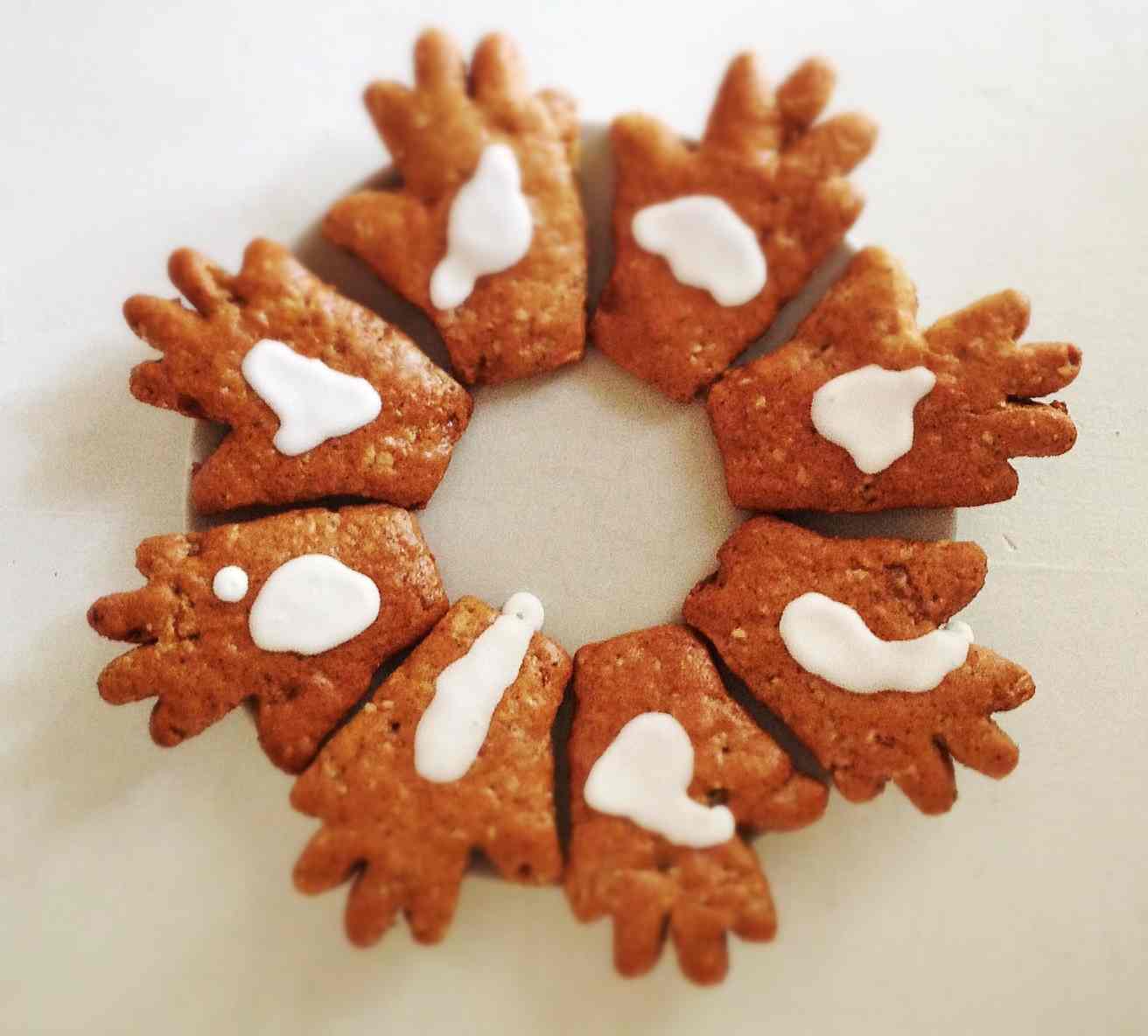
Royal icing is one of the traditional decorations for these cookies and I doled it out in blocks, lines, stars, and other shapes on the thick slabs I made with half the batch and on the thinner stars, gingerbread men, and open-palmed hands. A little bit of rum in the icing isn't a bad thing. Alton Brown has as good a recipe as any. He uses vanilla extract, but a similar amount of lemon juice or —my choice — rum also works to loosen and flavor the icing.

For those who can read the old German script, here's the recipe:

Gunter glieben glauchen globen. Doesn't make any sense to you? Check out below.
And if reading that doesn't come easily to you, here is my transliteration and adaptation for modern kitchens. The text of Frau Nietlispach's recipe follows for those who like to check against the original.

Elisenlebkuchen
(Rowley )

½ pound honey
½ pound sugar
100 g pork lard
1-1.25 pounds flour
½ pound peeled and grated sweet almonds
125 g finely cut mixed candied citron and orange peels
2 eggs
4 g each of ground cinnamon, ground cloves, cardamom
15 g of potash (potassium carbonate, 2.5 tsp), dissolved with 2 Tbl of rum
4 g hartshorn (ammonium carbonate, 0.75 tsp) dissolved with 2 Tbl of rum

Let the honey, sugar and fat boil in a pot. In the bowl of a stand mixer combine the spices, almonds, and one pound of the flour. Carefully add the hot honey mixture and mix slowly to blend. Then add the eggs, potash, and ammonium carbonate and continue mixing until the dough is smooth and shiny. Add additional flour if necessary to achieve a dough that’s just barely tacky to the touch.

Let it rest, covered with plastic wrap, overnight in the refrigerator.

When you are ready to cook, heat the oven to 350°F. Roll out the dough, using flour as necessary to prevent sticking, in large slabs [5-10mm thick] and cut into rectangles about 8 x 5 centimeters or round cakes roll about 5mm and cut into shapes with cookie cutters.

Line a cookie sheet with parchment paper a silicone baking mat. Transfer individual cookies to the sheets. Bake slabs 18-20 minutes or cut-out shapes 12-25 minutes. Transfer to a wire rack to cool. After cooling, coat them with different glazes to such as chocolate, sugar and raspberry glaze and decorate each cakes differently: with [royal icing], finely chopped almonds, colored granulated sugar (nonpareils), chopped, green pistachios, halved almonds, etc. [As an alternate to lining cooking sheets] before baking, you can put the cookies on Oblaten [baking wafers].

Elisenlebkuchen  
(Nietlispach)
1/2 Pdf. Bienenhonig, 1/2 Pdf. Zucker, 100 g Schweinschmalz, 1  Pdf. Mehl, 1/2  Pdf. geschälte und geriebene Süß Mandeln, 125 g feineschnittenes Zitronat, 2 Eier, 4 g gemahlener Zimt, Nelkenpulver, Kardamom, 15 g Pottasche, 4 g Hirschhornsalz, beides in etwas Rum aufgelöst — Honig, Zucker und Fett laßt man aufkochen, fügt  Gewürze, Mandeln und Mehl zu dem heißen Honig, verrührt gut und kochen. Dann kommen Eier, Pottasche und Hirschhornsalz dazu, worauf man den Teig sehr gut verkneten muß. Ist er glatt und blank, rollt man in aus, sticht große, runde Kuchen aus und bäckt sie aus gefettetem Blech schnell bei guter Hitze. Nach dem Erkalten sind sie mit verschiedenen Glasuren: Schokoladen-, Zucker- und Himbeerglasur zu überziehen und jeder Kuchen anders zu garnieren: mit feingehackten Mandeln, buntem Streuzucker (Nonpareilles), gehackten, grünen Pistazien, halbierten Mandeln ufw. Man kann die Kuchen vor dem Backen auch auf Oblaten legen.
Goes well with:
  • Elise Hannemann's Liverwurst, another old German recipe from the library here.
  • Ginger comes up a lot at the Whiskey Forge. From Soulless Ginger Lemonade to Kentucky Mules, check out some of the other recipes.
  • Want to make your own lard at home? It's easy as pie. Easier, even. Here're directions.
  • Look for potash (Pottasche) and hartshorn (Hirschhornsaltz) among the baking ingredients at grocers catering to a German clientele; the brand I use is Alba Gewürtze. No German delis in your neighborhood? Try ammonium carbonate and potassium carbonate from GermanDeli.com.

Friday, September 28, 2012

Coffee. Only Coffee. Nothing Else.

House rules. We know them. We largely abide by them. Most places that serve food or drinks — from McDonald's standard no-shirt-no-shoes-no-service policy to no-phone-calls-at-the-bar and keep-your-tongue-in-your-own-mouth rules at New York's PDT — have them.

A new Berlin coffee shop's rules, however, have some Berliners in a snit. The Barn — Roastery opened last week and almost immediately caused a furore lively discussion in the German press. At the heart of the debate is the cafe's no-stroller policy. Der Spiegel reports:
At the entrance to the café stands a one-meter (3 feet) high concrete post in the shape of a bowling pin that prevents parents from bringing buggies inside. In case the message wasn't clear enough, a sign on the window shows a pram with a line through it.
In fact, it's not just stollers that are verboten at the Barn — Roastery. Owner Ralf Rüller has instituted policies against pets, music, smoking, sugar, and, I'm hearted to read, ridiculous fake-Italian names for espresso-based milk drinks. Instead, order a 3, 6, or 10 oz cup. Laptops? A few are permitted at the media table. This, we are led to understand, is a place for coffee purists.

Rüller has been at pains online to clarify that the post can be removed for wheelchair access. As I mull over a trip to Berlin, his cafe is on my to-do list. But first, brandy distilling in another coffee-loving town: Portland.

The Barn — Roastery
Schönhauser Allee 8
10119 Berlin Mitte
Twitter: @THEBARNBERLIN 

Subway: Rosa-Luxemburg-Platz

Goes well with:

Tuesday, January 10, 2012

Kinderheim Gritz: Prohibition-era Pork Belly Charcuterie

North Carolina has liver mush, Pennsylvania is known for scrapple, and in some parts of Appalachia, poor-do is the local name for a dish that gives outsiders pause. These are venerable and entrenched regional charcuterie specialties with names that can be off-putting to modern eaters. Those who either grew up with them, though, or who have overcome the names, know that the stuff can be damn delicious when prepared properly.

Meat porridges such as scrapple or the unfortunately named liver mush are specialties that are particularly easy to make at home. They vary in their makeup, but share four characteristics.

They:
  • are made with meat (finely ground or chopped pork is most common, though beef, poultry, and even bison are not unheard of)
  • are thickened with cereal or buckwheat (Fagopyrum esculentum)
  • have a thick, gruel-like consistency when cooking
  • thicken on standing so that, once cool, may be sliced and fried
Yep. It's a Kookbook.
Add to these the Ohio/Kentucky specialty goetta. Like the others, it’s an immigrant dish. Although sometimes made with beef rather than pork, goetta is essentially scrapple made with steel-cut oats in the place of scrapple’s buckwheat. Its name is a transliteration into English of the Plattdeutsch (Low German) götta, meaning groats (i.e., hulled, cracked grains). In standard High German, the word is Grütze, a cognate our own Southern grits. In fact, my great grandmother’s name for sliceable puddings such as scrapple was Happelgritz. Happel is an old dialect word for “head” suggesting that her recipe was made from pork head — a very common practice.

Her recipe didn’t seem to survive. At least, I haven’t found it yet. I recognized the gist of it, though, in a recipe from a Prohibition-era fundraising cookbook from Addison, Illinois just outside Chicago. The recipe is, simply, Gritz. Its use of steel-cut oats puts it firmly in the Germanic Ohio/Kentucky goetta tradition while its call for pork bellies appeals to modern eaters who have rediscovered this unctuous cut of pork.

From the 1927 Kinderheim Kookbook, here’s Mrs. W. G. Bohnsack’s recipe for
GRITZ

4 to 5 lbs. of fresh pork sides (the part used for smoking bacon), cut in 3 or 4 inch pieces
Cover with hot water, add
1 teaspoonful sage
1 teaspoonful thyme
1 teaspoonful sweet marjoram
2 to 3 tablespoonfuls salt
½ teaspoonful each of cloves and allspice (ground)

Boil until meat is tender. Take meat out of juice and put through meat chopper. Strain liquid and add to it 1½ lbs. steel cut oats and stir until it starts to boil and boil fifteen minutes stirring constantly. Stir in ground meat and let all come to boiling point. Put tightly covered kettle in oven at 300° and bake one hour. Turn off gas and let gritz in oven one-half hour longer. Stir occasionally while in oven. May be cooked on top of stove by stirring constantly 1 hour or until oats are soft. When cooked gritz must be consistency of corn meal mush.

Fry in iron skillet ten minutes for breakfast. Gritz should be made in cold weather only. Small pig's head may be used instead of pork sides. After having made gritz once, each cook can determine whether she needs more oats, less meat or more seasoning.

Goes well with:
  • William Woys Weaver’s book Country Scrapple is a scholarly, but short and enjoyable, exploration of not just scrapple, but panhas, goetta, poor-do, liver mush, haslet, pashofa, backbone pie, and other such goodnesses in need of exoneration among squeamish eaters. I drew on it here for parsing out the shared characteristics of scrapple-like dishes and for some of the German vocabulary. 
  • My own bacon dumplings for a wicked hangover.

William Woys Weaver (2003)
Country Scrapple
162 pages (hardback)
Stackpole Books
ISBN: 081170064X
$19.95

Thursday, November 3, 2011

Tiki Cannibal Carnage for TDN: Nuku Hiva

Thursday Drink Night happens, more or less, once a week on...um, lemme check. Yep. Thursday. Celebrants sometimes gather in person, but it's more of an online deal in which cocktail bloggers, spirits writers, bartenders, and drinks enthusiasts fire up their computers, chat with each other, and mix cocktails based on a theme or a particular spirit. This week, the theme is tiki...with a twist.

From the Mixoloseum blog regarding tonight's Thursday Drink Night:

[The] theme will be “Nuku Hiva” based on recent events on that tropical Polynesian island. A little back story:
In early October, the charred remains of a German adventurer were discovered at a campfire site on a South Pacific island. The tabloid media were quick to portray the slaying as a possible case of cannibalism on Nuku Hiva, an island historically known for human sacrifice. But locals are offended and experts say such killings are a thing of the very distant past. (read more)
Therefore, in honor of this darkly exotic mystery, the goal of the night is to create tiki drinks with at least one German ingredient! Bonus if you use fire!  Stop in to the chatroom after 8pm EST for all the fun and frivolity.

Now, what's a German ingredient? Kirsch? Yes. Bärenjäger? Yes. Jägermeister? Yes. Jägertee? Sure. Speckklöße? Not so fast...

Goes well with:
  • A bit I wrote a few years ago on Santa Maria tri-tip, bringing together The Smiths, Mr Gay UK, a taste for human flesh, and the inestimable Jeffery Jones in the 1999 film Ravenous. 
  • On Licking a Human Skull. I have, certainly. What? You haven't? Savage. 

Saturday, October 22, 2011

Bacon Dumplings for a Wicked Hangover

Though I make Speckklöße only, at best, once a year, I lust after them each and every week. Speckwhat? Think of them as bacon dumplings. Think of them, also, as restorative after a night of debauchery and something you can make almost on autopilot. Hot, cheap, smoky, lightly greasy, carb-heavy with bacon’s ineffable umami loveliness, and better than aspirin when that bottle you hit last night smacks you right back. I could eat a dozen. Which is about how many this recipe makes.

Dumpling eaters. Don't make yours so big.
In Germany, Klöße and Knödl are names for poached dumplings made from potatoes, semolina, yesterday’s bread, flour, breadcrumbs, even crumbled dry pretzels. These dry ingredients are softened with stock, milk, or other liquids and are generally bound with eggs and flavored with fruits, nuts, or various proteins such as fish, cracklings, or — in this case — bacon.

Sidestepping the intricacies both of territorial nomenclature and of nearly infinite dumpling species, we’ll call these simply “Klöße.” That weird character, that ß, represents a sound we often make in English, but for which we don’t have a single character. It’s called an eszett and is pronounced like a double-s, so you’ll see these sometimes as Kloss (singular) or Klosse (plural). Speck is smoked bacon so Speck-Klöße are simply bacon dumplings.

Like all the German foods I ate growing up, I learned to make these in the American Midwest where German, Swiss, and Austrian bakeries, Konditoreien, sausage shops, and butchers were commonplace and the Germanic (or, as we called it, “Dutchy”) influence on home cooking was pervasive. The older I get, the less I eat the German foods of my youth. But as I work through our bacon inventory, I’ve been building a craving for a bowl of Speckklöße.

Today, I capitulated.

Speckklöße

The recipe calls for simmering the dumplings. Seriously: simmer. If you boil these, they are likely just to fall apart in the pot. Edible, but in the same way a fistful of dough is.

3” square of slab bacon, diced into tiny cubes (about 8 slices if using pre-sliced)
1 medium loaf of crusty bread
1 cup/250ml hot milk
2 eggs, beaten
Salt and pepper
q.s. rich chicken stock

Cut the loaf into slices (crust or no crust: your call, but save the cumbs) and pour the hot milk over them in a large bowl. Cover the bowl with a clean kitchen towel or a cutting board (careful that it doesn't tip the bowl) to keep in the heat and moisture. Fry the bacon pieces in a medium pan. When the bacon is browned, pour it, grease and all, over the soaking bread in the bowl. When the mixture cools, add the eggs, salt, and pepper. Mix gently but thoroughly.

Shape into small round dumplings about 1.5”/4cm in diameter. If they seem too wet, add some of the reserved breadcrumbs or even a small bit of flour. If they’re too dry, add a bit of stock. Then simmer the dumplings gently in rich chicken stock (I flavor my stock with roasted garlic and cumin) until they float and are cooked through (about 10-15 minutes).

Serve hot in shallow bowls with some of the stock.

Notes

About the bacon: Use the very best you can find. I like slab bacon, but pre-sliced is fine. Allan Benton’s stuff is amazing, but if you’ve got a local shop making or selling high-quality smoked pork belly, by all means shop there. And do check out Maynard Davies' Manual of a Traditional Bacon Curer.

About the bread: It’s easier to get good cupcakes in San Diego than good bread. Fortunately, we have Bread & Cie, a bakery that consistently puts out the sorts of high-quality breads I knew in the Midwest, on the East coast, and in Europe. Go for something with some character, a tight crumb, and a crisp crust. By all means, use flavored breads if you want to experiment; just keep in mind the effect that things like olives, rosemary, or jalapenos may have on the final dish.

For that matter, you can play with the poaching liquid. I find the idea repugnant, but you could — if you possess the perversity to do such things — swap out the bacon with country ham and poach these in coffee as a red-eye dumpling concoction. But beef stock, fumé, and vegetable stocks are all fine. Water, too, in a pinch, if it’s salted. Deep-fried in fat takes it an entirely different, though no less delicious, direction. Want to sauté some onion and include it in the dumplings? In. Got cracklings from rendering your own goose fat? In. Knock yourself out.

The version above is the no-frills classic I prefer at home, but there’s no reason not to take the basic idea and run with it.

Lord knows the Germans have.

Sunday, August 14, 2011

Elise Hannemann's Liverwurst

Even though one of my Irish grandfathers' families hails from Cork, a city known for its appreciation of offal, and the other from County Mayo, my wurstlust is traceable to another side of the family entirely.

As a child, if I were particularly antsy, my mother would rebuke me with an exasperated "Sitzt du!" and I would know to sit and immediately unfuss myself. Asked what I wanted for my birthday dinners, I declared the tedious "rouladen" more often than she probably liked to hear, and in my grade school, I was one of the only children — certainly the only freckled one — who toted Braunschweiger and mustard sandwiches for lunch. To this day, if you startle me, you're as likely to get a German expletive as an English one.

The unavoidable conclusion is that somewhere in the woodpile lurks a beer-drinking, sauerbraten-making, spätzle-simmering subject of the Kaiser. Suspicion falls squarely on my great grandmother whose maiden name, depending on which relative you asked, was either Schultz or von Hasenberg. As a small child, I once asked why some of our cousins had German names. She konked me on the head with the back of her hand and chided me. "We are not," she insisted, "German. We are Prussian." Years later, I think it may have been a joke...but, then, Lily von Hasenberg (if that was her real name) was not known for levity, so who knows?

That Braunschweiger above is a spreadable pork liver sausage, a subcategory of the wider liverwurst clan, and one likely to be found at family gatherings at my great-grandmother's massive lawn parties in the 1970's. To be honest, the kids generally eschewed it; those who didn't like it really didn't like its mineral bite. To me, though, it was one of the perks of no-class summer diversions. Broadly, Braunschweiger — known as BS to some of its admirers — is ground pork liver mixed with finely ground bacon, stuffed in hog bungs, simmered, then smoked. Because lately I've been both on a liverwurst kick and struck with bouts of insomnia, I've been digging up recipes that elucidate the whole category of liver sausages — and make sense of my childhood snacking.

On a hunt for Braunschweiger recipes in particular, I came across one in my library for "Leberwurst" from Elise Hannemann's 1904 Kochbuch. The book is dedicated to Hannemann's patron, Ihrer Majestat der Kaiserin ["your Majesty the Empress" (i.e., Augusta Victoria of Schleswig-Holstein, wife of Kaiser Wilhelm II)] and is a revealing look at middle class German cookery in the years before World War I. Although Hannemann does not call this particular sausage "Brauschweiger," the bacon and optional smoking would make recognizable to American Midwesterners as exactly that.

Klicken Sie hier
My somewhat free translation is below. Following that is my transcription of the original — as always, feel free to correct my translations. The original recipe's Fett- oder Krausedärme refer to slightly different natural hog casings. Those sold as 2.5-3-inch "bungs" (no snickering) in the US are just fine for a finely ground and simmered sausage like this. Wurstkräuter are simply herbs and spices for seasoning wurst. Although Hannemann doesn't specify, white pepper, marjoram, nutmeg, allspice, and even cloves would not be out of place. Start with a 3/8" plate, then grind twice more with a 1/8" plate.

Liverwurst
Very Good. In winter, it will last three weeks.

500 g liver
400 g of cooked bacon
1 whole egg
Sausage herbs
Dried truffles or fresh anchovies
Salt
Pepper

Run the liver and bacon through a grinder three times, then thoroughly mix in the herbs, salt, pepper, finely sliced truffles or chopped anchovies. Stuff this mixture loosely into hog bungs and let cook slowly for a half an hour* in boiling water. Then remove them immediately place in cold water.

The sausage for slicing and is especially good if they are smoked two days. 
*Note that some modern authorities suggest cooking liverwurst until its internal temperature is 165°F. 

Transcript of the above image:

Leberwurst.

Sehr Gut. Im Winter 3 Wochen haltbar.

500 g Leber
400 g gekochter Speck
1 ganzes Ei
Wurstkräuter
Getrocknete Trüffeln oder frische Sardellen
Salz
Pfeffer.

Die Leber und der Speck werden dreimal durch die Fleishhackmaschine genommen, mit den Krautern, Salz, Pfeffer, kleingeschnittenen Trüffeln oder gehackten Sardellen gut vermischt, lose in Fett- oder Krausedärme gestopft und ½ Stunde langsam in kochendem Wasser ziehen gelassen; dann werden sie herausgenommen und sosort in kaltes Wasser gelegt.

Die Wurst wird zum Ausschnitt verwandt und ist besonders gut, wenn sie zwei Tage gerauchert wird.

  
Goes well with:
  • I am a Meat Wagon —When I say "wurstlust," it's not a joke. I crave sausages and cured meats; my last stop out of New Orleans was at Butcher where I scored two types of bacon we can't get in San Diego . I even tempt the TSA in a story about getting stopped smuggling andouille after a trip to LaPlace, Louisiana. 

Thursday, December 9, 2010

Adobo, Pfeffernüsse, and a Game Called "Filippino"

I woke this morning thinking about adobo and Pfeffernüsse. No, it's not some lame odd-couple cop movie. They're two different foods. My brain runs that way, holding simultaneous parallel thoughts that have nothing to do with each other. It's not always for the best.

Adobo is a particularly Filipino way of preparing chicken, but also beef, pork, fish, and other animal proteins that often incorporates vinegar, garlic, black pepper, bay leaves, onions, and sometimes coconut milk. It's amazingly good and my life is better both for knowing how to make a few varieties and for having stellar Filipino friends who introduced me to it

Pfeffernüsse, on the other hand, hail from Germany. They are tiny cookies (literally "pepper nuts") that are more or less heavily spiced. They're good with coffee, tea, hot chocolate, hot spiced wines, and other winter warmers. Spices may include black pepper, anise, mint, ginger, cloves, etc. One also finds them under similar names in Russia, Ukraine, Poland, and Scandinavia. I first had them in graduate school in Kansas where a large Mennonite population still consider them part of traditional — almost obligatory — Christmas baking.

See? Simultaneous parallel thoughts that have nothing to do with each other.

Then, as I mulled over the morning's news with hot tea, I pulled a book on Pfeffernüsse off the cookie shelves. Page 25 of Peppernuts Plain and Fancy holds this little gem contributed by Johanne Reynolds of Hong Kong:
In Denmark pebernødder (peppernuts) were very much a part of our Christmas celebration. Not only did we children bake them, but also played a peppernuts game — 'filippino' — guessing how many pebernødder an opponent held in his hand. If you guessed correctly, he forfeited his handful to you. If wrong, you shared from your "store" the same number he held in his hand. That's the nearest we ever came to gambling in our Lutheran home!
A simple game for simpler times. Maybe 'filippino' was just one family's game, maybe it was more widespread. I'm not Danish, so I don't know. I do wonder, though, how it came to have the name. No answers today, just questions.


Norma J. Voth (1978) Peppernuts Plain and Fancy: A Christmas Tradition from Grandmother’s Oven. Herald Press, Scottsdale, Pennsylvania.

Tuesday, May 26, 2009

Grossmuttis Kartoffelsalat (We Call it Tater Salad)


Since moving to body-conscious Southern California, I’ve cut way back on taters, but with Irish roots on one hand and German on the other, I’ve got a double spudlust that makes my knees nearly buckle at the prospect of something so verboten as a bacon-studded German potato salad.

What better time than Memorial Day, though, to bust out a big bowl of the stuff to satisfy my lust for carbs? For weeks, I’d been craving the bacon fat-and-vinegar-laced salad that Philadelphia chef Fritz Blank used to make for staff lunches or special occasions when I would visit. It wasn’t the kind of food he’d serve at his fancy French restaurant Deux Cheminées, but to bolster our holiday grill of bratwurst, burgers, and chicken, it was just the ticket.

Blank, a former Army captain and microbiologist, is meticulous about recipe preparations and his original notes for this salad are worth reading for the amount of precise detail about the recipe. This meticulous scientist makes legions of jigger-wielding nouveau “cocktailians” look downright sloppy. Scroll down for a link to his notes and procedures for his grandmother’s potato salad.

With apologies to Fritz, I’ve adapted his grossmutti’s Kartoffelsalat to my kitchen and tastes. Most notably, I’ve cut the fat by nearly half (but kept every single drop of bacon fat) because I don’t care for an overly slick salad. I also used Yukon Golds, but cut into small slices, somewhere between the coin-shaped slices he calls for and the cubes he reserves for American-style potato salads.

Roll out the barrels, baby: this German classic is good all summer long.
German Potato Salad

5 lbs C or B-sized golden potatoes
1 ½ gallons of water
½ cup salt

¾ lb. double smoked bacon, cut into 1/4-inch slices
1 cup thinly sliced green onions, white part only
¾ cup fresh parsley, chopped “medium”
1 level tablespoon freshly cracked black peppercorns
1 ½ tablespoons coarse sea salt
1 cup of rice wine vinegar or a mild champagne vinegar
1 ½ cups oil mix (combined rendered bacon fat plus peanut oil)

Place the potatoes, ½ cup salt, and water into a 16-quart pot. The water should cover the potatoes by about 4 inches. Bring to a full boil over high heat; reduce to a gentle boil and cook uncovered until the potatoes are tender yet firm. Start testing after about 20 minutes. Test by sliding a knifepoint into potatoes: it should go in easily with minimal resistance. Carefully drain placing the potatoes in a single layer onto a tray to cool slightly.

In the meanwhile, render the bacon over medium heat until crispy, but not hard. Drain and reserve the drippings.

While the potatoes are still hot but able to be handled, slice them into bite-sized slices (or the “coins” Blank calls for) into a large mixing bowl. The slices should about 1⁄4-inch thick or slightly more, and should not break apart or crumble.

Add all of the remaining ingredients on top of the potatoes, and mix gently with a large spoon, silicon spatula, or your hands to distribute everything evenly. Do not overmix or break up the slices.

Let the salad sit for a few hours at room temperature to develop the flavors. Taste carefully and re-season if necessary with salt, pepper and/or vinegar. Serve warm or at room temperature.
Goes well with:

.