Showing posts with label milk. Show all posts

Wednesday, October 6, 2010

Egyptian Punch, An Untried Recipe

The milk punch family is divided into two main braches: whole and strained. The sort of milk punch you’re likely to encounter in New Orleans is what I call a whole-milk punch. Such a punch might be made with cream or milk, but the result is creamy, boozy, and takes on the color of the dairy that goes into it. Egg nog, brandy milk punch, bourbon milk punch, or even LSU Tiger’s milk punch are fair examples. In rare cases they are aged, but generally are served soon after mixing the ingredients.

The other sort is a strained milk punch. These have fallen from fashion and you’re less likely to encounter one. These are generally aged and mixed with high-acid citrus (such as lemon) that curdle the milk. They are then strained through filters such as flannel, cheesecloth, or paper. Fernand Point’s Liqueur du Grapillon is one example. Old American recipes for English or Italian lemonade call for the same technique: Mix sugar, lemon, milk, and sometimes spirits, let it stand to curdle, then strain and age the liquid. When it’s ready to drink, the resulting beverage is clear — though possibly colored by the spirits or other ingredients such as hibiscus.

Thumbing through the 1915 Pan-Pacific Cookbook, I came across a recipe for such a strained milk punch. I haven’t tried it yet, but the recipe is certainly older than 1915 and not particularly Egyptian. For the record, here’s
Egyptian Punch

Pare the thin rinds of eighteen lemons into a stone jar and cover with five pints each of Jamaica rum and whiskey; cover and let stand for thirty hours; add the lemon juice, three pounds of loaf sugar, two grated nutmegs, four quarts of water and, last, two quarts of boiling milk. Let it stand for half an hour, then mix well and strain — first, through a flannel bag and then through filter paper. Pout into bottles and cork tightly. The punch will be of light amber color and very clear. It improves with age.


Goes well with:
  • Erik Ellestad has written about about strained milk punches at Underhill Lounge. He's not the first to write about Rum Hibiscus Milk Punch, but I do like his photos.
  • Fernand Point’s Liqueur du Grapillon
  • Bourbon House in New Orleans once served cantaloupe bourbon milk punch. It's not an everyday offering, but check in during warm weather and you might just find it churning away in the freezer behind the bar. 
  • A brochure from the 1915 Panama-Pacific International Exposition — the Pan-Pacific in the cookbook's title — held in San Francisco (from the Museum of the City of San Francisco).

Thursday, December 31, 2009

Liqueur du Grapillon

One of the most important things
that distinguish man from other animals
is that man can get pleasure from drinking
without being thirsty.

~ Fernand Point

Not long ago, I plucked a 1974 copy of Fernand Point’s Ma Gastronomie from the shelf. Point was the French chef/restaurateur of La Pyramide, a renowned temple of gastronomy south of Lyon. I was looking for his recipe for a sort of simple French milk punch. Though he died in 1955, his life and work continue to inspire chefs today. Marc Vetri, for instance, whose restaurant Vetri Mario Batali claimed was possibly the best Italian restaurant on the East Coast, used to keep the same copy of Ma Gastronomie in his kitchen. Thomas Keller, no slouch in the kitchen, has written an introduction to a new edition of the cooking classic and it’s worth tracking down if, like me, you're into food as well as drinks.

The recipe I was hunting (from the oversized yellow-jacketed 1974 edition) is for a homemade liqueur that Point used to take with him as he went to survey the quality and maturity of the grapes of the Côte Rôtie. Reputedly, he would stop now and again on the steep slopes of the vineyards and take a swig of a tasty little pick-me-up he called Liqueur du Grapillon (or “Liqueur for the Grapes”).

The recipe calls for an entire lemon, cut into quarters, to be thrown in with brandy, milk, and vanilla. Citrus and dairy in the same drink can lead to some chewy disasters. They can be—and often are—combined without incident, but keep this formula in mind: [citrus + milk] = [curds + whey]. Fortunately, since the lemon is not squeezed into the mix and, as this mixture sits in the dark for almost two weeks, any curds formed are very small and easily strained out.
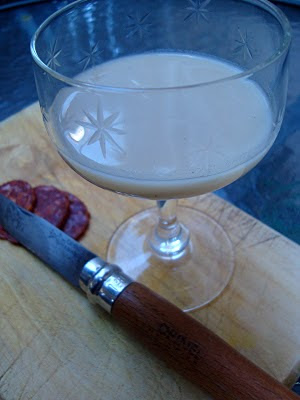
The result is a smooth, thick and mildly sweet liqueur, similar to egg nog but not as thick and without the eggy overtones, tasting of whole milk, vanilla, and cognac. After a few days of macerating, I tasted the drink and was leery: the lemon was overpowering, sharp, and biting. Resisting the temptation to yank it out of the jar (after all, presumably Point knew something about successfully combining tastes), I left it in and was rewarded after another week with a mellowed liqueur that no longer tasted like furniture polish.

On the last day of the decade, I poured myself a short glass, grabbed some dried sausage and a pocket knife, and moseyed out to the patio to read the paper and soak in the beautiful sun of Southern California. There are no grapes to survey, but the palm trees look mighty fine.

Liqueur du Grapillon
(“Liqueur for the Grapes”)

Combine sixteen ounces of milk, eight ounces of sugar, sixteen ounces of very good eau de vie or brandy and add a lemon cut in thirds and a vanilla bean. Let the mixture stand, stirring from time to time. After 12 days, strain and serve.
~ Fernand Point (1974) Ma Gastronomie. Lyceum Books, Wilton, CT.


Ingredient Notes: I’d used the vanilla pod in this recipe to make vanilla syrup as well as vanilla sugar, so a little bit of its moxie had been spent. To compensate, I used a pod and half, then, at bottling time, squeezed out all the remaining tiny black seeds as if from a tube of toothpaste into the strained liqueur.

For milk, use whole milk, preferably unpasteurized. It really does make a difference. Don't even bother with 1%, 2%, or soy abominations. The brandy I used was Claude Chatelier VS, about $20/750ml at Trader Joe's. If using a waxed lemon, give it a good short scrub in hot water to remove as much of the coating as possible. Pluck it from the backyward if, like me, you live in places where mixers grow on trees.

Secondhand editions of Point's book are still around, but if you want to score the new edition, here's the skinny:

Fernand Point with introduction by Thomas Keller (2008)
Ma Gastronomie
240 pages, hardback
Publisher: Overlook/Rookery
1585679615
$40.00

.

Monday, September 28, 2009

MxMo XLII: Dizzy Dairy and Rowley’s New Book

When I heard the theme for this month’s Mixology Monday—dairy cocktails—I gritted my teeth. In the last year I’ve had more milk and cream than at any time since my childhood. Why? Well, the rich history of, and modern innovation in, dairy cocktails is the topic of the book I’ve been working on.

Until I was ready to publish, I wasn’t eager to see public talk about them. No dice. MxMo host Chris Amirault over at eGullet has let the cow out of the barn with MxMo XLII: Dizzy Dairy. For one day, the majority of the world’s online cocktail writers will be blogging, tweeting, and posting Facebook updates on the very thing I’ve been keeping under wraps.

Ah, well. I know when to roll with new developments and, since this is hardly a secret topic anymore, let me tell you a little of what I’ve been up to and throw out a call for help.

As I’ve researched the book, I’ve sampled 1%, 2%, whole, raw, homogenized, and pasteurized milks from huge producers and small family farms. There’s been condensed, evaporated, caramelized, fermented, shelf-stable, and powdered samples decking the kitchen counters. I’ve looked into the dairy underground (where raw milk runners sometimes call their product “mooshine”), put archivists and librarians through their paces digging out manuscripts and old pamphlets, and ordered dairy cocktails in every city I visit. Some—like Ramos’ famous gin fizz—are classics. They can be as simple as Lebowski’s favorite White Russian or laced with fancy beurre noir and sage.

On a recent trip to Philadelphia, I dropped in Rum Bar to say hello to owner Adam Kanter. The milkiest drink on the menu? An orange batida. Long popular in Brazil, batidas often incorporate fruit and sweetened condensed milk (leite condensado) as well as cachaça, a hugely popular cane spirit gaining ground in the US. Bar manager Vena Edmonds kindly supplied the recipe. If you can't find Moleca, a three-year old wood-aged cachaça, consider substituting Leblon or Boca Loca brands. Not the same taste, but a little more funky than a lot of rums.
Orange Batida

1 oz Bacardi O
1 oz Moleca cachaça
1 barspoon of refined sugar (about a teaspoon)
1 oz sweetened condensed milk
½ oz orange juice

Shake hard with ice to fully mix the condensed milk and strain into an old fashioned glass with fresh ice. Garnish with an orange slice. You could also substitute simple syrup to taste for the sugar.

Of course, I was in Philly to hit libraries and archives, too. I’ve dug into the ethnographic, historic, culinary, and literary records from around the world for cultural and scientific information on the lactation of cows, goats, horses, buffalos, camels, and more. Want naturally rose-flavored milk? Grab your passport. The fermented Mongolian mare’s milk drink koumiss that used to be in all the bartenders’ manuals? Hard to find, but there’s an easy work-around. Beyond issues of palatability, I can tell you why we don’t milk pigs, why water buffalo cream is so thick, and how to break down milk punch into distinct families.

But I could use help. I’m looking for recipes to include—with attribution—in the book.

I’ve got more than enough historic American cocktail recipes. What would help are original dairy cocktails made by modern bartenders and cocktail enthusiasts—cocktails using milk, buttermilk, cream, butter (don’t look at me like that: you never heard of hot buttered rum?), or other dairy products. Innovative takes on older recipes and examples from outside the US are also good: Got experience with aged eggnogs, sloe gin fizzes, or pisco-spiked caramelized goat’s milk? I’d love to hear from you.

I can’t promise everyone’s recipe will make the final cut—my editor invariably cuts even my own recipes—but I can promise to talk with you about your cocktail(s), see if there’s room to include them, and give you all kinds of lavish credit if one or more of your recipes makes the final draft.

Email me at moonshinearchives [at] gmail [dot] com and let’s see what we can do.

.