Showing posts with label France. Show all posts

Sunday, October 27, 2013

1950 Paraty Cocktail: An Old Style Dry Shake for an Old Style Cachaça

In 1723, Jacques Savary des Bruslons informed readers of his Dictionnaire universel du commerce that native Brazilians — before Europeans came on the scene — were the most robust of all men, seven feet tall, and at the age of 100, they were no more decrepit than Europeans aged merely 60 years. However, he noted, ils ne vivaient que de maïs, d’oranges et de sucre — they lived on maize, oranges, and sugar. French merchants made fortunes on that Brazilian sugar and, in the process, some developed a taste for a Brazilian cane spirit called paraty (par-a-CHEE).

Over 225 years later, the 9th edition of Henri Babinski Gastronomie Pratique (1950), gives a recipe for a paraty cocktail "particularly appreciated in Brazil," but which is too strong, presumably, for more refined French palates. Paraty we would recognize today as cachaça and the technique he recommended for taming it as a variation on the dry shake so popular in recent years.

The dry shake, as practiced today, is a straightforward technique used to emulsify egg whites in drinks. Some think it’s new; it’s not. First, some portion (and sometimes all) of the cocktail’s ingredients is put in a shaker with the egg white. Then the bartender seals the shaker, shakes hard to emulsify, then re-shakes with ice, and pours the drink in a glass. It may or may not be strained into the glass, depending on the drink — and the bartender. The result is a velvet-textured drink with a foamy head made of very fine bubbles.

The technique Babinski (or Ali Bab, as he was known) recommends is different. Paraty — named for a colonial-era town of the same name in the state of Rio de Janeiro — was rough stuff for drinkers used to fine French brandies (though God knows some calvados could strip the paint off a barn door). It had what Ali Bab referred to as l’odeur empyreumatique, a “burned” smell, possibly from using direct-fire stills.

As anyone who has ever truffled eggs in the shell, refined homemade wines, or cleared soup stock or boiled coffee knows, egg whites can be used to absorb odor and trap particulates in liquids for easy removal. This is the same idea. Mixing egg white with the “burned” spirit, then straining the mix before using it in a cocktail, helped to remove some of the objectionable odor — which, seemingly, native Brazilians did not mind, even those who lived to a hundred years and stood seven feet tall.

Once softened and strained, the spirit was approachable for goût francais and could be blended with lemon juice, pineapple syrup, and bitters.

Cachaça imported today in the United States and western Europe generally does not need such taming. Leblon, for instance, works just fine without the strained egg white treatment. Some of today’s moonshine, though, could benefit from a bit of last-minute polishing…

From Ali Bab’s 1950 Gastronomie Pratique:
Paraty Cocktail

20 grams of paraty,
10 grams of lemon juice,
10 grams of syrup of pineapple,
5 drops of Angostura bitters,
1 egg white,
Crushed ice,
Zest of one lemon. 
Mix the paraty and egg white in a glass, which has the effect of mitigating some of the paraty’s burned aroma: shake it all for a few minutes, then strain. 
Put the strained paraty in a shaker with lemon juice, pineapple syrup, angostura bitters, crushed ice, shake to chill; pour into a cocktail glass, squeeze the lemon zest over the drink and serve with small straws.
And the original for those whose French is better than mine:
Cocktail au paraty 
Le cocktail au paraty est particulièrement apprécié au Bresil. Sa composition intégrale nous semblerait trope forte. En voici une adaptation au goût francais. 
Pour chaque personne, prenez:
20 grammes de paraty,
10 grammes de jus de citron,
10 grammes de sirop d’ananas,
5 gouttes de bitter angostura,
1 blanc d’oeuf,
Glace pilee,
Zeste d’un citron. 
Reunissez dans un verre le paraty et le blanc d’oeuf, qui a pour effet de mitiger un peu l’odeur empyreumatique du paraty: agitez le tout pendant quelques minutes; filtrez. 
Mette dans un shaker le paraty filtré, le jus de citron, le sirop d’ananas, le bitter angostura, de la glace pilée; secouez pour glacer; passes dans un verre à cocktail, ajoutez le jus du zeste d’un citron et servez avec des petites pailles.

Thursday, September 26, 2013

Dry Curaçao Ancienne Méthode

Brad Farran's Julius Orange
We like orange liqueurs at the Whiskey Forge. For decades, we’ve relied on those two old stalwarts, Cointreau and Grand Marnier. Cointreau in particular is a workhorse around here. When Mandarine Napoleon showed up on local shelves, I added that to the rotation. Solerno, a blood orange liqueur, is an interesting twist; we like it in cobblers. But perhaps my favorite of the lot is Dry Curaçao Ancienne Méthode from Cognac Ferrand.

Ferrand’s curaçao, a blend of cognac, vanilla, and citrus peels, is based on a 19th century recipe and made in consultation with drinks historian, David Wondrich. The Floating Rum Shack gives the backstory of how the brand came to be. We use it in punches, Mai Tais, with gin, with whiskey. It’s just a beautifully balanced, superbly well-done orange liqueur that’s earned a permanent place on our copper-topped dry sink.

New York bartender Brad Farran gave a recipe for Orange Jul…erm…Julius Orange in a Wall Street Journal piece last summer. I admit; the result is a lot like a boozy version of that shopping mall favorite.

Julius Orange 
2 oz Pierre Ferrand Dry Curaçao Ancienne Méthode
½ oz Cruzan Single Barrel Rum½ oz lemon juice
½ tsp vanilla syrup
½ tsp sugar cane syrup
1 dash orange bitters
½ oz heavy cream
Freshly grated nutmeg 
Combine liquid ingredients in a cocktail shaker, adding cream last. Shake hard with ice. Strain into a rocks glass over crushed ice. Garnish with nutmeg.
Something lighter, without the sugar and cream, is the Alabazam. I pinched the recipe from 19th century bartender William “The Only William” Schmidt and upped the curacao just a bit to really bring it forward. For the original, see his 1891 bartending manual, The Flowing Bowl.
Alabazam 
2 oz brandy
.75 oz lemon juice
.5 oz Pierre Ferrand Dry Curaçao Ancienne Méthode
.25 oz simple syrup
Two dashes Angostura bitters
Soda water (Q or Fever Tree)
Fill a tall highball glass two-thirds with crushed ice. Shake all the ingredients except the soda water with ice. Strain into the serving glass, top with soda, and stir.
Goes well with:

  • If Orange Julius-type drinks get you going, but you'd prefer one without the booze, try Kenny Shopsin's take on them with fresh orange juice, powdered egg whites, powdered sugar, and crushed ice.
  • That cobbler with Solerno I mentioned? It's very nice with Lillet, as served from time to time at San Diego's Polite Provisions. 

Monday, June 24, 2013

19th Century Rose Brandy from Virginia

Within days of moving into the new house, I uprooted all the rose bushes. This was partly because I wanted to make room for herbs in that spot (indeed, wormwood, basil, parsley, and more grow there now). I uprooted them also because they weren’t healthy bushes and I would rather coax something to life there rather than nurse them back to health. But mostly I ripped them out because I can’t abide the overpowering smell of fresh roses. Not in a vase, not in a garden, not as a gift — and for God’s sake, never even near the dinner table where their overpowering odor would ruin any meal.

That’s fresh roses. Roses preserved are another matter. The suffocating, cloying smell of fresh roses can be tempered through skillful distillation, infusion, and preserving in sugar that leaves their distinctive floral notes in place, but smooths out the high notes. Candied rose petals strewn across a cake? Fine. Looks pretty, too. Rosewater in cocktails? Sure, Champagne and mild bourbons can — with a restrained hand — sometimes become the base of delicious rosy drinks. Odds are, I’d rather enjoy that bourbon without the rosewater, but if some bartender wants to show off, why not?

And then there’s baking. Desserts, puddings, pies ~ this is where rose flavors can shine and, apart from the occasional cocktail, where I tend to use rose as a flavoring. A hand pie, filled with stewed dried apples, palm sugar, and rosewater then fried and tossed in sugar is a sublime thing indeed. Good rosewater and even rose syrups are available in Middle Eastern markets and well-stocked liquor stores, but I am tempted to try a batch of 19th century rose brandy. This recipe hails from Virginia, but the technique is nearly identical to older French recipes.

From Mary Stuart Smith’s 1885 Virginia Cookery-Book, here is a rose brandy specifically for flavoring cakes and other desserts. And, hey, maybe a few cocktails.
Rose Brandy for Flavoring 
Gather leaves from fragrant roses, without bruising; fill a pitcher with them, and cover them with French brandy; next day pour off the brandy, take out the leaves, and fill the pitcher with fresh ones, and return the brandy. Do this until it is strongly impregnated; then bottle it. Keep the pitcher closely covered during the process.
Now if only I hadn't ripped out all those rose bushes...

Goes well with:

Tuesday, June 11, 2013

Canned Foods in French Restaurants?! What Would Escoffier Say? Let's See...

A law should stipulate
that in a restaurant
food that has been cooked
on site with fresh ingredients
is served to customers.

Didier Chenet
President of French restaurant union, Synhorcat


Yesterday in the online edition of the German magazine Spiegel, Stefan Simons wrote that French restaurateurs are rankling under an onslaught of prepared meals and ingredients in places that serve food. With shorter lunch breaks, a greater emphasis on healthy eating, and a tighter economy, fast food joints and kitchen shortcuts are becoming increasingly common in the land known for boeuf Bourguignon and cassoulet. A slice of pizza for lunch might not at first blush seem "healthy," but compared to the traditional options at the long, drawn-out lunches of old, it's quicker, cheaper, and may have fewer calories.

What specifically upsets restaurateurs, though, is the crush of canned, bagged, bottled, and otherwise preserved or pre-made dishes and ingredients in so-called restaurants. Many argue that places that serve such food ought not be called "restaurants" at all. Simons writes:
A recent poll of culinary professionals in France by restaurant union Synhorcat found that 31 percent of French eateries are now often looking to the can for their culinary inspiration. Increasingly, this means salads out of bags, industrially produced French fries and potato wedges, canned vegetables, flavor concentrates, vacuum-packed fish as well as sauces and dressings out of the bucket. One-quarter of meals are no longer cooked -- they are simply stirred together or warmed up with nary a mention on the menu that what the customer is getting isn't fresh. As a result, half of customers no longer trust the restaurants that serve them.
Horrible. Simply horrible. Sauces from buckets! Canned produce! Such degradation of French cuisine. Can you imagine what the sainted Auguste Escoffier — the king of chefs and the chef of kings — would say if he weren't so busy turning in his grave? What sputtered indignation could he offer us?

We don't have to imagine. Escoffier actually wrote about such things. From Auguste Escoffier: Memories of My Life:
Since I created Pêche Melba, which now enjoys world wide renown, demand for tender peaches, both fresh and preserved whole, has increased considerably. To ensure the high quality of such peaches, the fruit must not be too fragile. Montreuil peaches were excellent, but in recent years that quality of peach became difficult to find. I noticed that in the Rhone valley there grew a peach that was very similar to the Montreuil peach. I tested it and was very happy with the results. The next year, in 1911, 15,000 of these peaches were canned. The year after, 30,000 peaches were canned, and the third year the figure had reached 60,000. The producer was planning to can 100,000 of these peaches when the war broke out. This kind of incontestable success would never had [sic] existed without the creation of Pêche Melba.
Escoffier did not merely tolerate canned and bottled goods cooked off-site, he embraced them. He encouraged producers to bottle, can, and ship overseas produce and sauces. He even later owned a company to manufacture canned and bottled goods. Although the codifier of haute French cuisine developed an improved tomato purée around 1874 (when the custom among cooks was to pour the purée in Champagne bottles and sterilize them), he could not convince a manufacturer to can the product until about 1892, when he took the entire 2,000 can run for his kitchens at the Savoy. The year after that, the manufacturer canned 60,000 kilos of crushed tomatoes. Today, some of the best restaurants in the world use canned tomato products.

From truffles to tomatoes, Escoffier knew that seasonality and adverse local growing conditions could make certain foodstuffs occasionally unavailable. Granted, he maintained high standards, but there was — and remains — no reason that high-quality preserved foods shouldn't be in anyone's kitchen larder. Do you truly want to mill your own grains, make your own pasta, pickle your own capers, grown your own cotton, stitch every bit of your clothing, build your own bike, forge your own knives — and create by your own hands every single thing you want to eat, drink, wear, or use every single day? There comes a point when we must rely on others who do good work so that we can get on with doing our own good work.

So, yeah. Despite some pretty schlocky examples on the market, canned, bottled, and jarred products don't bother me in and of themselves. I know how to make whiskey and homemade butter couldn't be easier, but frankly, it's a lot more expedient to buy those things from others who know what they're doing.

I sympathize with their frustrations, but clinging to notions of authenticity centered on fresh ingredients cooked in-house is going to be a slippery prospect for France's restaurateurs.

Goes well with:


Monday, March 18, 2013

Bottling the Pamper Moose: Homemade Vin de Pamplemousse with Bergamot

This year's label
It's been said that San Diego's seasons can be divided roughly into four: Early Summer, Summer, Late Summer, and Next Summer. As local flowers start to bloom, nights remain chilly and one still does see young women wearing hot pants, scarves, and fleece-lined boots, but it's undeniable that Early Summer is on us once more. Summer can't be far off — and with it comes a craving for lighter and more bitter drinks. Whether that bitterness comes from hops, citrus peel, quinine, wormwood, or more esoteric bittering agents, count me in. This weekend I got a leg up on Summer by bottling a faintly bitter grapefruit aperitif for our yard drinks in the coming months.

The vin d'orange, a bitter orange wine I put up last month, is still maturing in big glass jars and will be for another several weeks, but a grapefruit version of essentially the same aperitif, vin de pamplemousse, only took a month to macerate. Yesterday I bottled six liters of the traditional before-dinner drink. The recipe isn't wholly traditional, however. Oh, the grapefruit (pamplemousse in French) is legit. Even the sweet oranges I sliced and threw in to soften the wine a bit wouldn't raise every eyebrow in France. However, I'd gotten my hands on a load of bergamot oranges and included one in the mix, an addition that may cause purists to sniff in disdain. Ah, well. Their loss.

Racked, clear, and bottled: grapefruit wine
Bergamot, tea fanciers know, is a type of sour orange that lends its distinctive, almost lavender-like aroma to Earl Grey tea. The fruit looks a bit like a lemon, but unlike a lemon's, the volatile oils in its skin are so potent that they easily overwhelm food and drink if not treated with care. The juice is mild enough and can be used much like lemon juice, but truly, a small amount of skin or zest goes a long, long way. Two common precautions against its dominance in cooking and preserves making are (a) to use small amounts relative to the other ingredients and (b) to blanch each fruit before use. I chose the former: only one bergamot to every six grapefruit and two oranges.

Even in southern California, bergamots can be hard to track down during their late-winter Early Summer season. If you have access, use one. If not, just toss in an extra sliced grapefruit.

Vin de Pamplemousse with Bergamot

2 white grapefruit
4 ruby red grapefruit
1 bergamot
2 navel oranges
1 2" piece of vanilla bean, split lengthwise and cut into thirds
4.5 L crisp white wine such as Sauvignon Blanc (e.g., Trader Joe's coastal)
750ml 80 proof (40% abv) vodka
1.75 cups/350 g sugar

Cut each piece of citrus into an upper and lower half. Slice each half into half-moon shapes, about 1/4"/6mm thick, saving any juice. Combine all the ingredients (including any juice from slicing) into a single two-gallon/8L nonreactive container with a sealable lid such as a jar or carboy.

Stir or shake it, then allow it to rest in a cool, dark place (a closet is fine: no need to refrigerate). Strain after one month into a similar large container. After one day, rack the cleared liquid off the  cloudy residue at the bottom of the container. Strain this through cheesecloth or other clean filter, and bottle in clean, sterilized wine bottles. Seal with new corks and label. Let rest a few months in a cool, dark place.

Makes about six liters.

Goes well with:

  • That vin d'orange I mentioned. Good stuff. 
  • Each year, I try to make a batch of creme de noyau using crushed peach pits and a recipe from an old, old Creole cookbook. I don't always get around to it, but when I do make some, here's the recipe I use
  • If light wines aren't your speed, how about fifty oranges and a gallon of corn whiskey?
  • Fany Gerson's recipe for pasita, a dark raisin cordial from Mexico.
  • Finally, more old recipes: three separate recipes for syrup of violets spanning nearly 250 years. 


Thursday, February 14, 2013

An Old Distiller's Trick Revived in Oregon

In Hillsboro, Oregon, west of Portland, the Imbrie family erected a granary barn around 1855, a few years before Charles Darwin published The Origin of Species. With a handful of repairs here and there and a new concrete floor, it remains standing today. Inside, distiller Bart Hance makes whiskey and brandy on a still that's almost as old as the building itself.

Look closely: that's a metal can dangling in the middle.
The still is a French model, known in Cognac as an alambic Chartentais, typically used to make brandy and popular on the American west coast. This one was found in an old barn in France and shipped to Oregon where it stayed boxed for years before being installed in the granary. Other than a few brass fittings, the pot still is entirely copper and has a graceful, curving neck through which alcohol-rich vapor rises on its way to the condenser. At 160 gallons, it's not the biggest still one will find in the United States, but it is one of the more venerable. Unlike some modern stills, it has no sight glasses, no thermometers, no computerized reports indicating what's happening inside. On an old still like this, to know what's happening on the other side of the copper at any given moment, one must relies on sight, smell...and sound.

Sure, there's the sound of the gas fire. The intensity of that sound will indicate broadly how much heat is directed at the bottom of the pot. If the sound of the fire dies away unexpectedly, trouble — dangerous trouble — may be brewing. But attendees of a brandy distilling workshop sponsored by the American Distilling Institute learned from Hance to listen for another sound: the jarring clang of falling metal.

See, it takes a long time for wine or beer to heat up in the boiler of a pot still, especially if it's at the frosty room temperature of an old wooden barn. A distiller can't just sit there like a plate of biscuits waiting for the wash inside the pot to warm. There are forms to be completed, barrels to move, and a dozen other tasks involved in running a distillery. So, lacking readouts and internal thermometers common in some modern stills, Hance deploys an old French trick well-known to Cognac makers that allows him to do those other jobs while the still heats. He attaches a large, empty metal can to a string, then loosely wraps the string around the still's neck. With a dab of wax, the string stays in place.

And then the distiller walks away.

As the wash heats and vapor begins to rise, the copper (an excellent heat conductor) grows warm. Eventually, the neck grows warm enough to melt that dab of wax and — CLANG — the can drops and clatters onto the bricks below, sounds loud enough to be heard anywhere in the barn. That's the signal that Hance has perhaps ten minutes before liquids start trickling from the condenser and to wrap up whatever he's doing; there are cuts to be made.

Hats off, Hance; that right there is some old school merde.

Goes well with:

  • A visit to Cornelius Pass Roadhouse and Imbrie Hall. The former Imbrie homestead is now owned by McMenimins who were instrumental in getting the property listed on the National Register of Historical Places. The whiskeys, brandies, and other spirits made at Cornelius Pass and at the company's Edgefield distillery are not for sale in liquor stores, but are entirely for internal use at the various bars, hotels, and restaurants under the McMenamins banner. Imbrie Hall, however, offers a selection of bottles for take out.

Wednesday, February 6, 2013

Making Vin d'Orange with the Last of the Seville Oranges

Now that winter has hit full stride, the citrus offerings could hardly be better. We’ve been making marmalades, lemon curds, desserts, and cocktails with the aromatic bounty. In the kitchen now, I’ve got 5 kilos of navel oranges, a box of Meyer lemons, a bowl of blood oranges, several dozens each of limes and Eureka lemons, a bowl of bergamots — and three Seville oranges.

Those last three bitter oranges may end up as the base for ice cream or a cake. Maybe syrup. Perhaps a tincture. Not entirely sure. I’ll have it figured out by dinner. The rest of them are soaking in wine.

Unlike relatively sweet Washington or Valencia oranges typical of American supermarkets, the rough-skinned Seville oranges are an older bitter/sour variety with limited availability in the US. Centuries ago, when members of the English and French aristocracies grew trees in their glass-enclosed orangeries, these were the fruits they grew. In Florida today, grocery stores and fruit stands may sell them as sour oranges or naranjas agrias — a core component of Cuban mojo, a ubiquitous (and delicious) marinade. In Spain, most of the bitter orange crop is exported to the UK where it is turned to classic orange marmalade. The dried peels of Caribbean harvests remain the building blocks of numerous famous orange liqueurs.

Lumpy-ass bitter oranges, freshly washed
But it is France, where bitter oranges are known as bigarades, that inspired me this weekend to convert a batch into a simple orange-infused aperitif called vin d’orange. The instructions below may seem proscriptive, but in truth, it’s a flexible recipe with room for adjustments. Do you prefer a drier result? Use less sugar and a drier wine. Like something more full-bodied? Try it with red wine rather than the rosé I used. If white wine is your thing, who’s to stop you from using white? Precedents exist for each. You could even ditch the bitter oranges entirely and make vin de pamplemousse with grapefruit.

By early summer, the wine will have taken on the ethereal taste of vanilla and bitter orange. Balanced with the sweetness of cane sugar, it will be just the thing for our pre-meal drinks outdoors. And, of course, if you want to play with it as an alternate to sweet vermouth or Lillet, you’d be on solid ground.
Vin d’Orange

8-10 Seville oranges (about 1 kilo or 2-2.5lbs) quartered lengthwise and sliced in smallish chunks — peel, pith, seeds, and all
2 entire lemons, sliced similarly
6 (750ml each for a total of 4.5 liters) bottles of cheap but decent rosé wine (see below)
1 liter vodka 80 proof/40% abv
2 vanilla beans, split lengthwise and cut into thirds
700g-1 kilo sugar (1.5-2.2 lbs)

If you have a container large enough to hold 2 gallons, put everything in it. If, like me, you use two smaller jugs, split the ingredients evenly between them.

I'll get to you when I return from Kentucky.
Put all the ingredients into one (or two) jars. Seal, shake. The sugar won't all dissolve at first. Patience; it will over time. Put the jars in a dark spot such as a cabinet, closet, or basement. Give it a shake or two every day for two weeks. Just to show it who's boss. Then every week or so do the same. So it doesn't forget.

After a rest of 30-60 days (I find better extraction at 60 days, but even an hour shows marked improvement on taste and some impatient souls simply can't wait two months), strain the mixture into a large clean bucket, carboy, fermentation tub or what have you. Cover it and let it settle a day, then line a funnel with several layers of cheesecloth and rack the heady wine into the clean bottles you saved, leaving any sediment behind in the bucket.

Done. Label it, date it, store it in a cool, dark place. One bottle should go into that cool, dark place known as the fridge.
Equipment note: You’ll need one or two large glass jars or stainless steel containers for the long infusion. Make sure they are airtight. I used 5-liter glass jugs with swing tops and gasket closures. When the time comes to bottle, you’ll also need clean glass wine bottles. My suggestion: wash and save the ones you emptied into the jugs.

Goes well with:

Monday, October 29, 2012

California XO Brandies Fare Well Against Cognac

Claret is the liquor for boys; 
port for men; 
but he who aspires to be a hero must drink brandy. 
In the first place the flavour of brandy is most grateful to the palate 
and then brandy will do soonest for a man what drinking can do for him.
 There are indeed few who are able to drink brandy. 
That is a power rather to be wished for than attained.

~ ascribed to Samuel Johnson in Boswell's 1791 Life of Johnson

Elin McCoy's recent piece for Bloomberg pits California brandies against Cognacs which for centuries has stood as France's ne plus ultra brandy. The subcategory under review is XO, the "extra old" brandies that spend at least six years (and sometimes decades) in barrels and which may be a blend of dozens of brandies.

McCoy writes:
With only five serious producers, California was the underdog in this competition against six French bottlings. Cognac is home to four giant global brands and hundreds of small family distilleries, and only brandy made there can be named after that region. Like producers in Cognac, the Californians double distill wine in traditional copper pot stills. The big difference is the grapes. Cognac is restricted to ugni blanc (for roundness), colombard (for depth) and folle blanche (for finesse). Any varieties can be used in California. 
For the blind tasting, she brought together Falvian Desoblin, founder of New York's Brandy Library, Jason Hopple, beverage director of New York’s North End Grill, and wine collector Stuart Leaf. The California distilleries represented in their blind tasting include Osocalis, Etude (which sells remaining XO inventory made by Remy Martin on the premises), Germain-Robin, Jepson, and Charbay. Their finding? A Cognac — Jean Fillioux XO Grande Reserve — just beat out the American offerings.

Here they are discussing the selections. Link to the original article with ratings and prices after the video.


Goes well with:

Thursday, October 4, 2012

Truffled Rum and (Fine) Champagne Punch

[Edit later that same morning: see Said's answer (a painfully obvious one) to my question in the comments section below. In this case, "fine" Champagne is not sparkling wine, but brandy.] 

At nearly 1,300 pages and weighing over six pounds, my copy of Ali-Bab’s Gastronomie Pratique is a beast. Despite the author’s name, it is not a Persian text; it’s French. Ali-Bab was the pseudonym of Henri Babinski (1855-1931), a French mining engineer who was an amateur avid cook as well. His culinary encyclopedia was first published in 1907 with a modest 314 pages, but was expanded over subsequent editions. My beastly edition is the 9th from 1981. Sometime between the presidencies of Theodore Roosevelt and Ronald Reagan, a recipe for truffled rum and Champagne punch — punch truffé — slipped in.

The recipe is problematic and I’m giving it here partly as a curiosity. I use truffles when they are in season, but I’m not as lavish in my use of them as Babinski seems to have been. More to the point, I think the recipe is promising but doesn’t work as written; in particular, the order of adding rum and Champagne seems inverted. My French is self-taught and I’d like someone else to take a run at a translation.

The problem, as I see it, is that a mix of sugar, sparkling wine, and nutmeg won't catch fire. BUT — as anyone who's been around my house for Thanksgiving can attest — a mix of rum, sugar, and nutmeg will, when warmed, catch alight. I think the way to fix this is simply that: change the position of rum and Champagne, then proceed as directed.

Or am I missing something? Here’s the original followed by my translation. Anyone — francophiles, French bartenders, punch enthusiasts — want to have a go at it? [See comments section]
Punch truffé (Babinski)

Pour six à huit personnes, prenez:
  
350 grammes de fine champagne,
350 grammes de vieux rhum,
250 grammes de sucre,
120 grammes de vin de Malaga,
1 belle trufle noire du Périgord,
1 citron,
¼ noix muscade.
 
Mettez dans un bol à punch la fine champagne, la muscade et le sucre, faites flamber, mélangez bien. Lorsque le sucre sera dissous, ajoutez le rhum et le jus du citron ; activez la flamme. En meme temps, faites cuire la truffe dans le malaga, retirez-la, puis ajoutez le malaga au melange rhum et fine champagne.

Coupez la truffe en tranches minces, metiez une tranche dans chaque verre de punch et servez chaud.
 And mine:
Truffled Punch (Rowley)

For six to eight people, take:

350 grams of fine champagne,
350 grams of old rum,
250 grams of sugar, 120 grams of Malaga wine,
One beautiful black Périgord truffle,
1 lemon,
¼ nutmeg.

Put the fine champagne [see comments section], nutmeg, and sugar in a punch bowl, set alight, mix well. When the sugar has dissolved, add the rum and lemon juice; activate the flame. At the same time, cook the truffle in Malaga, remove it, then add the rum mixture to the Malaga and champagne.

Cut the truffle into thin slices, put a slice in each glass punch, and serve hot.

Goes well with: 
  • More about Babinski and his book. An English version of Gastronomie Pratique was printed in 1974 as The Encyclopedia of Practical Gastronomy. Peter Herzmann has several copies of this book, but doesn’t care for that one.
  • Another Henri — this one Henri Charpentier — gave a recipe for Eggs, William S. Burroughs in his privately published 1945 Food and Finesse: The Bride's Bible. Here's the recipe.
  • Speaking of flames and punch, San Francisco barman Martin Cate made a hell of a show at Tiki Oasis a few years back with fire and rum. The tale of the punch so big it had to be made in a koi pond is here

Tuesday, June 19, 2012

A Dispiriting Glimpse at Molecular Mixology's Latest Offering

My book Moonshine has lots of sidebars, little snippets of text related to the nearby sections, but just enough off-topic that they felt clunky in the main copy. They reflect my scattershot, parenthetical way of thinking and the somewhat difficult time I have keeping my tongue in check. One such sidebar I cut from the final draft concerned booty bumps.

Booty what? Oh, come now. Don't tell me you've never heard of booty bumps.

Photograph: Franck Fife/AFP/Getty Images from The Guardian
Working from the delusion that those around them are unable to detect its aroma, certain day drinkers drink only vodka. Regardless of federal guidelines that specify vodka is to be odorless and tasteless, it is neither. In fact, vodka has a distinct odor and only seems odorless and tasteless when compared with whiskeys, rums, brandies, and other spirits that have more obvious characteristic smells. In other words, we're all onto you, drunkie.

Consumers who want to employ an even sneakier workaround, several informants explained, may take their alcohol from the other end. They may, in effect, take vodka enemas. Ethanol is absorbed rapidly into the bloodstream through the membrane of the lower intestine, delivering the alcoholic punch of a shot of booze, but without the resultant telltale vodka breath. The booty bump. Of course, it's easy to take poisonous amounts of alcohol into one's system accidentally through this inelegant backdoor method. Lest there's any uncertainty; it is not advised.

The things one learns in the course of pursuing a life in alcohol.

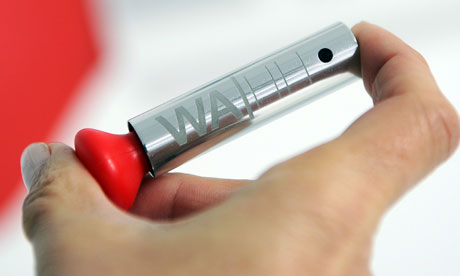
I was reminded of this alternate quick-delivery system because this Sunday's Guardian featured a story about the WA/HH spray that's just gone on sale in Paris. Kim Willsher writes:
With one squirt, its inventors promise, you'll feel all the euphoria of being inebriated for a few seconds without the nasty side-effects of behaving like an idiot and falling over. 
Willsher goes on:
With each squirt from the WA/HH spray delivering just 0.0075ml of alcohol and about 20 squirts in each €20 (£16) lipstick-sized spray, it's pricey night out – the equivalent of €1,300 (£1,000) for a unit of alcohol.
What's next? Whiskey tabs that dissolve on one's tongue? Patches that deliver small but continuous doses of Cognac for hours on end? Call me old fashioned, but I like my whiskey, wine, cider, port, rum, punch and other boozy repasts down my throat in liquid form. Ok, and maybe occasionally as a jelly. I enjoy the taste of alcoholic drinks. God help us all if we grow old in a world where the best option for a stiff drink is £1,000 spritzes of aerosol grain spirits.

If molecular mixology continues in this direction, that ass full of vodka might not seem like such a bad idea.

Thursday, April 14, 2011

Fez Monkeys

I am, sad to say, fascinated with fez monkeys. Have been for decades. You know what I'm talking about. You've seen them. Chimps, spider monkeys, organ-grinding monkeys, monkeys dressed in human clothing or just behaving as humans do, but always with a red fez on their little heads. They've been used as pencil tops, calling card holders, windup toys, wall sconces, and countless other decorative arts.

C'est si bon!
The imagery is old and fabulous in the word's truest sense. Animals have since before Aesop been used to illustrate the best and worst of human behavior and monkeys, so human in their stance and demeanor, are no exception. With rare exceptions, monkeys wearing red fezzes are bad monkeys, indulging in alcohol, smoking, and other human vices.

I've found old French porcelain statuettes of simian gentlemen in finest 18th century garb, aping humanity. When the fez in particular came into play, I haven't been able to tell. My gut tells me that for the answer to that, we should look to French-occupied North Africa — Tunisia, Morocco, or Algeria — but I don't yet have the resources to track down earliest examples.

I do, however, collect images of these red-hatted monkeys behaving badly when I travel. About ten years ago, I wandered into a postcard shop in Paris. Cartophilia was jammed, floor to ceiling, with boxes of old postcards. They were organized by themes familiar to those who prowl such shops: hotels, railroads, clowns, butchers, etc. When I entered, the owner was engaged in low conversation with another old man. I smiled. "Bonjour." He looked me over and turned back to his conversation with a polite but dismissive "Bonjour, monsieur."

I had been weighed and measured — and apparently did not meet standards. The two continued to talk, paying no further attention. A younger woman in the shop glanced up and smiled at me, then went back to her box of old cards. My French is self-taught and far from perfect. But I hauled it into use.

"Excusez-moi, monsieur"

He looked up. "Oui?"

"Je suis à la recherche d'une carte postale."

He thrust out his chin, gave his shoulders a shrug, and indicated the hundreds of boxes around him like I was an idiot for not seeing them myself. "Oui?"

"Je suis à la recherche d'une carte postale," I continued, "avec une image de singes..."

"Les singes?!" he exclaimed ("Monkeys?!"). Whoever heard of such a thing?

"Oui." I plowed on. "Oui, mais...mais les singes avec des chapeaux rouges." Monkeys with red hats. He looked at me, a face filled with incredulity. An imbecile stood before him. Impossible to conceive that such a thing did or ever could exist.

"No." He turned back to his conversation.

At that point, the pretty young woman cleared her throat. In lightly accented English, she asked "Are you looking for monkeys wearing fezzes?" I admitted that I was.

She turned to the old man. "Papa. Un chapeau tunisien."

"Ahh!" His face lit up like fireworks. "Un chapeau tunisien!" Monkey with a red hat he'd never heard of, a conceptual impossibility, but a monkey with a Tunisian hat? Well, that's a different story entirely! One was located within 2 minutes.

I bought my postcard with its bad booze-drinking monkeys and learned that when I return to France on the trail of these fez monkeys so popular with the tiki crowd, I shall hunt for les singes avec des chapeaux tunisien.

But I'm sure something else will be wrong.

Thursday, December 31, 2009

Liqueur du Grapillon

One of the most important things
that distinguish man from other animals
is that man can get pleasure from drinking
without being thirsty.

~ Fernand Point

Not long ago, I plucked a 1974 copy of Fernand Point’s Ma Gastronomie from the shelf. Point was the French chef/restaurateur of La Pyramide, a renowned temple of gastronomy south of Lyon. I was looking for his recipe for a sort of simple French milk punch. Though he died in 1955, his life and work continue to inspire chefs today. Marc Vetri, for instance, whose restaurant Vetri Mario Batali claimed was possibly the best Italian restaurant on the East Coast, used to keep the same copy of Ma Gastronomie in his kitchen. Thomas Keller, no slouch in the kitchen, has written an introduction to a new edition of the cooking classic and it’s worth tracking down if, like me, you're into food as well as drinks.

The recipe I was hunting (from the oversized yellow-jacketed 1974 edition) is for a homemade liqueur that Point used to take with him as he went to survey the quality and maturity of the grapes of the Côte Rôtie. Reputedly, he would stop now and again on the steep slopes of the vineyards and take a swig of a tasty little pick-me-up he called Liqueur du Grapillon (or “Liqueur for the Grapes”).

The recipe calls for an entire lemon, cut into quarters, to be thrown in with brandy, milk, and vanilla. Citrus and dairy in the same drink can lead to some chewy disasters. They can be—and often are—combined without incident, but keep this formula in mind: [citrus + milk] = [curds + whey]. Fortunately, since the lemon is not squeezed into the mix and, as this mixture sits in the dark for almost two weeks, any curds formed are very small and easily strained out.

The result is a smooth, thick and mildly sweet liqueur, similar to egg nog but not as thick and without the eggy overtones, tasting of whole milk, vanilla, and cognac. After a few days of macerating, I tasted the drink and was leery: the lemon was overpowering, sharp, and biting. Resisting the temptation to yank it out of the jar (after all, presumably Point knew something about successfully combining tastes), I left it in and was rewarded after another week with a mellowed liqueur that no longer tasted like furniture polish.

On the last day of the decade, I poured myself a short glass, grabbed some dried sausage and a pocket knife, and moseyed out to the patio to read the paper and soak in the beautiful sun of Southern California. There are no grapes to survey, but the palm trees look mighty fine.

Liqueur du Grapillon
(“Liqueur for the Grapes”)

Combine sixteen ounces of milk, eight ounces of sugar, sixteen ounces of very good eau de vie or brandy and add a lemon cut in thirds and a vanilla bean. Let the mixture stand, stirring from time to time. After 12 days, strain and serve.
~ Fernand Point (1974) Ma Gastronomie. Lyceum Books, Wilton, CT.


Ingredient Notes: I’d used the vanilla pod in this recipe to make vanilla syrup as well as vanilla sugar, so a little bit of its moxie had been spent. To compensate, I used a pod and half, then, at bottling time, squeezed out all the remaining tiny black seeds as if from a tube of toothpaste into the strained liqueur.

For milk, use whole milk, preferably unpasteurized. It really does make a difference. Don't even bother with 1%, 2%, or soy abominations. The brandy I used was Claude Chatelier VS, about $20/750ml at Trader Joe's. If using a waxed lemon, give it a good short scrub in hot water to remove as much of the coating as possible. Pluck it from the backyward if, like me, you live in places where mixers grow on trees.

Secondhand editions of Point's book are still around, but if you want to score the new edition, here's the skinny:

Fernand Point with introduction by Thomas Keller (2008)
Ma Gastronomie
240 pages, hardback
Publisher: Overlook/Rookery
1585679615
$40.00

.

Monday, March 9, 2009

German Bitters, an Untried Recipe

My French is entirely self-taught and I’m not by any assessment fluent. Oh, I’m competent enough not to starve or go without a roof when I travel in France. I’m also able to dig through old books to find recipes for those homemade tinctures, infusions, macerations, and beverages of which the French still seem inordinately fond.

But because I’m leery of sounding foolish with my ham-fisted translations in print, I turned to upstate New York cider maker and longtime friend S. David White, who yielded a more user-friendly reading than the one I came up with for this old recipe. The result seems to yield more of an amer style bitter than the cocktail bitters we usually think of. Did you catch that "seems" so? Haven't made this concoction. Just offering for your consideration. Might in fact be a delightful cocktail ingredient.

This recipe, for German bitters, is from M. Ferreyol’s 1894 Manuel Pratique pour la Fabrication rapide et economique des Liqueurs et des Spiritueux sans Distillation (reprint available here). White’s translation follows (and, in the Shake ‘n’ Bake tradition, I helped).

Bitter allemand

Anis vert……………………………………………...…10 grammes
Bais de genievre…………………………………......10 —
Ecorces d’organges ameres seches……...…….10 —
Sauge seche………..………..………..………..….….10 —
Absinthe seche………..………..………..………..…10 —
Calamus………..………..………..………..………..…10 —
Girofles………..………..………..………..………..……5 —
Menthe seche………..………..………..………..…….5 —
Lavande fleurs seches………..………..………..…..5 —
Racine d’angelique seche………..………..……..…5 —

1º On pile finement toutes les substances et on les fait macrer pendant 10 jours dans 1 litre d’alcool a 90º.

2º On soutire la maceration et sur le residue on verse un mélange compose d’alcool ½ litre et l’eau 1 litre.

3º Au bout de 10 jours, on mele les deux macerations, on colore avec du jus de cerises noires, puis on filtre.

German Bitters

Anise...………..………..................10 grams
Juniper berries ..………..………...10 --
Dried bitter orange peel ..……...10 --
Dried sage ..………..………...........10 --
Dried absinthe..………..……….....10 --
Calamus ..………..……...........…...10 --
Cloves ..………..…................……...5 --
Dried mint..............………..……….5 --
Dried lavender flowers....…...…...5 --
Dried angelica root..………..……...5 --

First — Finely grind all the ingredients above and macerate them for 10 days in a liter of 90 degree alcohol.

Second — strain off the maceration [e.g., the liquid] and retain. Onto the residue pour a mixture of ½ liter of alcohol and 1 liter of water.

Third — After 10 days, mix the two macerations. Color the liquid with black cherry juice, then filter.

.